 Back
Cell Communication and Signal Transduction Pathways: Study Guide
Study Guide - Smart Notes
 Tailored notes based on your materials, expanded with key definitions, examples, and context.
Cell Communication and Signal Transduction Pathways
Overview of Cell Signaling
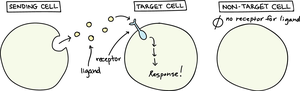
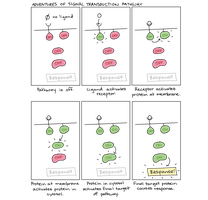
Cell signaling is a fundamental process by which cells communicate with each other to coordinate biological activities. Chemical signals, often proteins or other molecules, are produced and secreted by a sending cell and travel to neighboring cells. Only target cells with the appropriate receptor can detect and respond to the signal. The binding of a signaling molecule (ligand) to its receptor alters the receptor's shape or activity, triggering changes inside the cell.
Ligands: Signaling molecules that bind to receptors.
Receptors: Proteins on the target cell that recognize and bind ligands.
Response: The cellular change triggered by ligand-receptor interaction.
Specificity: Only cells with the correct receptor respond to the signal.
Example: Hormones, neurotransmitters, and growth factors.
Signal Relay and Transduction
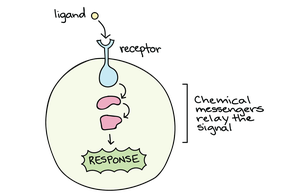
Once a ligand binds to its receptor, the message is relayed through a chain of chemical messengers inside the cell, leading to a change in cellular activity. This process converts an intercellular signal (between cells) into an intracellular signal (within the cell), ultimately triggering a response such as gene expression or cell division.
Signal Transduction: The process of relaying and amplifying the signal inside the cell.
Intracellular Messengers: Proteins and other molecules that propagate the signal.
Cellular Response: Alteration in gene activity, metabolism, or cell behavior.
Forms of Cell Signaling
Categories of Chemical Signaling
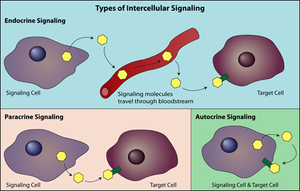
Multicellular organisms use four main categories of chemical signaling, distinguished by the distance the signal travels:
Paracrine Signaling: Local signaling between neighboring cells.
Synaptic Signaling: Specialized paracrine signaling in nerve cells.
Autocrine Signaling: A cell signals itself.
Endocrine Signaling: Long-distance signaling via the bloodstream.
Paracrine Signaling
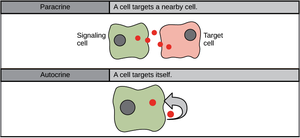
Paracrine signaling occurs between cells that are near each other. Chemical messengers (ligands) diffuse through the space between cells, allowing local coordination of activity. This is especially important during development, where cells communicate identities and instructions.
Synaptic Signaling
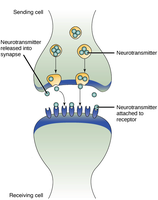
Synaptic signaling is a specialized form of paracrine signaling used by nerve cells. An electrical impulse travels down the axon to the synapse, triggering the release of neurotransmitters. These ligands cross the synaptic gap and bind to receptors on the receiving cell, often converting the chemical signal back into an electrical signal.
Neurotransmitters: Ligands released at the synapse.
Rapid Reset: Neurotransmitters are quickly degraded or reabsorbed.
Autocrine Signaling
Autocrine signaling involves a cell releasing a ligand that binds to its own receptors. This mechanism is important for confirming cell identity during development and is implicated in cancer metastasis.
Comparison: Autocrine vs Paracrine
Type | Description |
|---|---|
Paracrine | A cell targets a nearby cell. |
Autocrine | A cell targets itself. |
Endocrine Signaling
Endocrine signaling involves long-distance communication, typically using the circulatory system. Specialized cells release hormones into the bloodstream, which travel to distant target cells. Human glands such as the thyroid, hypothalamus, and pituitary produce hormones that regulate growth, metabolism, and other functions.
Hormones: Signaling molecules distributed via blood.
Example: Growth hormone from the pituitary stimulates cell division in cartilage.
Comparison: Endocrine, Autocrine, Paracrine
Type | Distance | Example |
|---|---|---|
Endocrine | Long-distance | Hormones |
Paracrine | Local | Developmental signals |
Autocrine | Self | Cancer metastasis |
Cell-Cell Contact
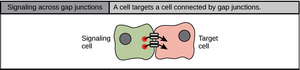
Direct cell contact allows communication through physical connections such as gap junctions in animals and plasmodesmata in plants. These channels enable intracellular mediators to diffuse between cells, coordinating responses across groups of cells.
Gap Junctions: Channels connecting animal cells.
Plasmodesmata: Channels connecting plant cells.
Signal Transduction Pathways
Intracellular Signal Transduction
Signal transduction pathways are chains of molecules that relay signals inside the cell. When a ligand binds to a receptor, the intracellular domain changes, setting off a series of signaling events. These pathways often amplify the initial signal, so one ligand molecule can activate many downstream molecules. Proteins are the most common relay molecules.
Amplification: One ligand can activate many downstream molecules.
Relay Molecules: Usually proteins.
Phosphorylation: The On/Off Switch
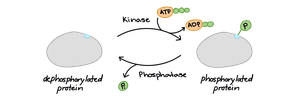
Phosphorylation is a key mechanism for regulating protein activity. Kinases are enzymes that add phosphate groups to proteins, which can activate or inactivate them. Phosphatases remove phosphate groups, reversing the effect. Phosphorylation is not always an 'on' switch; it can also inactivate proteins.
Kinase: Enzyme that adds phosphate group.
Phosphatase: Enzyme that removes phosphate group.
Equation:
Second Messengers
Second messengers are small, non-protein molecules that propagate signals initiated by ligand binding. Common examples include calcium ions, cyclic AMP (cAMP), and inositol phosphates.
Calcium Ions: Released into cytoplasm, bind to proteins to continue signaling.
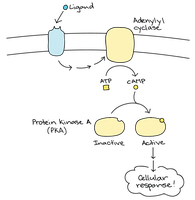
cAMP: Produced from ATP by adenylyl cyclase, activates protein kinase A.
Inositol Phosphates: Derived from phospholipids, act as secondary messengers.
Cyclic AMP (cAMP) Pathway
cAMP is a second messenger made from ATP by adenylyl cyclase. It activates protein kinase A, which phosphorylates targets and propagates the signal. cAMP is degraded by phosphodiesterases.
Equation:
Inositol Phosphates Pathway
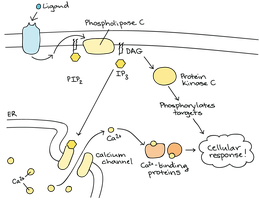
Phosphatidylinositols can be phosphorylated and cleaved, releasing two fragments (DAG and IP3) that act as secondary messengers. IP3 opens calcium channels, allowing Ca2+ to enter the cytoplasm and bind to proteins, continuing the pathway.
Complexity of Signal Transduction
Pathway Interactions
Signal transduction pathways can interact, activate multiple responses, or require multiple pathways for a single response. The same signaling molecule may produce different results depending on the cell's context and receptor type.
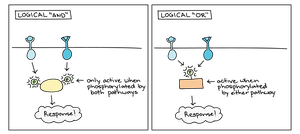
Logical AND/OR: Some responses require activation by multiple pathways (AND), others by any pathway (OR).
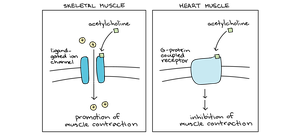
Example: Acetylcholine causes contraction in skeletal muscle but inhibition in heart muscle due to different receptors.
Cellular Responses
Gene Expression
Gene expression is a common cellular response to signaling. It involves transcription (making RNA from DNA) and translation (making protein from RNA). This allows cells to produce specific proteins in response to signals.
Cellular Metabolism
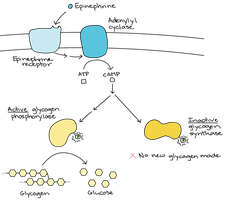
Signaling pathways can alter metabolic enzyme activity. For example, the fight-or-flight response involves epinephrine signaling, which activates enzymes to break down glycogen into glucose for energy.
Apoptosis
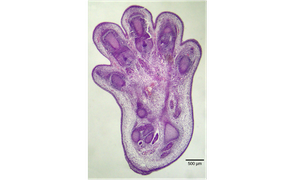
Apoptosis is programmed cell death, triggered by internal or external signals. It prevents the release of harmful molecules and is essential for development and cancer prevention. For example, apoptosis shapes fingers during embryonic development.
Additional info: Signal transduction pathways are highly conserved and fundamental to all forms of life, underlying processes from development to immune response.
