 Back
Cell Communication and Signaling: Chapter 11 Study Notes
Study Guide - Smart Notes
 Tailored notes based on your materials, expanded with key definitions, examples, and context.
Cell Communication
Introduction to Cell Signaling
Cell communication is essential for the coordination of activities in multicellular organisms and is also found in unicellular organisms. Cells receive and respond to signals from their environment and other cells, enabling processes such as development, immune response, and homeostasis. - Cell signaling involves the conversion of external signals into cellular responses. - Signal transduction is the process by which a cell converts a signal from outside the cell into a functional change inside the cell. 
Evolution of Cell Signaling
Cell signaling mechanisms evolved early and are conserved across prokaryotes and eukaryotes. - Quorum sensing is a process by which bacteria detect and respond to population density using signaling molecules. - Biofilm formation is an example of quorum sensing, where bacteria aggregate and adhere to surfaces. - Disrupting quorum sensing is a potential strategy for combating bacterial infections. 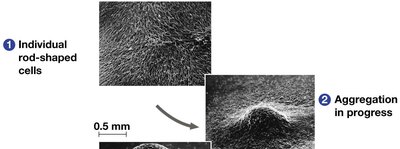
Communication Among Eukaryotes: Yeast Mating
The yeast Saccharomyces cerevisiae uses signaling to coordinate mating between two types, a and α. - Cells secrete specific factors to locate and recognize each other. - Binding of mating factors initiates a signal transduction pathway leading to mating. - The molecular details of yeast and mammalian signaling are similar. 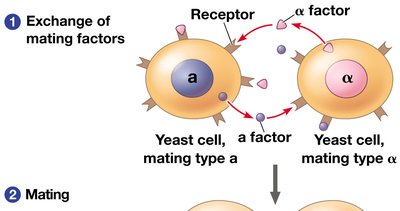
Local and Long-Distance Signaling
Direct Contact and Local Signaling
Cells communicate locally via direct contact or short-range signaling molecules. - Cell junctions (gap junctions in animals, plasmodesmata in plants) allow direct transfer of signaling substances. - Cell-surface molecules can interact directly for communication. - Local signaling is crucial in development, immune response, and stem cell maintenance. 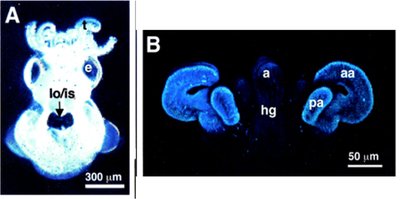
Paracrine and Synaptic Signaling
- Paracrine signaling: Cells release local regulators (e.g., growth factors) that affect nearby cells. - Synaptic signaling: Neurotransmitters are released in response to electrical signals and diffuse across synapses to target cells. 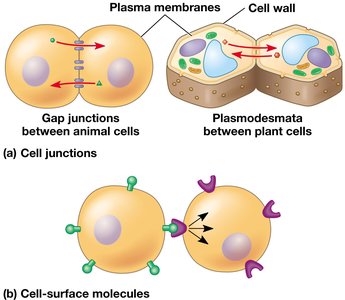
Long-Distance Signaling: Hormones
- Hormonal (endocrine) signaling: Specialized cells release hormones that travel through the bloodstream to distant target cells. - The ability of a cell to respond depends on the presence of specific receptors. 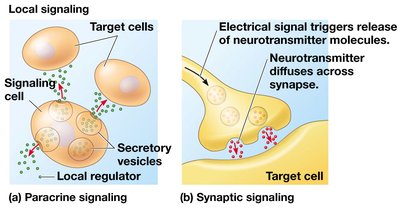
The Three Stages of Cell Signaling
Signal Reception
Signal reception occurs when a signaling molecule (ligand) binds to a receptor protein, causing a shape change. - The binding is highly specific. - Most receptors are plasma membrane proteins, but some are intracellular. 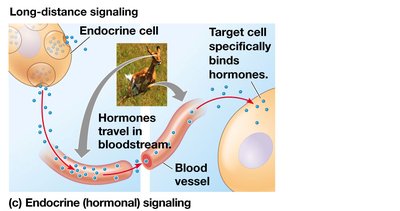
Signal Transduction
Transduction involves a series of steps that relay the signal inside the cell, often through a cascade of molecular interactions. - Multistep pathways amplify signals and allow regulation. - The signal is often transduced by a change in protein shape.
Cellular Response
The final stage is the cellular response, which can involve changes in gene expression or cytoplasmic activity.
Types of Cell-Surface Receptors
G Protein-Coupled Receptors (GPCRs)
GPCRs are the largest family of cell-surface receptors. - They transmit information from the extracellular environment to the cell interior. - GPCRs work with G proteins, which bind GTP. - GPCR systems are widespread and diverse. 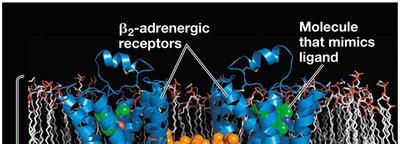
Receptor Tyrosine Kinases (RTKs)
RTKs catalyze the transfer of phosphate groups from ATP to proteins. - RTKs can trigger multiple signal transduction pathways simultaneously. - Abnormal RTK function is linked to cancers.
Ion Channel Receptors
Ligand-gated ion channel receptors open or close in response to ligand binding, allowing specific ions to pass through.
Intracellular Receptors
Mechanism and Examples
Intracellular receptors are found in the cytoplasm or nucleus. - Small or hydrophobic messengers (e.g., steroid and thyroid hormones) can cross the membrane and activate these receptors. - Activated hormone-receptor complexes act as transcription factors.
Signal Transduction Pathways
Protein Phosphorylation and Dephosphorylation
- Protein kinases transfer phosphate groups from ATP to proteins (phosphorylation). - Protein phosphatases remove phosphates (dephosphorylation). - This system acts as a molecular switch.
Second Messengers
Second messengers are small, nonprotein molecules or ions that spread by diffusion. - Common second messengers: cyclic AMP (cAMP) and calcium ions (Ca2+).
Cyclic AMP (cAMP)
- Produced from ATP by adenylyl cyclase. - Activates protein kinase A, which phosphorylates other proteins. - Regulation can occur via G protein systems that inhibit adenylyl cyclase.
Calcium Ions and Inositol Trisphosphate (IP3)
- Ca2+ is widely used as a second messenger. - IP3 and diacylglycerol (DAG) are produced by cleavage of membrane phospholipids and help release Ca2+ from intracellular stores.
Cellular Responses to Signals
Nuclear and Cytoplasmic Responses
- Signal transduction pathways regulate cellular activities in the nucleus (gene expression) or cytoplasm (enzyme activity, ion channel opening). - The final molecule may act as a transcription factor or regulate metabolic enzymes.
Regulation of the Response
Amplification, Specificity, Efficiency, and Termination
- Amplification: Enzyme cascades increase the response magnitude. - Specificity: Different cells respond differently to the same signal due to unique protein collections. - Efficiency: Scaffolding proteins group relay proteins to increase efficiency. - Termination: Inactivation mechanisms ensure signals are not perpetually active.
Apoptosis: Programmed Cell Death
Mechanism and Importance
Apoptosis is a controlled process where cells are dismantled and removed without harming neighboring cells. - Triggered by internal or external signals. - Involves activation of proteases (caspases) and nucleases. - Essential for development, maintenance, and disease prevention.
Apoptosis in C. elegans and Mammals
- In C. elegans, the protein CED-9 regulates apoptosis; when inactivated, caspases (CED-3) are activated. - In mammals, multiple pathways and caspases are involved. - Apoptosis is crucial for normal development (e.g., removal of webbing in digits) and may be implicated in diseases like cancer and neurodegeneration.
Summary Table: Types of Cell Signaling
Type | Distance | Example | Key Molecules |
|---|---|---|---|
Direct Contact | Local | Gap junctions, plasmodesmata | Cell-surface proteins |
Paracrine | Local | Growth factors | Local regulators |
Synaptic | Local | Neurotransmitters | Neurotransmitter molecules |
Endocrine | Long-distance | Hormones | Hormones |
Summary of Key Concepts
- Cell signaling is a three-stage process: reception, transduction, and response. - Multiple types of receptors and signaling pathways exist, each with specific functions and mechanisms. - Regulation of signaling ensures appropriate cellular responses and prevents uncontrolled activity. - Apoptosis is a vital process for organismal health and development.
