 Back
Cell Communication: Mechanisms and Pathways part 1
Study Guide - Smart Notes
 Tailored notes based on your materials, expanded with key definitions, examples, and context.
Cell Communication
Introduction to Cell Communication
Cell communication is essential for the coordination of cellular activities in both unicellular and multicellular organisms. Cells detect and respond to signals from their environment and from other cells, allowing them to adapt, grow, and survive. - Cell signaling involves the conversion of external signals into cellular responses. - This process is evolutionarily conserved and critical for processes such as development, immune response, and homeostasis.
Evolution of Cell Signaling
Cell signaling mechanisms originated in prokaryotes and single-celled eukaryotes and were adapted for use in multicellular organisms. - Quorum sensing is a process in which bacteria sense local population density through the concentration of signaling molecules. - Quorum sensing can lead to behaviors such as biofilm formation and toxin secretion. - Disrupting quorum sensing is a potential strategy for combating bacterial infections. 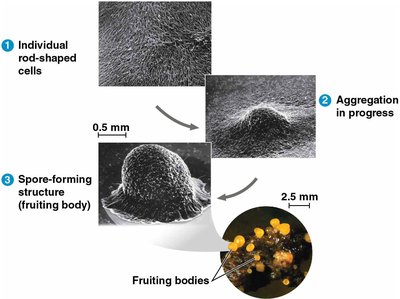
Cell Signaling in Yeast
The yeast Saccharomyces cerevisiae uses signaling to coordinate mating between two types: a and α. - Each cell type secretes a specific mating factor that binds to receptors on the other type, initiating a signal transduction pathway that leads to cell fusion. - The molecular details of yeast and mammalian signal transduction are highly similar. 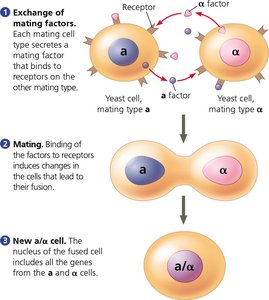
Types of Cell Signaling
Local Signaling
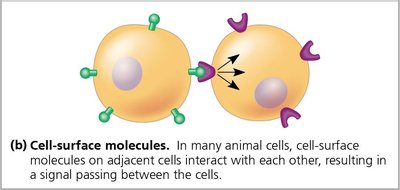
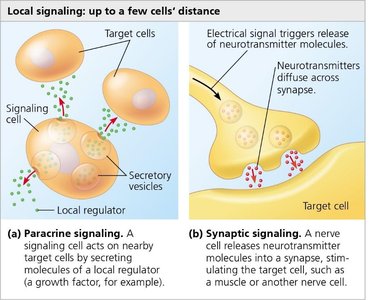
Cells can communicate through direct contact or by releasing signaling molecules that affect nearby cells. - Cell junctions (gap junctions in animals, plasmodesmata in plants) allow direct transfer of signaling molecules between adjacent cells. 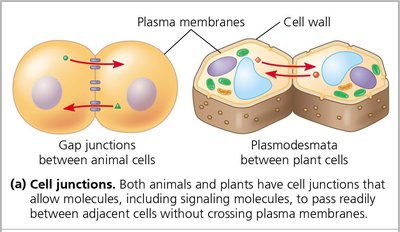 - Cell-surface molecules on adjacent cells can interact, important for cell recognition and immune responses.
 - Paracrine signaling involves the release of local regulators (e.g., growth factors) that act on nearby cells. - Synaptic signaling occurs in the nervous system, where neurotransmitters are released in response to electrical signals and act on adjacent target cells.
Long-Distance Signaling
- Endocrine (hormonal) signaling involves hormones released by specialized cells that travel through the bloodstream to reach distant target cells. - The response depends on the presence of specific receptors on target cells. 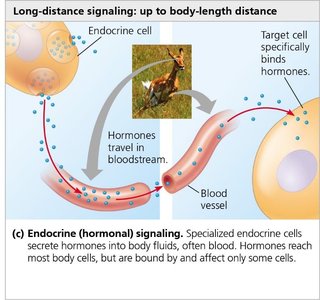
The Three Stages of Cell Signaling
Overview of the Stages
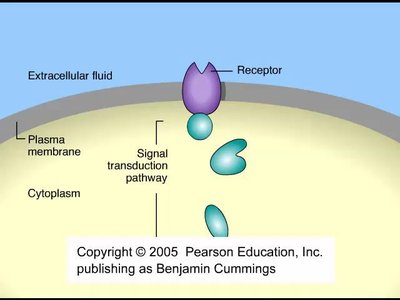
Earl W. Sutherland's research established that cell signaling involves three main stages: 1. Reception: The target cell detects a signaling molecule (ligand) that binds to a receptor protein on the cell surface or inside the cell. 2. Transduction: The binding of the ligand changes the receptor, initiating a signal transduction pathway, often involving multiple steps. 3. Response: The transduced signal triggers a specific cellular response. 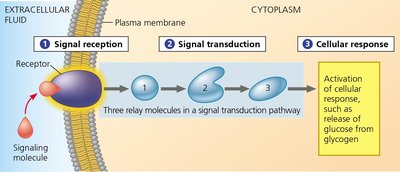
Reception: Signal Molecules and Receptors
Ligand-Receptor Interactions
- A ligand is a signaling molecule that binds specifically to a receptor. - The binding is highly specific and usually causes a conformational change in the receptor, initiating signal transduction. - Most receptors are plasma membrane proteins, but some are intracellular.
Types of Receptors in the Plasma Membrane
There are three main classes of cell-surface receptors:
G Protein-Coupled Receptors (GPCRs)
- GPCRs are the largest family of cell-surface receptors. - They interact with G proteins, which bind GTP and relay signals inside the cell. - GPCRs are involved in a wide variety of physiological processes. 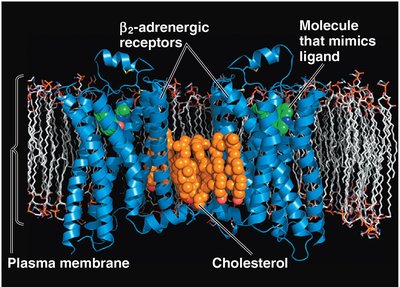
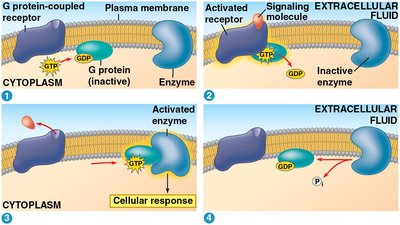
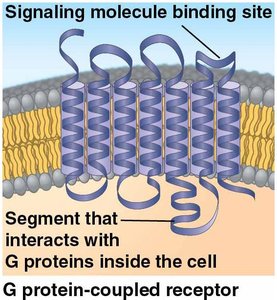 - The GPCR system involves the exchange of GDP for GTP on the G protein, activation of an enzyme, and generation of a cellular response.
Receptor Tyrosine Kinases (RTKs)
- RTKs are membrane receptors that catalyze the transfer of phosphate groups from ATP to tyrosine residues on target proteins. - RTKs can activate multiple signal transduction pathways simultaneously. - Abnormal RTK activity is linked to many cancers. 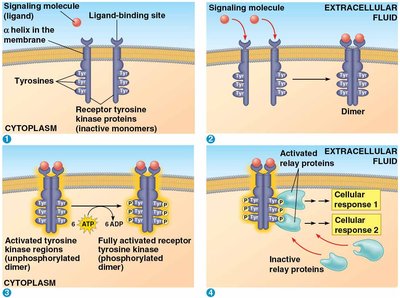
Ligand-Gated Ion Channel Receptors
- These receptors act as gates that open or close in response to ligand binding, allowing specific ions (e.g., Na+, Ca2+) to pass through the membrane. 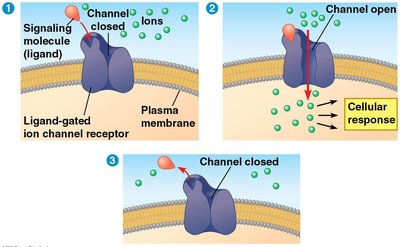
Intracellular Receptors
- Intracellular receptors are located in the cytoplasm or nucleus. - Small or hydrophobic molecules (e.g., steroid and thyroid hormones) can cross the plasma membrane and bind these receptors. - The hormone-receptor complex often acts as a transcription factor, regulating gene expression. 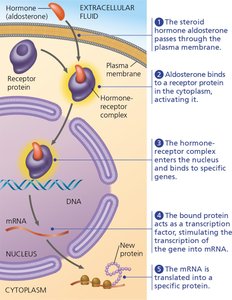
Summary Table: Types of Cell Signaling and Receptors
Signaling Type | Distance | Example Molecules | Receptor Location |
|---|---|---|---|
Paracrine | Local | Growth factors | Plasma membrane |
Synaptic | Local | Neurotransmitters | Plasma membrane |
Endocrine | Long-distance | Hormones | Plasma membrane or intracellular |
Key Terms and Concepts
- Quorum sensing: Bacterial communication based on population density. - Biofilm: Aggregation of bacterial cells on a surface. - Signal transduction pathway: Series of steps by which a signal is converted into a cellular response. - Ligand: A molecule that binds specifically to a receptor. - G protein: A protein that binds GTP and transduces signals from GPCRs. - Kinase: An enzyme that transfers phosphate groups. - Transcription factor: A protein that regulates gene expression.
Example Exam Questions
1. What is the process by which bacteria sense population density and coordinate behavior? Answer: Quorum sensing. 2. Which type of receptor requires GTP for its function? Answer: G protein-coupled receptors (GPCRs). 3. Which signaling mechanism involves hormones traveling through the bloodstream? Answer: Endocrine (hormonal) signaling. 4. What is the main function of receptor tyrosine kinases? Answer: Catalyze the transfer of phosphate groups from ATP to tyrosine residues on proteins. 5. Which type of receptor is found inside the cell and binds steroid hormones? Answer: Intracellular receptors.
Additional info: This guide expands on the provided notes with definitions, examples, and a summary table for clarity and completeness.
