 Back
BackCell Communication: Mechanisms and Pathways (Campbell Biology, Ch. 11)
Study Guide - Smart Notes
 Tailored notes based on your materials, expanded with key definitions, examples, and context.
Cell Communication
Introduction to Cell Signaling
Cell communication is essential for the coordination of cellular activities in multicellular organisms and is also critical among unicellular organisms. Cells use signaling molecules to transmit information, allowing them to respond to environmental changes and coordinate complex processes such as growth, development, and immune responses.
Cell signaling involves the conversion of external signals into cellular responses.
Signaling can occur between cells of the same organism or between different organisms (e.g., bacteria in quorum sensing).
Disruption of cell signaling can lead to diseases, including cancer and neurological disorders.
Evolution of Cell Signaling
Cell signaling mechanisms are evolutionarily conserved and found in both prokaryotes and eukaryotes. Early research demonstrated that even bacteria can communicate using chemical signals.
Quorum sensing: Bacteria release signaling molecules to sense population density, coordinating behaviors such as biofilm formation and toxin production.
Interfering with quorum sensing is a potential strategy for combating bacterial infections.
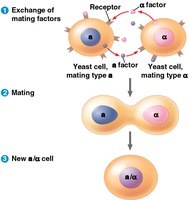
Yeast cells (Saccharomyces cerevisiae) use signaling to identify mating partners, initiating a signal transduction pathway that leads to mating.
Local and Long-Distance Signaling
Direct Contact and Local Signaling
Cells can communicate through direct contact or by releasing signaling molecules that affect nearby cells.
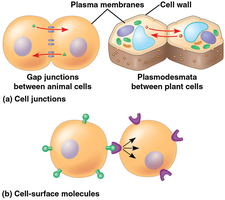
Cell junctions (gap junctions in animals, plasmodesmata in plants) allow molecules to pass directly between adjacent cells.
Cell-surface molecules can interact to transmit signals during processes like immune responses and development.
Paracrine and Synaptic Signaling
Paracrine signaling: Secreted molecules (e.g., growth factors) act on nearby cells to stimulate growth and division.
Synaptic signaling: In the nervous system, neurotransmitters are released in response to electrical signals, affecting target cells at synapses.
Hormonal (Endocrine) Signaling
In long-distance signaling, hormones are released into the circulatory system and affect target cells throughout the organism.
Only cells with specific receptors for a hormone can respond to it.
The Three Stages of Cell Signaling
Overview of Signal Reception, Transduction, and Response
Cell signaling typically involves three main stages:
Reception: A signaling molecule (ligand) binds to a receptor protein, usually on the cell surface.
Transduction: The receptor changes shape, initiating a cascade of molecular events (signal transduction pathway).
Response: The cell carries out a specific activity, such as gene expression or enzyme activation.
Signal Reception: Receptors and Ligands
Types of Receptors
Receptors can be located in the plasma membrane or inside the cell. The binding between ligand and receptor is highly specific and usually triggers a conformational change in the receptor.
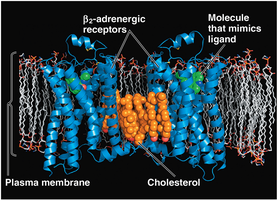
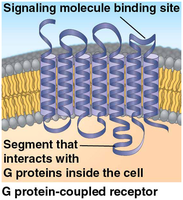
G protein-coupled receptors (GPCRs): The largest family of cell-surface receptors; they transmit signals via G proteins that bind GTP.
Receptor tyrosine kinases (RTKs): Membrane receptors that catalyze the transfer of phosphate groups from ATP to proteins, often activating multiple pathways.
Ligand-gated ion channels: Receptors that open or close ion channels in response to ligand binding, allowing specific ions to pass through the membrane.
Intracellular Receptors
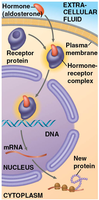
Some receptors are found inside the cell, in the cytoplasm or nucleus. These typically bind small or hydrophobic molecules (e.g., steroid hormones, thyroid hormones) that can cross the plasma membrane.
The hormone-receptor complex can act as a transcription factor, regulating gene expression.
Signal Transduction: Cascades and Second Messengers
Signal Transduction Pathways
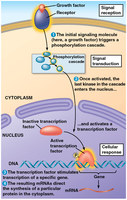
Signal transduction often involves a series of protein activations, forming a cascade that amplifies the signal and allows for regulation at multiple steps.
Protein kinases add phosphate groups to proteins (phosphorylation), while protein phosphatases remove them (dephosphorylation).
This phosphorylation cascade acts as a molecular switch, turning cellular activities on or off as needed.
Second Messengers
Many signaling pathways use small, nonprotein molecules called second messengers to relay signals inside the cell. Common examples include cyclic AMP (cAMP) and calcium ions (Ca2+).
cAMP is produced from ATP by the enzyme adenylyl cyclase and activates protein kinase A, which phosphorylates target proteins.
cAMP pathways are involved in many physiological responses and can be hijacked by bacterial toxins (e.g., cholera toxin).

Calcium ions (Ca2+) are widely used as second messengers. Their concentration is tightly regulated, and small changes can trigger significant cellular responses.
Other second messengers, such as inositol trisphosphate (IP3) and diacylglycerol (DAG), are produced by cleavage of membrane phospholipids and help release Ca2+ from internal stores.
Cellular Responses to Signals
Nuclear and Cytoplasmic Responses
The final outcome of a signaling pathway is a specific cellular response, which may involve changes in gene expression or alterations in cytoplasmic activities.
Many pathways regulate the synthesis of proteins by activating transcription factors in the nucleus.
Other responses include changes in enzyme activity, ion channel opening, or cell division.
Regulation of Cell Signaling
Amplification, Specificity, and Termination
Amplification: Enzyme cascades can greatly increase the strength of the signal, as each step activates multiple downstream molecules.
Specificity: Different cell types have unique collections of proteins, allowing them to respond differently to the same signal.
Scaffolding proteins enhance signaling efficiency by bringing together multiple components of a pathway.
Termination: Inactivation mechanisms ensure that signaling is temporary and reversible, allowing cells to reset and respond to new signals.
Apoptosis: Programmed Cell Death
Mechanisms and Importance of Apoptosis
Apoptosis is a form of programmed cell death that is essential for development, maintenance, and defense in multicellular organisms. It involves the orderly dismantling of cellular components, preventing damage to neighboring cells.
Triggered by internal or external signals, apoptosis activates a cascade of proteases (caspases) and nucleases.
In Caenorhabditis elegans, the protein CED-9 acts as a master regulator, inhibiting apoptosis unless a death signal is received.
In mammals, multiple pathways and caspases are involved; apoptosis is crucial for normal development (e.g., formation of fingers and toes) and for preventing diseases such as cancer and neurodegeneration.
Summary Table: Types of Cell Signaling
Type of Signaling | Distance | Example | Key Molecules |
|---|---|---|---|
Direct Contact | Adjacent cells | Gap junctions, plasmodesmata | Ions, small molecules |
Paracrine | Local | Growth factors | Proteins, peptides |
Synaptic | Local (synapse) | Neurotransmitters | Acetylcholine, dopamine, etc. |
Endocrine (Hormonal) | Long-distance | Insulin, adrenaline | Hormones |
Key Equations
cAMP formation:
Protein phosphorylation:
Protein dephosphorylation:
Additional info: Apoptosis is also involved in immune system regulation and the removal of potentially cancerous or virus-infected cells. Disruption of apoptosis can contribute to autoimmune diseases and cancer progression.
