 Back
BackCH 11- Cell Communication: Mechanisms and Pathways in Biology
Study Guide - Smart Notes
 Tailored notes based on your materials, expanded with key definitions, examples, and context.
Cell Communication
Introduction to Cell Communication
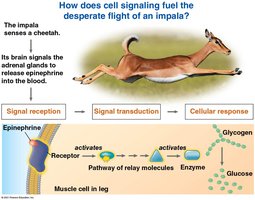
Cell communication is essential for the coordination and regulation of cellular activities in multicellular organisms. Cells communicate through chemical signals that are detected and interpreted by target cells, leading to specific responses. 
Types of Cell Signaling
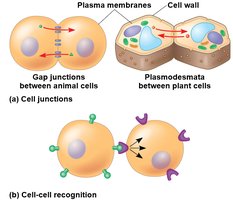
Local Signaling: Involves direct contact or the release of local regulators that affect nearby cells. Examples include paracrine signaling (growth factors) and synaptic signaling (neurotransmitters).
Long-Distance Signaling: Utilizes hormones that travel through the circulatory system to reach distant target cells. This is known as endocrine signaling in animals.
Stages of Cell Signaling
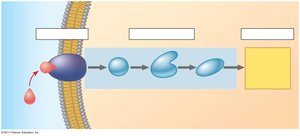
Cell signaling typically occurs in three main stages:
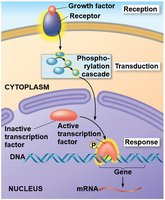
Reception: The target cell detects a signaling molecule (ligand) that binds to a receptor protein on the cell surface or inside the cell.
Transduction: The binding of the ligand changes the receptor, initiating a signal transduction pathway, often involving multiple relay molecules.
Response: The transduced signal triggers a specific cellular response, such as gene expression or enzyme activation.
Signal Reception: Receptors and Their Types
Membrane Receptors
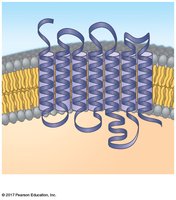
Most signal receptors are plasma membrane proteins. There are three main types:
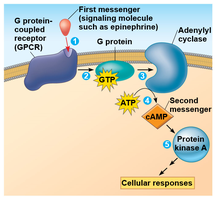
G Protein-Coupled Receptors (GPCRs): Work with the help of G proteins, which bind GTP. GPCRs are involved in a wide variety of physiological processes.
Receptor Tyrosine Kinases (RTKs): Transfer phosphate groups from ATP to tyrosine residues on proteins, often triggering multiple pathways simultaneously.
Ion Channel Receptors: Act as gates that open or close in response to ligand binding, allowing specific ions to pass through the membrane.
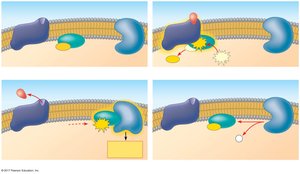
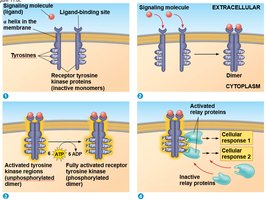
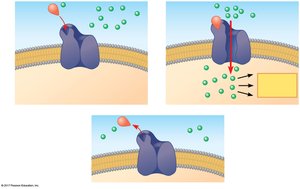
Intracellular Receptors
Some receptors are located inside the cell, in the cytoplasm or nucleus. These typically bind small or hydrophobic molecules (e.g., steroid hormones). The hormone-receptor complex often acts as a transcription factor, regulating gene expression. 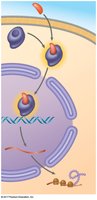
Signal Transduction Pathways
Overview of Signal Transduction
Signal transduction involves a cascade of molecular interactions that relay signals from receptors to target molecules inside the cell. Each step often involves a change in protein shape or activity. 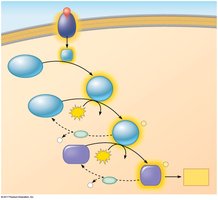
Protein Phosphorylation and Dephosphorylation
Protein Kinases: Enzymes that transfer phosphate groups from ATP to proteins (phosphorylation), often activating them.
Protein Phosphatases: Enzymes that remove phosphate groups (dephosphorylation), inactivating proteins.
This system acts as a molecular switch, regulating cellular activities.
Second Messengers
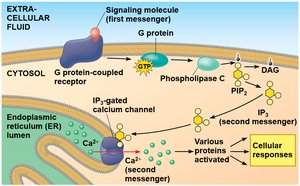
Many pathways use small, nonprotein, water-soluble molecules or ions as second messengers.
Cyclic AMP (cAMP): Produced from ATP by adenylyl cyclase; activates protein kinase A.
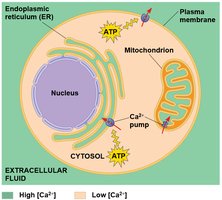
Calcium Ions (Ca2+): Released from intracellular stores; involved in muscle contraction, secretion, and other processes.
Inositol Triphosphate (IP3): Triggers Ca2+ release from the endoplasmic reticulum.

Cellular Responses to Signals
Regulation of Transcription and Cytoplasmic Activities
The final outcome of cell signaling is a specific cellular response, which may involve:
Regulation of gene expression (e.g., turning genes on or off in the nucleus).
Regulation of enzyme activity in the cytoplasm.
Signal Amplification
Enzyme cascades amplify the cell’s response to a signal. At each step, the number of activated molecules increases, resulting in a large cellular response from a small initial signal. 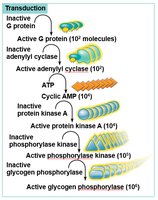
Specificity and Coordination of the Response
Different cells have different proteins and pathways, allowing the same signal to produce different responses.
Pathway branching and cross-talk enable integration and coordination of multiple signals.
Signaling Efficiency: Scaffolding Proteins
Scaffolding proteins organize groups of relay proteins, increasing the efficiency and specificity of signal transduction. 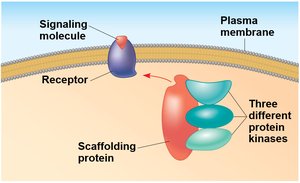
Termination of the Signal
Inactivation mechanisms ensure that signaling is temporary and reversible. When the external signal is removed, receptors and relay molecules return to their inactive states.
Summary Table: Types of Cell Signaling
Type | Distance | Example | Key Molecules |
|---|---|---|---|
Paracrine | Local | Growth factors | Local regulators |
Synaptic | Local | Neurotransmitters | Neurotransmitters |
Endocrine | Long-distance | Hormones (e.g., insulin) | Hormones |
Direct Contact | Local | Immune cell recognition | Cell surface molecules |
Key Terms
Ligand: A molecule that specifically binds to another (usually larger) molecule, such as a receptor.
Receptor: A protein that detects a signal molecule and initiates a cellular response.
Second Messenger: A small molecule or ion that relays a signal inside the cell.
Protein Kinase: An enzyme that adds phosphate groups to proteins.
Phosphorylation Cascade: A series of protein phosphorylations that amplify and transmit a signal.
Equations
ATP hydrolysis (for phosphorylation):
cAMP formation:
Conclusion
Cell communication is fundamental to the survival and function of multicellular organisms. Through a combination of receptors, signaling pathways, and cellular responses, cells can sense and appropriately respond to their environment, ensuring proper growth, development, and homeostasis.
