Back
Cell Communication: Mechanisms and Pathways in Biology
Study Guide - Smart Notes
 Tailored notes based on your materials, expanded with key definitions, examples, and context.
Cell Communication
Overview of Cell Communication
Cell communication is essential for the coordination of activities within and between cells in multicellular organisms. It involves the transmission of signals via signaling molecules, which activate signal transduction pathways and ultimately lead to a cellular response.
Signaling molecules are released by cells to communicate with other cells.
Signal transduction pathways convert the signal from the signaling molecule into a specific cellular response.
Cell communication is crucial for processes such as development, immune response, and homeostasis.
Cell Signaling in Prokaryotes: Quorum Sensing
Prokaryotes, such as bacteria, use cell signaling to coordinate group behaviors. When signaling molecules reach a threshold concentration, cells can sense population density, a process known as quorum sensing.
Quorum sensing regulates biofilm formation and toxin secretion.
Disrupting quorum sensing is a strategy for controlling bacterial populations.
Mechanisms of Cell Communication
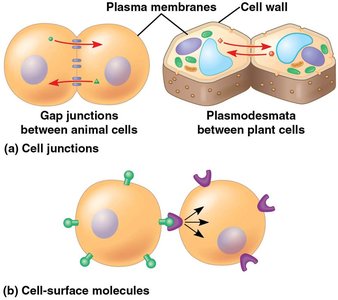
Cells communicate through various mechanisms, including direct contact and signaling molecules.
Cell junctions allow direct passage of signaling molecules between adjacent cells.
Direct contact involves cell-surface molecules interacting without junctions.
Types of Cell Signaling
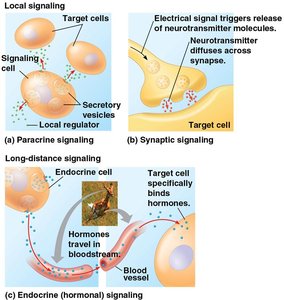
Cell signaling can be classified based on the distance the signal travels:
Paracrine signaling: Local signaling where molecules travel short distances.
Synaptic signaling: Neurotransmitters are released after electrical signals and bind to receptors in the nervous system.
Endocrine (hormonal) signaling: Hormones travel long distances through the bloodstream and bind to specific receptors.
Steps of Cellular Communication
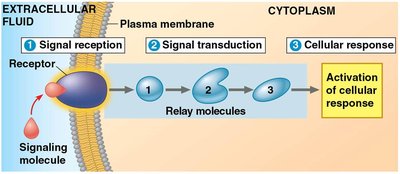
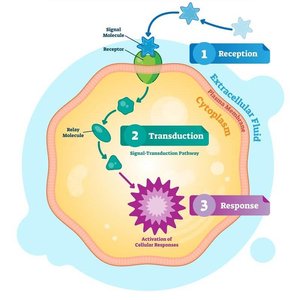
Cellular communication occurs in three main steps:
Signal Reception: The target cell detects a signaling molecule via receptor proteins.
Signal Transduction: The receptor changes shape, initiating a signal transduction pathway.
Cellular Response: The transduced signal triggers a specific change in the target cell.
Signal Reception
Signal Reception: Ligand Binding
Signal reception begins when a signaling molecule (ligand) binds to a specific receptor, usually a protein on the cell membrane or inside the cell. This binding causes a conformational change in the receptor, which is essential for signal transduction.
Most receptors are membrane proteins, but some are internal.
Ligand binding triggers a shape change in the receptor.
Types of Membrane Signal Receptors
There are three main types of membrane signal receptors:
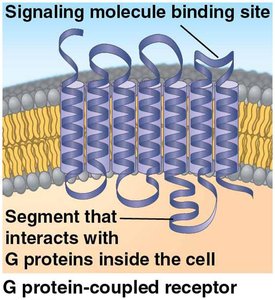
G-protein-coupled receptors (GPCRs): The largest family of receptors in multicellular organisms.
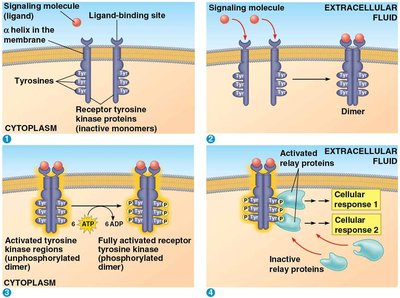
Receptor tyrosine kinases (RTKs): Catalyze the transfer of phosphate groups from ATP to proteins.
Ion channel receptors: Open or close in response to ligand binding, affecting ion concentrations.
G-Protein-Coupled Receptors (GPCRs)
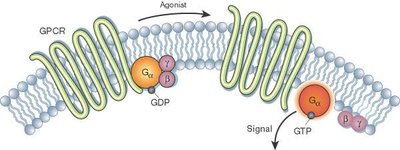
GPCRs are transmembrane proteins that interact with G-proteins inside the cell. Upon ligand binding, the GPCR undergoes a shape change, allowing GTP to replace GDP on the G-protein, which then activates downstream enzymes.
GPCRs trigger a variety of cellular responses.
G-proteins act as molecular switches.
Receptor Tyrosine Kinases (RTKs)
RTKs are membrane proteins that transfer phosphate groups from ATP to relay proteins. Ligand binding causes RTKs to dimerize and self-phosphorylate, activating multiple signal transduction pathways.
RTKs can trigger multiple pathways simultaneously.
Ion Channel Receptors
Ligand-gated ion channel receptors open or close in response to ligand binding, allowing ions to flow across the membrane and altering cellular ion concentrations.
Ion channels are crucial for nerve impulse transmission and muscle contraction.
Internal (Intracellular) Receptors
Intracellular receptors are located in the cytoplasm or nucleus and interact with small or hydrophobic signaling molecules, such as steroid hormones and vitamins. Once activated, these receptors can regulate gene expression and other cellular functions.
Internal receptors are activated by molecules that can cross the cell membrane.
Signal Transduction
Signal Transduction Pathways
Signal transduction involves a series of molecular interactions that transmit signals from receptors to relay molecules inside the cell. This multi-step process often includes changes in receptor shape and the activation of various proteins.
Phosphorylation and de-phosphorylation regulate protein activity.
Protein kinases transfer phosphates from ATP to proteins, creating phosphorylation cascades.
Protein phosphatases remove phosphates, acting as molecular switches.
Second Messengers
Second messengers are small, water-soluble molecules or ions that help propagate the signal within the cell. They are commonly used in GPCR and RTK pathways.
Cyclic AMP (cAMP): Produced from ATP by adenylyl cyclase, cAMP activates protein kinase A, which phosphorylates other proteins.
Second messengers play roles in metabolism, ion regulation, and water balance.
Summary of Cellular Communication
Key Points
Cells communicate via direct contact, local signaling, and long-distance signaling.
Signal detection relies on ligand binding to receptors such as GPCRs, RTKs, and ion channels.
Signal transduction involves phosphorylation, shape changes, and second messengers.
Example: Cellular Response to Epinephrine
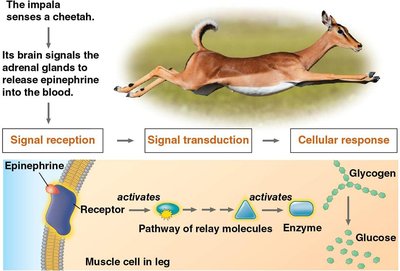
When an impala senses a cheetah, its brain signals the adrenal glands to release epinephrine. Epinephrine binds to receptors on muscle cells, activating a pathway that leads to the breakdown of glycogen into glucose, providing energy for escape.
Signal reception: Epinephrine binds to receptor.
Signal transduction: Relay molecules and enzymes are activated.
Cellular response: Glycogen is converted to glucose.