 Back
Cell Communication: Mechanisms and Pathways in General Biology
Study Guide - Smart Notes
 Tailored notes based on your materials, expanded with key definitions, examples, and context.
Cell Communication
Overview: Cellular Messaging
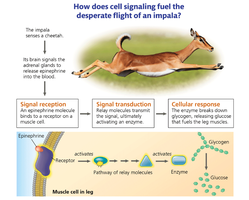
Cell-to-cell communication is fundamental for both multicellular and unicellular organisms. Universal mechanisms of cellular regulation have been discovered, with cells most often communicating via chemical signals. For example, the fight-or-flight response is triggered by the signaling molecule epinephrine, which initiates a cascade of cellular events.
Key Concepts in Cell Communication
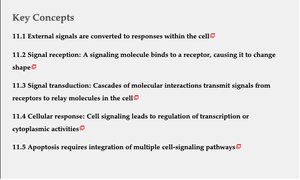
External signals are converted to responses within the cell
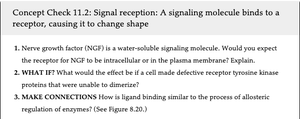
Signal reception: A signaling molecule binds to a receptor, causing it to change shape
Signal transduction: Cascades of molecular interactions transmit signals from receptors to relay molecules in the cell
Cellular response: Cell signaling leads to regulation of transcription or cytoplasmic activities
Apoptosis: Requires integration of multiple cell-signaling pathways
External Signals and Cellular Responses
Conversion of External Signals to Cellular Responses
Cells detect external signals and convert them into specific responses through a series of steps. In yeast, Saccharomyces cerevisiae, cells of different mating types locate each other via secreted factors. In animals, hormones like epinephrine trigger responses such as glycogen breakdown in muscle and liver cells, fueling rapid actions like the flight of an impala.
Types of Cell Signaling
Local and Long-Distance Signaling
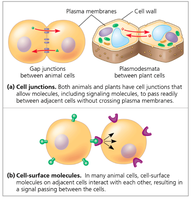
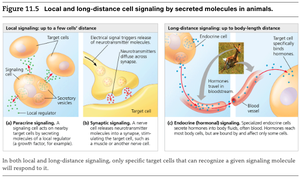
Cells communicate either by direct contact or by secreted molecules. Local signaling includes cell junctions and cell-surface molecules, while long-distance signaling involves hormones traveling through the bloodstream.
Gap junctions (animals) and plasmodesmata (plants) allow molecules to pass directly between cells.
Cell-surface molecules interact on adjacent cells, transmitting signals without crossing membranes.
Paracrine signaling: Local regulators affect nearby cells.
Synaptic signaling: Neurotransmitters cross synapses to target cells.
Endocrine (hormonal) signaling: Hormones travel long distances via the bloodstream.
The Three Stages of Cell Signaling
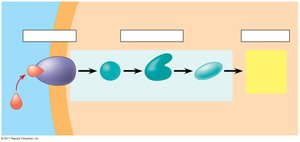
Reception, Transduction, and Response
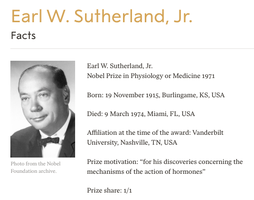
Earl W. Sutherland discovered the mechanism by which epinephrine acts on cells, earning the Nobel Prize in 1971. He proposed that cells receiving signals undergo three processes:
Reception: The cell detects a signaling molecule from the outside.
Transduction: The signal is relayed and amplified through a cascade of molecular interactions.
Response: The cell responds, often by activating an enzyme or gene expression.
Signal Reception
Receptors in the Plasma Membrane
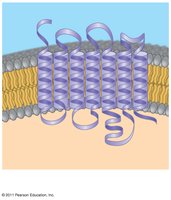
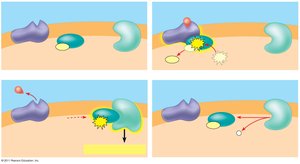
Most water-soluble signal molecules bind to specific sites on receptor proteins that span the plasma membrane. There are three main types of membrane receptors:
G protein-coupled receptors (GPCRs): Largest family, work with G proteins as on/off switches.
Receptor tyrosine kinases (RTKs): Attach phosphates to tyrosines, can trigger multiple pathways.
Ion channel receptors: Act as gates for ions when the receptor changes shape.
Mutations in these receptors can lead to diseases such as cancer, heart disease, and asthma.
Intracellular Receptors
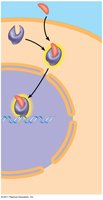
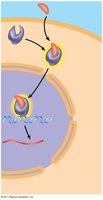
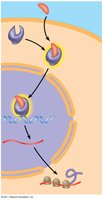
Intracellular receptor proteins are found in the cytosol or nucleus. Small or hydrophobic messengers, such as steroid and thyroid hormones, can cross the membrane and activate these receptors. The hormone-receptor complex often acts as a transcription factor, turning on specific genes.
Signal Transduction
Transduction Pathways
Signal transduction usually involves multiple steps, allowing amplification and specificity. The molecules that relay a signal are mostly proteins, and the signal is often transduced into a different form, such as a shape change in a protein.
Phosphorylation cascade: Protein kinases transfer phosphates from ATP to proteins, activating them.
Dephosphorylation: Protein phosphatases remove phosphates, deactivating proteins.
This system acts as a molecular switch, turning activities on and off as needed.
Second Messengers
Small Molecules and Ions as Second Messengers
Second messengers are small, nonprotein, water-soluble molecules or ions that spread throughout a cell by diffusion. They participate in pathways initiated by GPCRs and RTKs. Common second messengers include cyclic AMP (cAMP) and calcium ions (Ca2+).
Cyclic AMP (cAMP): Produced by adenylyl cyclase from ATP in response to extracellular signals.
Calcium ions (Ca2+): Act as second messengers in many pathways, regulated by the cell.
Inositol triphosphate (IP3): Helps release Ca2+ from intracellular stores.
Example equation for cAMP production:
Cellular Response
Regulation of Transcription or Cytoplasmic Activities
A signal transduction pathway leads to regulation of one or more cellular activities. The response may occur in the cytoplasm or nucleus. Many pathways regulate the synthesis of enzymes or proteins by turning genes on or off in the nucleus. The final activated molecule may function as a transcription factor.
Regulation of the Response
Amplification, Specificity, Efficiency, and Termination
Cell signaling is regulated in several ways:
Amplification: Enzyme cascades amplify the response; each step activates more molecules.
Specificity: Different cells have different proteins, allowing unique responses to the same signal.
Efficiency: Scaffolding proteins group relay proteins, increasing efficiency.
Termination: Inactivation mechanisms ensure signals are not perpetuated indefinitely.
Apoptosis: Programmed Cell Death
Integration of Cell-Signaling Pathways
Apoptosis is controlled cell suicide, essential for development and preventing damage to neighboring cells. It involves chopping up cellular components and packaging them for digestion by scavenger cells. Apoptosis is regulated by multiple signaling pathways and is crucial in processes like embryonic development.
Caspases: Main proteases that carry out apoptosis.
Triggers: Extracellular death signals, DNA damage, or protein misfolding.
Defects in apoptosis regulation can lead to diseases such as cancer or degenerative disorders.
Summary Table: Types of Cell Signaling
Type | Distance | Example | Mechanism |
|---|---|---|---|
Direct Contact | Adjacent cells | Gap junctions, plasmodesmata | Molecules pass directly |
Paracrine | Local | Growth factors | Local regulators diffuse |
Synaptic | Local | Neurotransmitters | Released at synapse |
Endocrine | Long-distance | Hormones | Travel via bloodstream |
Concept Checks and Applications
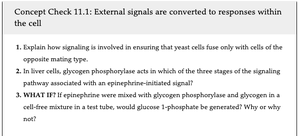
How signaling ensures yeast cells fuse only with cells of the opposite mating type.
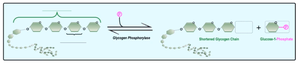
Role of glycogen phosphorylase in epinephrine signaling.
Why cell-free mixtures of epinephrine and glycogen do not produce glucose-1-phosphate.
Additional info:
Cell signaling pathways are highly conserved across species, indicating their fundamental importance.
Defects in signaling can lead to a wide range of human diseases, including cancer, diabetes, and neurological disorders.
