 Back
Cell Communication: Mechanisms and Signaling Pathways
Study Guide - Smart Notes
 Tailored notes based on your materials, expanded with key definitions, examples, and context.
Cell Communication
Overview of Cellular Communication
Cell communication is essential for coordinating activities within multicellular organisms. Cells must receive and respond to signals to regulate growth, division, death, and specialized functions such as protein production, contraction, and secretion. Communication also enables cells to adapt to environmental changes, such as fluctuations in glucose levels.
Control Mechanisms: Nervous and endocrine systems rely on cellular responses to information.
Intercellular Communication: Cells communicate about supplies, conditions, and functional instructions.
Environmental Response: Cells adjust their activities based on external signals.
Types of Cell Communication
Cells communicate through direct contact or by sending signaling molecules to target cells. The mode of communication depends on the distance and the nature of the signal.
Direct Contact: Includes cell junctions (gap junctions in animals, plasmodesmata in plants) and cell-cell recognition.
Local Signaling: Paracrine and synaptic signaling involve nearby cells.
Long-Distance Signaling: Endocrine (hormonal) signaling uses hormones transported via the bloodstream to distant cells.
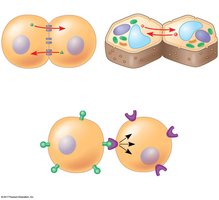
Local and Long-Distance Signaling
Local signaling involves the release of signaling molecules that affect nearby cells, while long-distance signaling uses hormones to communicate with cells throughout the body.
Paracrine Signaling: Local regulators are secreted and affect nearby target cells.
Synaptic Signaling: Neurotransmitters are released across synapses in the nervous system.
Endocrine Signaling: Hormones travel through the bloodstream to reach distant target cells.
The Three Stages of Cell Signaling
Stages of Cell Signaling
Cell signaling consists of three main stages: reception, transduction, and response. Each stage is crucial for the cell to interpret and act upon external signals.
Reception: The cell detects a signaling molecule (ligand) via a receptor protein.
Transduction: The signal is converted into a form that can bring about a specific cellular response, often through a cascade of molecular events.
Response: The cell carries out a specific activity, such as gene expression, enzyme activation, or secretion.
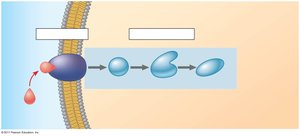
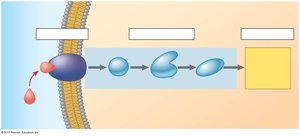
Signal Reception
Types of Membrane Receptors
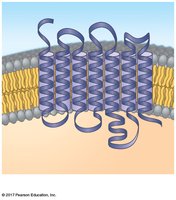
Membrane receptors are specialized proteins that bind signaling molecules and initiate cellular responses. The two main types are ligand-gated ion channels and G protein-coupled receptors (GPCRs).
Ligand-Gated Ion Channels: Open or close in response to ligand binding, allowing ions to flow across the membrane. Important in nerve conduction.
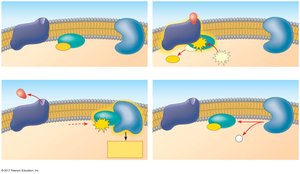
G Protein-Coupled Receptors (GPCRs): Activate intracellular G proteins upon ligand binding, triggering various signaling pathways.
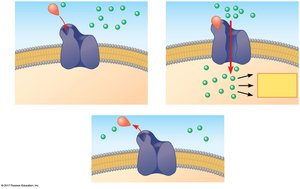
Signal Transduction
Transduction Mechanisms
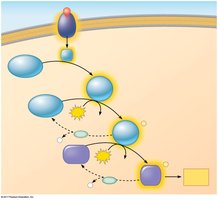
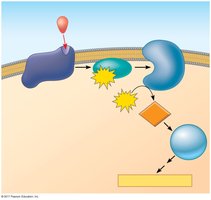
Transduction converts the signal from one form to another, often involving a series of molecular changes known as a signal transduction pathway. This process can amplify the signal and diversify the response.
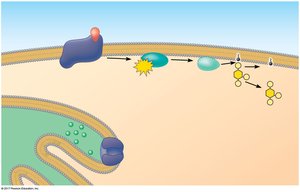
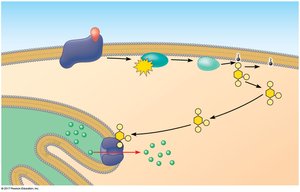
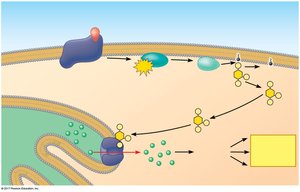
Phosphorylation Cascade: Sequential activation of protein kinases by phosphorylation, leading to a cellular response.
Second Messengers: Small, nonprotein molecules (e.g., cAMP, Ca2+, IP3) that relay signals inside the cell.

Cellular Response
Types of Cellular Responses
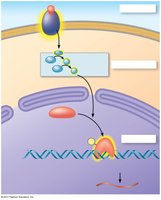
The final stage of cell signaling is the cellular response, which can involve changes in gene expression, enzyme activity, or other cellular functions. Responses may be targeted to the nucleus or occur in the cytoplasm.
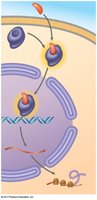
Gene Expression: Activation of transcription factors leads to mRNA synthesis and protein production.
Enzyme Activation: Signaling pathways can activate or inhibit enzymes, affecting metabolic processes.
Intracellular Receptors: Some signals, such as steroid hormones, act inside the cell and directly influence gene expression.
Regulation of the Response
Signal Regulation and Amplification
Cellular responses are not simply "on" or "off"; they can be regulated in terms of strength, specificity, and duration. Signal amplification allows a small number of signaling molecules to produce a large cellular response.
Amplification: Each step in the pathway can increase the number of activated molecules, resulting in a stronger response.
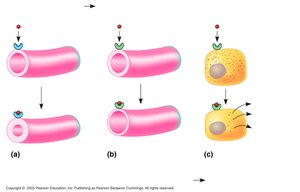
Specificity: Different cells may respond differently to the same signal, depending on the receptors and intracellular proteins present.
Cross-Talk: Pathways can interact, leading to complex cellular outcomes.
Examples of Signal Specificity
Cells with different receptors or intracellular proteins can respond to the same signaling molecule in distinct ways, such as constriction or dilation of blood vessels, or glycogen breakdown in liver cells.
Summary Table: Types of Cell Signaling
Type | Distance | Example | Mechanism |
|---|---|---|---|
Direct Contact | Adjacent cells | Gap junctions, plasmodesmata | Physical connection |
Paracrine | Local | Growth factors | Local regulator diffusion |
Synaptic | Local | Neurotransmitters | Diffusion across synapse |
Endocrine | Long-distance | Hormones | Bloodstream transport |
Key Terms and Concepts
Ligand: A molecule that binds to a receptor to initiate a signal.
Receptor: Protein that detects a signaling molecule.
Transduction: Conversion of a signal from one form to another.
Second Messenger: Intracellular signaling molecule (e.g., cAMP, Ca2+).
Phosphorylation Cascade: Series of protein kinase activations.
Amplification: Increase in signal strength through pathway steps.
Specificity: Unique cellular responses based on receptor and protein composition.
Important Equations
Many signaling pathways involve the conversion of ATP to cAMP:
Phosphorylation reactions:
Dephosphorylation reactions:
Additional info: Signal transduction pathways are highly regulated and can involve feedback mechanisms, cross-talk between pathways, and adaptation to prolonged stimulation.
