 Back
Cell Communication: Mechanisms and Types of Signaling
Study Guide - Smart Notes
 Tailored notes based on your materials, expanded with key definitions, examples, and context.
Cell Communication
Overview of Cell Signaling
Cell communication is essential for the coordination of cellular activities in multicellular organisms and even among single-celled organisms. Cells receive external signals and respond through a series of molecular events, which can regulate growth, development, and survival.
Cell signaling involves the transmission of signals from the environment to the cell, resulting in a cellular response.
Single-celled organisms, such as bacteria, can signal each other to form structures like biofilms.
Disrupting bacterial signaling is a promising approach for developing new antibiotics.
Types of Signaling
Local Signaling
Local signaling occurs between cells that are in close proximity. It is crucial for processes such as embryonic development, immune responses, and maintenance of stem cell populations.
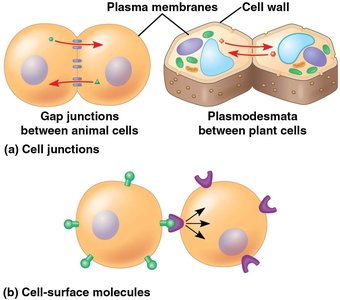
Direct contact: Animal and plant cells have cell junctions (gap junctions in animals, plasmodesmata in plants) that allow signaling substances to pass directly between adjacent cells.
Cell-surface molecules can also mediate communication through direct contact.
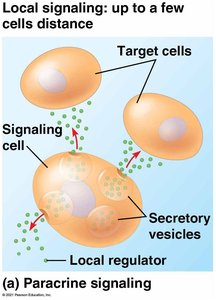
Paracrine signaling: Cells secrete local regulators that affect nearby target cells. Growth factors are common paracrine signals that stimulate cell division.
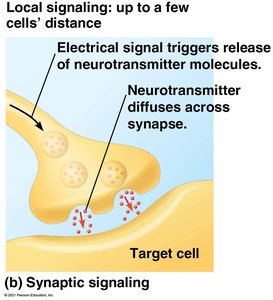
Synaptic signaling: In the nervous system, electrical signals trigger the release of neurotransmitters, which diffuse across synapses to target cells. This process is affected by drugs used to treat neurological disorders.
Long-Distance Signaling
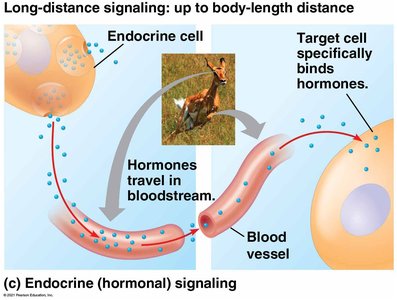
Long-distance signaling involves hormones that travel through the bloodstream to reach target cells throughout the body.
Endocrine (hormonal) signaling: Specialized cells release hormones, which are transported via the circulatory system to distant target cells.
The ability of a cell to respond depends on the presence of specific receptors for the hormone.
Stages of Cell Signaling
Three Stages of Cell Signaling
Cell signaling typically involves three stages: reception, transduction, and response.
Reception: The target cell detects a signaling molecule (ligand) that binds to a receptor protein on the cell surface or inside the cell.
Transduction: The binding of the ligand alters the receptor, initiating a signal transduction pathway, often involving multiple steps and relay molecules.
Response: The transduced signal triggers a specific cellular response, such as gene expression, enzyme activation, or cell division.
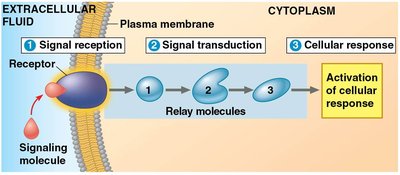
Signal Reception
Types of Membrane Receptors
Most signal receptors are plasma membrane proteins, but some are located inside the cell. There are three main types of membrane receptors:
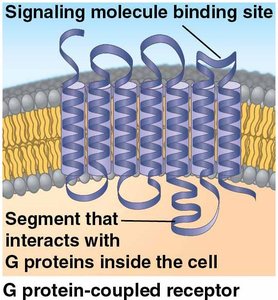
G protein-coupled receptors (GPCRs): These are cell-surface transmembrane receptors that interact with G proteins, which bind GTP. GPCRs are highly diverse and widespread in function.
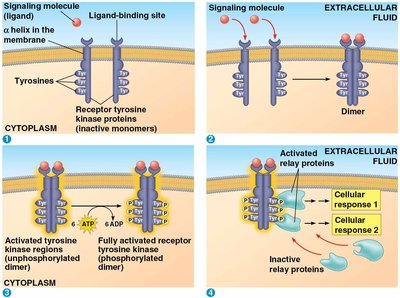
Receptor tyrosine kinases (RTKs): These membrane receptors catalyze the transfer of phosphate groups from ATP to other proteins. RTKs can trigger multiple signal transduction pathways simultaneously. Abnormal RTK function is linked to various cancers.
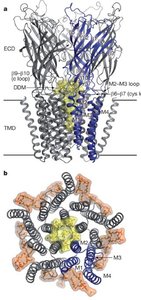
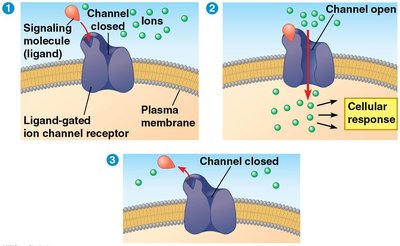
Ligand-gated ion channel receptors: These act as gates that open or close in response to ligand binding, allowing specific ions (e.g., Na+, Ca2+) to pass through the channel.
Intracellular Receptors
Some receptors are located inside the cell, in the cytoplasm or nucleus.
Intracellular receptor proteins are activated by small or hydrophobic messengers that can cross the cell membrane, such as steroid and thyroid hormones.
An activated hormone-receptor complex can act as a transcription factor, regulating gene expression.
Cellular Response and Regulation
Regulation of the Response
The cellular response to a signal can be tightly regulated, ensuring appropriate outcomes such as cell growth, differentiation, or apoptosis (programmed cell death).
Signal transduction pathways often involve amplification and integration of signals.
Cells can regulate the sensitivity and duration of their response by modulating receptor activity and downstream signaling components.
Apoptosis
Apoptosis is a form of programmed cell death that is essential for development and maintaining tissue homeostasis.
Signals can trigger apoptosis through specific pathways, leading to the orderly dismantling of cellular components.
Apoptosis prevents damage to neighboring cells and is crucial for removing unwanted or damaged cells.
Examples and Applications
Yeast Mating and Signal Transduction
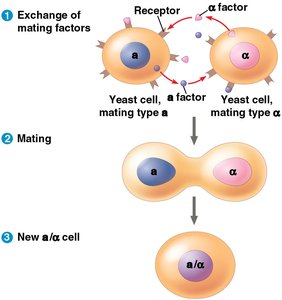
The yeast Saccharomyces cerevisiae uses signaling to locate mating partners and initiate mating. The molecular details of yeast and mammalian signal transduction are remarkably similar.
Yeast cells of different mating types secrete specific factors and respond via signal transduction pathways.
Summary Table: Types of Cell Signaling
Type | Distance | Example | Key Feature |
|---|---|---|---|
Direct Contact | Adjacent cells | Gap junctions, plasmodesmata | Physical connection |
Paracrine | Local (few cells) | Growth factors | Secreted local regulators |
Synaptic | Local (synapse) | Neurotransmitters | Electrical signal triggers chemical release |
Endocrine | Long-distance | Hormones | Transport via bloodstream |
Key Terms
Ligand: A molecule that binds specifically to a receptor.
Receptor: A protein that detects a signaling molecule and initiates a response.
Signal transduction pathway: A series of molecular events triggered by receptor activation.
Apoptosis: Programmed cell death.
Transcription factor: A protein that regulates gene expression.
Equations and Formulas
ATP Hydrolysis (for RTK activation)
G Protein Activation
Ion Channel Flow
Additional info:
Cell signaling is a fundamental topic in General Biology, directly relevant to Chapter 11: Cell Communication.
Images included are directly relevant to the explanation of each signaling mechanism and receptor type.
