 Back
Cell Communication: Mechanisms and Types of Signaling
Study Guide - Smart Notes
 Tailored notes based on your materials, expanded with key definitions, examples, and context.
Cell Communication
Introduction to Cell Communication
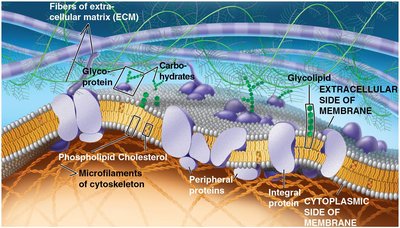
Cell communication is a fundamental process that allows cells to sense and respond to signals from their environment and other cells. This process is essential for the coordination of activities in multicellular organisms and for the survival of single-celled organisms. The cell membrane acts as a boundary, distinguishing "self" from "nonself," but information from outside must be sensed and processed inside the cell.
Key Terms in Cell Signaling
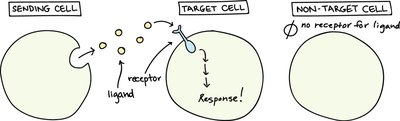
Ligand: A signaling molecule that binds to a specific receptor, acting as a molecular key.
Receptor: A protein that recognizes and binds the ligand, acting as a molecular lock.
Signal Transduction: The process by which a signal is relayed inside the cell after receptor activation.
Cellular Response: The final action triggered in the cell, such as gene expression, enzyme activation, or cytoskeletal changes.
Stages of Cell Signaling
1. Signal Reception
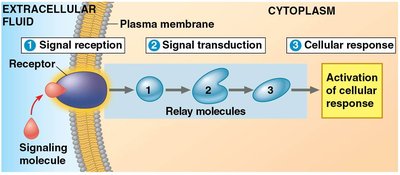
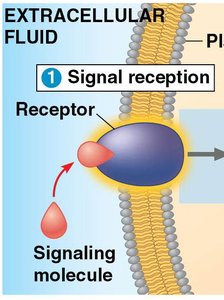
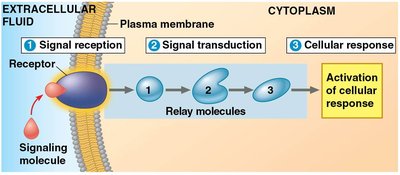
Signal reception is the first step in cell signaling. A ligand binds to a specific receptor protein on the cell surface, causing a conformational change in the receptor. Only cells with the correct receptor can detect and respond to the signal.
2. Signal Transduction
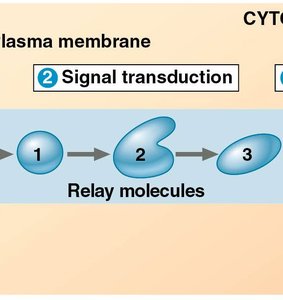
Signal transduction involves a cascade of relay molecules inside the cell, often activated by phosphorylation or dephosphorylation. This cascade amplifies the signal and leads to the activation of a final target molecule or process.
3. Cellular Response
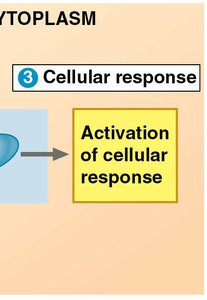
The transduced signal triggers a specific response in the target cell. Responses can include changes in gene expression, enzyme activity, cytoskeletal organization, or metabolism. The response depends on the cell type and the signal received.
Summary of Cell Signaling
Cell signaling begins when a ligand binds a membrane receptor.
This triggers an intracellular relay cascade.
The cascade ultimately activates a specific cellular response.
Cell fate can involve simple responses or dramatic changes such as growth, differentiation, or apoptosis.
Cell Signaling in Single-Cell Organisms
Bacterial Signaling and Quorum Sensing
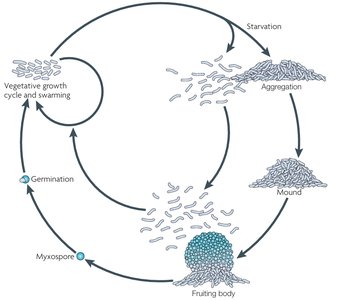
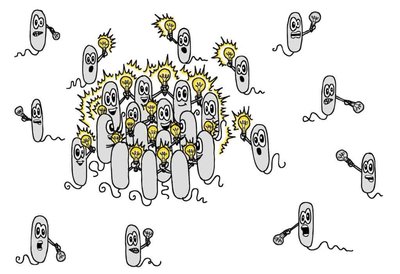
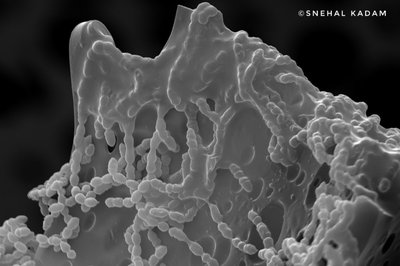
Bacteria use cell signaling to facilitate cooperation, such as in Myxococcus xanthus. Ancestral signaling molecules likely evolved in prokaryotes and were adopted by multicellular descendants. Many bacteria communicate through quorum sensing, releasing autoinducers that allow cells to sense population density and coordinate behaviors like biofilm formation and bioluminescence.
Yeast Mating and Signal Transduction
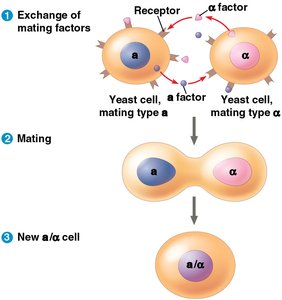
The yeast Saccharomyces cerevisiae has two mating types, a and α. Cells locate each other via secreted factors specific to each type. Binding of a mating factor at a receptor initiates a signal transduction pathway, with molecular details similar to those in mammals.
Multicellular Organisms: Types of Signaling
Categories of Signaling Based on Distance
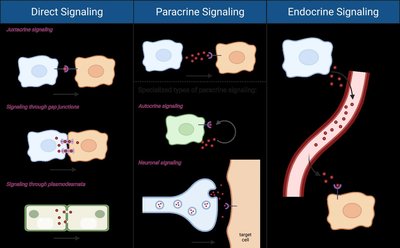
Multicellular organisms use local and long-distance signaling. The main categories are:
Direct signaling: Through cell junctions or cell-surface molecules.
Paracrine signaling: Short-distance signaling to nearby cells.
Endocrine signaling: Long-distance signaling via hormones.
Direct Cell-to-Cell Communication
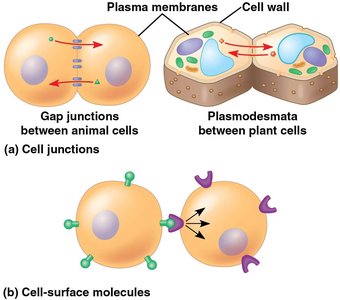
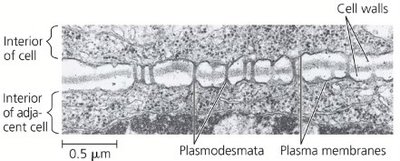
Gap junctions in animal cells and plasmodesmata in plant cells allow ions and small molecules to pass directly between neighboring cells. Cell-surface molecules can interact through direct contact, triggering responses in adjacent cells (juxtacrine signaling). These forms are essential for development, immune responses, and tissue organization.
Paracrine Signaling
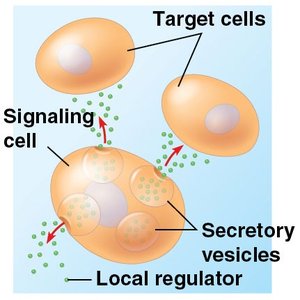
Paracrine signaling involves the release of local regulators that affect nearby target cells. Examples include growth factors stimulating cell division and synaptic signaling in the nervous system.
Autocrine Signaling
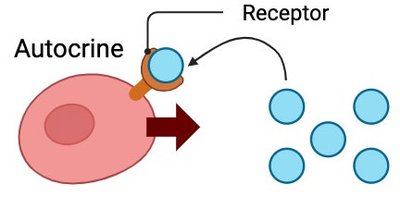
Autocrine signaling is a special type of paracrine signaling where a cell releases signals that bind to its own receptors, allowing self-regulation. This is common in immune cells and feedback loops.
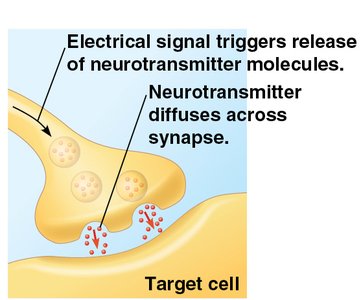
Synaptic Signaling
Synaptic signaling occurs in the nervous system, where neurotransmitters are released at synapses in response to electrical signals, allowing rapid communication between neurons.
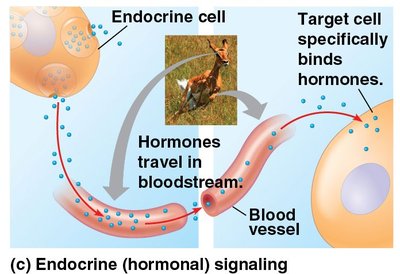
Endocrine (Hormonal) Signaling
Endocrine signaling involves hormones traveling through the bloodstream to reach distant target cells. Both animals and plants use hormones for long-distance communication, with diverse regulatory roles.
Signal Reception: Receptor Types
Receptor Locations
Receptors can be located on the cell membrane or inside the cell. Most ligands are received at the cell surface by integral protein receptors. Hydrophobic ligands that can cross the membrane bind to intracellular receptors.
Cell surface receptors: G protein-coupled receptors (GPCRs), receptor tyrosine kinases (RTKs), ligand-gated ion channels.
Intracellular receptors: Activated by small or hydrophobic ligands, such as steroid and thyroid hormones.
G Protein-Coupled Receptors (GPCRs)
GPCRs are diverse cell-surface receptors that interact with G proteins and GTP. The mechanism involves ligand binding, G protein activation, enzyme activation, and self-shutdown by GTP hydrolysis.
Ligand binds to GPCR, activating G protein (GDP → GTP exchange).
Active G protein activates target enzyme.
Enzyme triggers cellular response.
G protein hydrolyzes GTP to GDP, returning to resting state.
Receptor Tyrosine Kinases (RTKs)
RTKs catalyze the transfer of phosphate groups from ATP to proteins. They begin as inactive monomers, dimerize upon ligand binding, and phosphorylate each other's tyrosine residues. Activated RTKs serve as docking sites for relay proteins, triggering multiple signaling pathways.
Ligand binding triggers dimerization and kinase activation.
Phosphorylation of tyrosine residues creates docking sites.
Relay proteins bind and activate multiple pathways.
Signaling ends when relay proteins detach.
Ligand-Gated Ion Channel Receptors
These receptors act as ion gates, opening or closing in response to ligand binding. They allow specific ions, such as Na+ or Ca2+, to flow through the channel, triggering cellular responses.
Ligand binding opens the channel.
Ions flow through, altering cell activity.
Neuronal Ligand-Gated Ion Channel Receptors
N-methyl-D-aspartate receptors (NMDARs) are activated by glutamate, allowing Ca2+ influx and triggering action potentials in neurons.
Intracellular Receptor Proteins
Found in the cytoplasm or nucleus, these receptors are activated by small or hydrophobic ligands. The hormone-receptor complex can act as a transcription factor, regulating gene expression.
Examples: steroid and thyroid hormones.
Activated complex regulates specific genes.
Summary Equation
The general equation for cell signaling can be represented as:
Review Table: Types of Cell Signaling
Type | Distance | Example | Key Feature |
|---|---|---|---|
Direct (Juxtacrine) | Adjacent cells | Gap junctions, plasmodesmata | Direct contact |
Paracrine | Short | Growth factors, synaptic signaling | Local regulators |
Autocrine | Self | Immune cell regulation | Self-signaling |
Endocrine | Long | Hormones | Bloodstream transport |
