Back
BackBIO 102 Chapter 11 Modules 3-5
Study Guide - Smart Notes
 Tailored notes based on your materials, expanded with key definitions, examples, and context.
Cell Communication and Signal Transduction
Overview of Signal Transduction Pathways
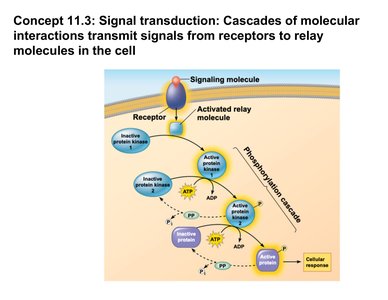
Cell communication is essential for coordinating cellular activities in multicellular organisms. Signal transduction pathways transmit signals from receptors on the cell surface to relay molecules inside the cell, resulting in a specific cellular response. These pathways often involve multiple steps, allowing for regulation and amplification of the signal.
Signaling molecule (ligand) binds to a receptor protein on the cell membrane.
The receptor activates a relay molecule, which initiates a cascade of molecular interactions.
Each step typically involves a shape change in a protein, often through phosphorylation.
This cascade is known as a phosphorylation cascade.
Protein Phosphorylation and Dephosphorylation
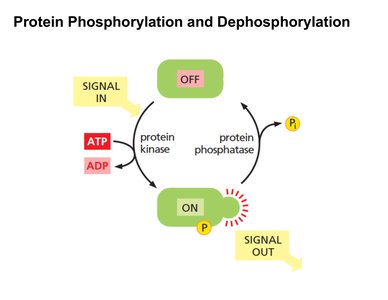
Phosphorylation and dephosphorylation are key post-translational modifications that regulate protein activity in signal transduction pathways.
Protein kinases transfer phosphate groups from ATP to proteins, activating or deactivating them.
Protein phosphatases remove phosphate groups, reversing the effect of kinases.
This reversible mechanism acts as a molecular switch, turning protein activities on or off as needed.
Second Messengers in Signal Transduction
Role of Second Messengers
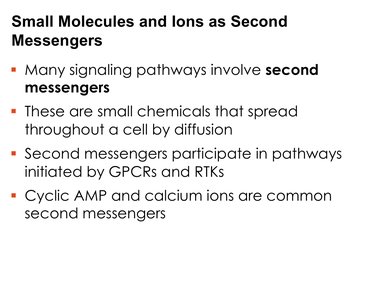
Many signaling pathways use second messengers, which are small molecules or ions that diffuse rapidly within the cell to amplify and propagate the signal.
Common second messengers include cyclic AMP (cAMP) and calcium ions (Ca2+).
They participate in pathways initiated by G protein-coupled receptors (GPCRs) and receptor tyrosine kinases (RTKs).
Cyclic AMP (cAMP) Pathway
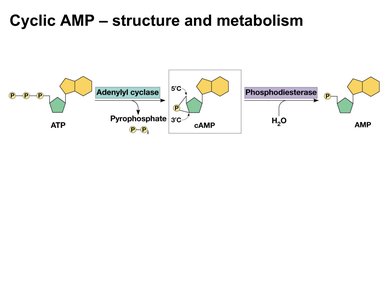
cAMP is a widely used second messenger synthesized from ATP by the enzyme adenylyl cyclase after receptor activation. Its concentration is tightly regulated by synthesis and degradation.
Adenylyl cyclase converts ATP to cAMP, releasing pyrophosphate.
Phosphodiesterase hydrolyzes cAMP to AMP, terminating the signal.
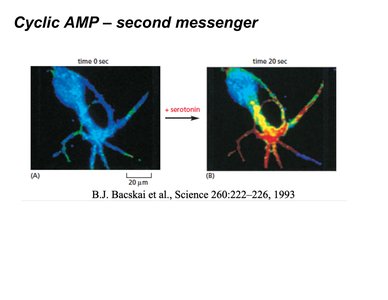
cAMP levels can change rapidly in response to extracellular signals, as shown in nerve cells treated with serotonin, where cAMP concentration increases within seconds.
cAMP in G Protein-Coupled Receptor Pathways
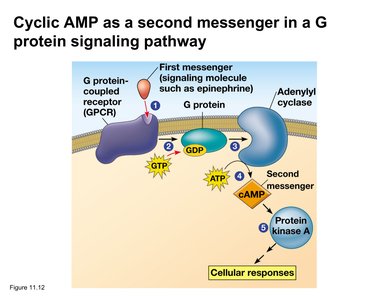
In GPCR pathways, a signaling molecule (e.g., epinephrine) binds to the receptor, activating a G protein, which then activates adenylyl cyclase to produce cAMP. cAMP activates protein kinase A (PKA), which phosphorylates target proteins to elicit cellular responses.
cAMP acts as an allosteric effector, binding to regulatory subunits of PKA and releasing active catalytic subunits.
Phosphodiesterase provides negative feedback by degrading cAMP, preventing prolonged responses.
Calcium Ions (Ca2+) as Second Messengers
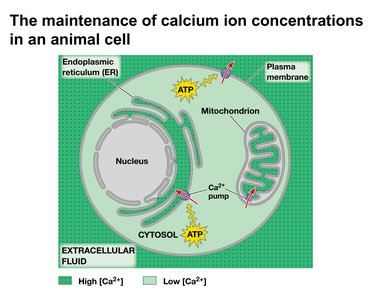
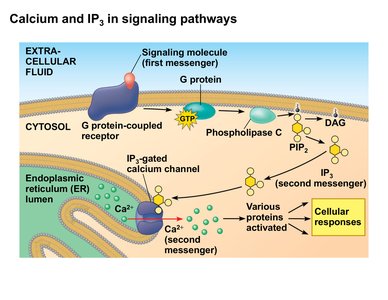
Calcium ions are another common second messenger. Their concentration in the cytosol is kept much lower than in the extracellular fluid, endoplasmic reticulum (ER), or mitochondria by ATP-driven pumps. Release of Ca2+ into the cytosol triggers various cellular responses.
Calcium pumps in the plasma membrane, ER, and mitochondria maintain low cytosolic Ca2+ levels.
Opening of Ca2+ channels allows rapid influx, amplifying the signal.
IP3 and DAG Pathway
Some pathways use inositol trisphosphate (IP3) and diacylglycerol (DAG) as second messengers. Activation of phospholipase C by a G protein cleaves PIP2 into DAG (membrane-bound) and IP3 (water-soluble). IP3 binds to Ca2+ channels on the ER, releasing Ca2+ into the cytosol.
Both IP3 and DAG amplify the signal, but act in different cellular locations.
Cellular Responses to Signals
Regulation of Transcription and Cytoplasmic Activities
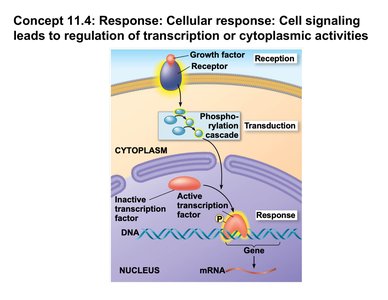
Signal transduction can regulate cellular activities by altering protein function in the cytoplasm or by controlling gene expression in the nucleus. Phosphorylation cascades can activate transcription factors, which then increase or decrease transcription of specific genes.
Activated transcription factors bind DNA and regulate mRNA synthesis.
This allows the cell to control protein production in response to external signals.
Regulation of Signal Transduction Pathways
Aspects of Signal Regulation
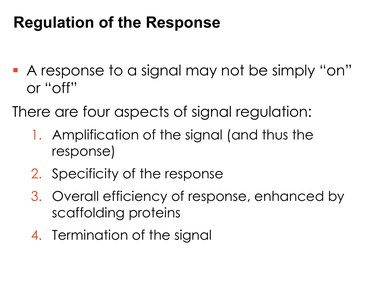
Signal transduction pathways are tightly regulated to ensure appropriate cellular responses. Four key aspects of regulation include amplification, specificity, efficiency, and termination.
Amplification: A single signaling event can activate many downstream molecules, greatly amplifying the response.
Specificity: Different cell types and pathways respond specifically to particular signals.
Efficiency: Scaffolding proteins organize signaling components for rapid and localized responses.
Termination: Mechanisms exist to turn off the signal, preventing overstimulation.
Signal Amplification
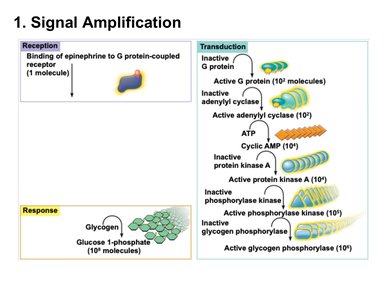
Amplification occurs when each step in a pathway activates multiple molecules in the next step. For example, one epinephrine molecule can lead to the production of millions of glucose molecules by activating a cascade of enzymes involved in glycogen breakdown.
Each activated enzyme can catalyze the activation of many downstream molecules.
This allows for a rapid and robust cellular response to a small initial signal.
Specificity and Coordination of the Response
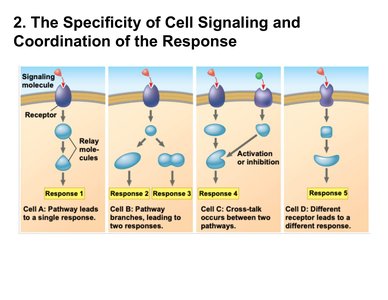
Cells achieve specificity in signaling by expressing unique sets of proteins and receptors. The same signaling molecule can produce different responses in different cell types, depending on the proteins and pathways present. Pathways can also branch or interact (crosstalk) to coordinate complex responses.
Specificity is determined by receptor-ligand interactions and downstream signaling components.
Pathway branching and crosstalk allow integration of multiple signals.
Ligand-Receptor Affinity and Dissociation Constant
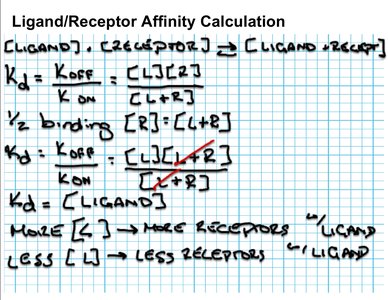
The strength of the interaction between a ligand and its receptor is quantified by the dissociation constant (Kd). This value reflects the concentration of ligand at which half of the receptors are bound. A lower Kd indicates higher affinity.
At half-maximal binding:
More ligand increases receptor-ligand complexes; less ligand decreases them.
High affinity (low Kd) means strong binding and greater likelihood of a response.
Signaling Efficiency: Scaffolding Proteins
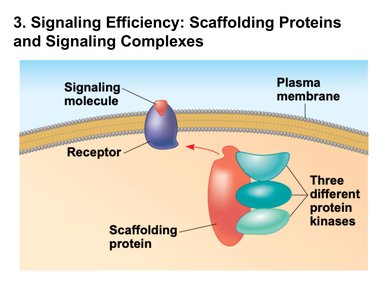
Scaffolding proteins enhance signaling efficiency by bringing together multiple components of a pathway, increasing the speed and specificity of the response. They can also prevent cross-talk between pathways by localizing signaling events.
Scaffolding proteins organize kinases and other enzymes near the receptor.
This spatial organization facilitates rapid and efficient signal transduction.
Termination of the Signal
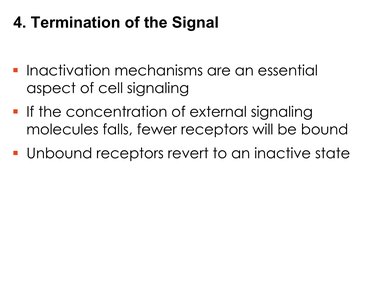
Turning off signaling pathways is essential to prevent continuous stimulation, which can be harmful. Signal termination can occur by reducing ligand concentration, receptor desensitization, or dephosphorylation of pathway components.
Unbound receptors revert to an inactive state.
Cells can upregulate or downregulate receptor numbers to modulate sensitivity.
Apoptosis: Programmed Cell Death
Overview of Apoptosis
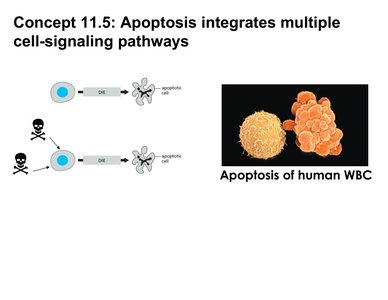
Apoptosis is a regulated process of programmed cell death, essential for development and homeostasis. It is distinct from necrosis, which is uncontrolled cell death due to injury. Apoptosis involves a series of signaling events that lead to the orderly dismantling of cellular components.
Apoptotic cells are broken into fragments and removed by phagocytosis.
Prevents release of harmful substances into surrounding tissue.
Caspases and the Apoptotic Pathway
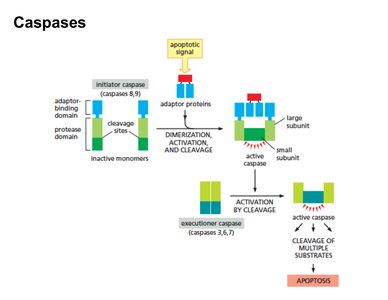
Caspases are a family of proteases that play a central role in apoptosis. They exist as inactive precursors and are activated in response to apoptotic signals. Initiator caspases activate executioner caspases, which then cleave cellular substrates, leading to cell death.
Initiator caspases are activated by dimerization and cleavage.
Executioner caspases are activated by cleavage and amplify the apoptotic response.
Genetic Control of Apoptosis: C. elegans Model
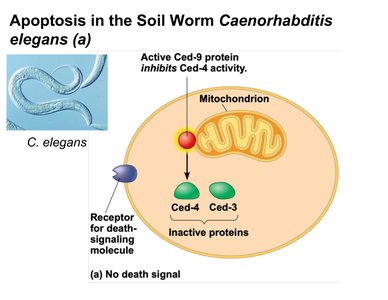
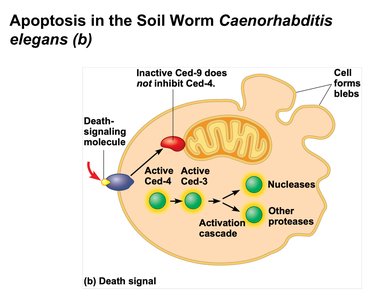
The nematode Caenorhabditis elegans is a model organism for studying apoptosis. In the absence of a death signal, the CED-9 protein inhibits apoptosis by blocking activation of CED-4 and CED-3. When a death signal is present, CED-9 is inactivated, allowing CED-4 to activate CED-3, which triggers the apoptotic cascade.
CED-9: Inhibitor of apoptosis (active in absence of signal).
CED-4: Activator of CED-3 (inactive when CED-9 is active).
CED-3: Main caspase executing apoptosis.
Apoptosis in Development and Disease
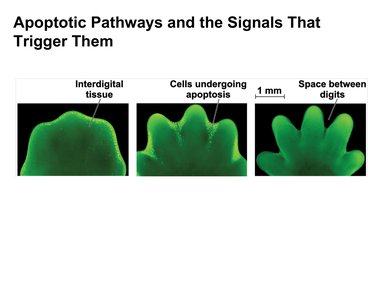
Apoptosis is crucial for normal development, such as the removal of interdigital tissue during limb formation. It also eliminates damaged or potentially harmful cells, preventing diseases like cancer.
Cells undergoing apoptosis can be visualized by specific staining techniques.
Failure to regulate apoptosis can lead to developmental defects or uncontrolled cell proliferation.
Diversity of Cellular Responses to the Same Signal
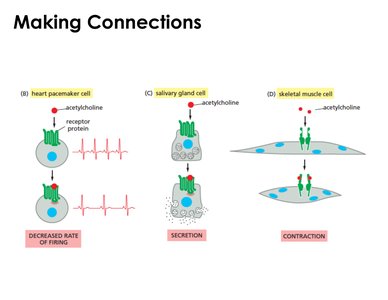
The same signaling molecule can elicit different responses in different cell types, depending on the receptor and intracellular machinery present. For example, acetylcholine can decrease heart rate, stimulate secretion in salivary glands, or trigger muscle contraction.
Different receptors and pathways allow for diverse cellular outcomes from a single ligand.