Back
BackCell Cycle and Cell Division
Study Guide - Smart Notes
 Tailored notes based on your materials, expanded with key definitions, examples, and context.
Cell Cycle and Cell Division
Introduction to Cell Division
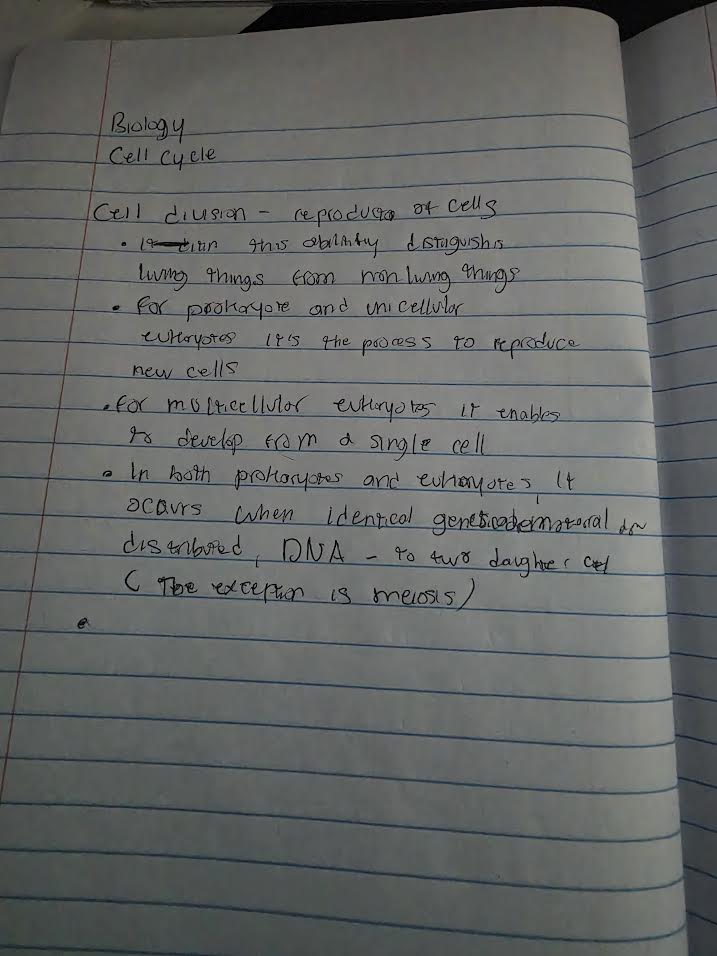
Cell division is a fundamental process by which cells reproduce, ensuring the continuity of life. This ability to divide distinguishes living organisms from non-living matter and is essential for growth, development, and maintenance in all forms of life.
Definition: Cell division is the process by which a parent cell divides to form two or more daughter cells.
Significance: This process is crucial for reproduction, growth, and repair in living organisms.
Cell Division in Prokaryotes and Unicellular Eukaryotes
For prokaryotes (such as bacteria) and unicellular eukaryotes (such as yeast), cell division is the primary means of reproduction. It allows these organisms to produce new cells and propagate their species.
Prokaryotic Cell Division: Typically occurs through a process called binary fission, where the cell duplicates its DNA and splits into two identical cells.
Unicellular Eukaryotic Cell Division: Involves mitosis, where the nucleus divides before the cell splits.
Outcome: Both processes result in genetically identical offspring.
Cell Division in Multicellular Eukaryotes
In multicellular eukaryotes (such as plants and animals), cell division enables the organism to develop from a single cell (zygote) and is essential for growth, tissue repair, and maintenance.
Development: Cell division allows a single fertilized egg to develop into a complex multicellular organism.
Growth and Repair: New cells replace old or damaged cells through mitosis.
Genetic Consistency in Cell Division
In both prokaryotes and eukaryotes, cell division usually results in daughter cells that are genetically identical to the parent cell. This is achieved by the accurate duplication and distribution of DNA.
DNA Replication: Before a cell divides, its DNA is replicated so that each daughter cell receives a complete set of genetic information.
Exception: The process of meiosis (in sexually reproducing eukaryotes) produces daughter cells with half the genetic material, leading to genetic diversity in offspring.
Key Terms:
Mitosis: The process of nuclear division resulting in two genetically identical daughter cells.
Meiosis: A specialized form of cell division that reduces the chromosome number by half, producing four genetically diverse gametes.
Binary Fission: A simple form of cell division in prokaryotes.
Example: When a human skin cell divides by mitosis, it produces two identical skin cells, each with the same genetic material as the original cell.