 Back
Cell Cycle and Cell Division: Structure, Regulation, and Cancer
Study Guide - Smart Notes
 Tailored notes based on your materials, expanded with key definitions, examples, and context.
Cell Cycle and Cell Division
Overview of the Cell Cycle
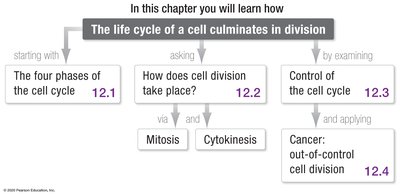
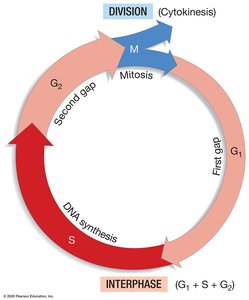
The cell cycle is the series of events that cells undergo to grow and divide. It is fundamental to the development, growth, and maintenance of all living organisms. The cell cycle consists of interphase (G1, S, G2) and the M phase (mitosis and cytokinesis).
Interphase: The cell grows (G1), replicates its DNA (S), and prepares for division (G2).
M phase: Includes mitosis (division of the nucleus) and cytokinesis (division of the cytoplasm).
Cellular Organization of Genetic Material
Genetic material is organized into chromosomes, which are composed of DNA and associated proteins. Chromosomes ensure accurate distribution of genetic material during cell division.
Genome: All DNA in a cell; can be a single molecule (prokaryotes) or multiple molecules (eukaryotes).
Chromosome: A single long double helix of DNA wrapped around histone proteins.
Sister chromatids: Duplicated chromosomes joined at the centromere.
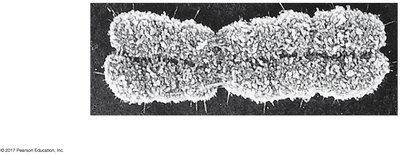
Phases of the Cell Cycle
The cell cycle is divided into distinct phases, each with specific functions and checkpoints to ensure proper cell division.
G1 phase: Cell growth and preparation for DNA replication.
S phase: DNA synthesis and chromosome replication.
G2 phase: Preparation for mitosis.
M phase: Mitosis and cytokinesis.
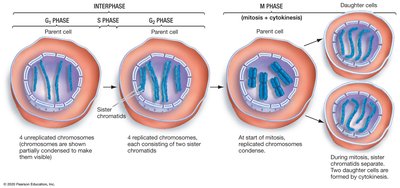
Mitosis and Cytokinesis
Events in Mitosis
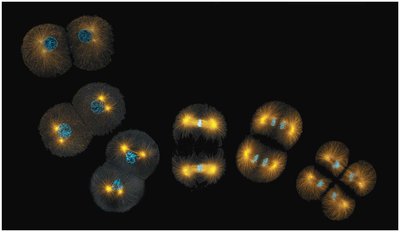
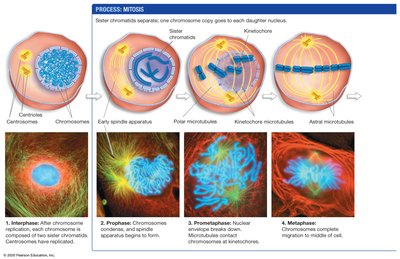
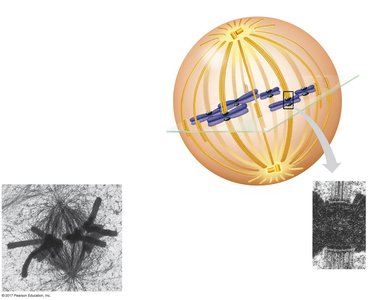
Mitosis is a continuous process divided into five subphases: prophase, prometaphase, metaphase, anaphase, and telophase. It ensures equal distribution of chromosomes to daughter cells.
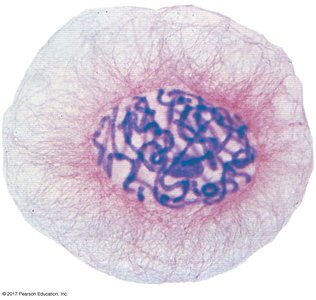
Prophase: Chromosomes condense; spindle apparatus forms.
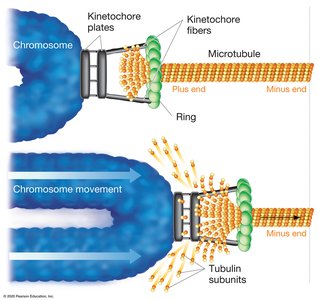
Prometaphase: Nuclear envelope breaks down; microtubules attach to kinetochores.
Metaphase: Chromosomes align at the metaphase plate.
Anaphase: Sister chromatids separate and move to opposite poles.
Telophase: Nuclear envelope reforms; chromosomes decondense.
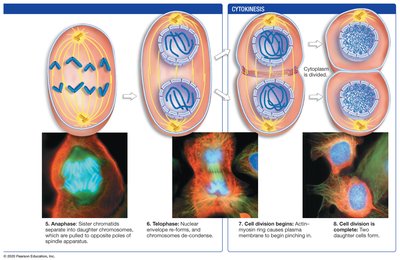
Cytokinesis
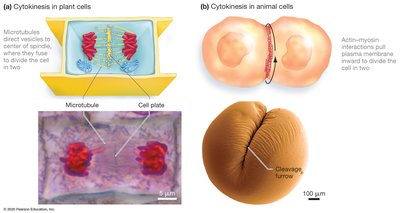
Cytokinesis is the division of the cytoplasm, resulting in two daughter cells. The mechanism varies between plant and animal cells.
Animal cells: Actin-myosin interactions pinch the membrane inward, forming a cleavage furrow.
Plant cells: Microtubules direct vesicles to the center, forming a cell plate.
Bacterial Cell Division
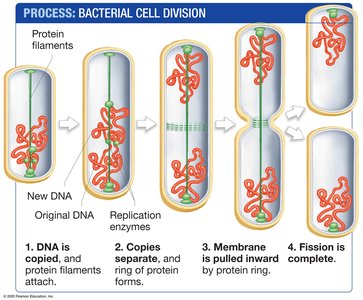
Bacteria divide by binary fission, a process similar to eukaryotic M phase but simpler.
Chromosomes are replicated.
Protein filaments attach and pull chromosomes apart.
Proteins divide the cytoplasm.
Regulation of the Cell Cycle
Cell-Cycle Regulation and Checkpoints
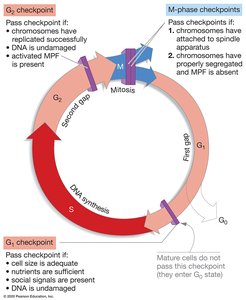
The cell cycle is tightly regulated by checkpoints and protein complexes to ensure proper division and prevent errors.
G1 checkpoint: Checks cell size, nutrients, social signals, and DNA damage.
G2 checkpoint: Ensures DNA replication is complete and undamaged.
M-phase checkpoints: Ensure chromosomes are properly attached and segregated.
Key Regulatory Proteins
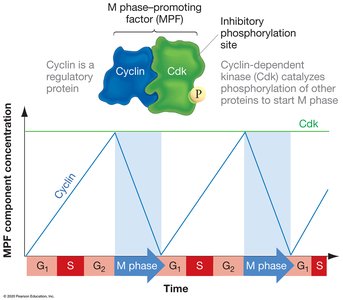
Cell cycle progression is controlled by cyclins and cyclin-dependent kinases (Cdks). The M phase-promoting factor (MPF) is a key complex that drives cells from G2 into M phase.
Cyclin: Regulatory protein whose concentration fluctuates throughout the cell cycle.
Cdk: Protein kinase that catalyzes phosphorylation of target proteins.
MPF: Cyclin-Cdk complex that initiates M phase.
Cancer and Cell Cycle Control
Cancer: Out-of-Control Cell Division
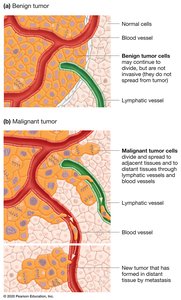
Cancer arises when cell cycle checkpoints fail, leading to uncontrolled cell division and tumor formation. Tumors can be benign (noninvasive) or malignant (invasive and metastatic).
Malignant tumors: Invade tissues and spread via blood or lymph (metastasis).
Benign tumors: Noninvasive and do not spread.
Defects in Cell Cycle Regulation
Cancerous cells often have two types of defects:
Gain-of-function mutations: Activate oncogenic proteins required for cell growth.
Loss-of-function mutations: Inhibit tumor suppressor proteins from shutting down the cell cycle.
G1 Checkpoint and Social Control
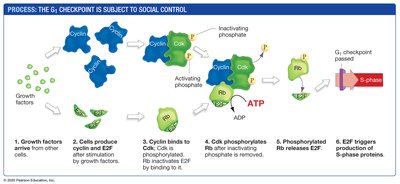
Growth factors stimulate production of regulatory proteins, such as E2F and Rb, which control passage through the G1 checkpoint. Defects in these proteins can lead to uncontrolled division.
E2F: Triggers expression of genes required for S phase.
Rb: Tumor suppressor that binds E2F and keeps cell in G0.
Summary Table: Cell Cycle Checkpoints
Checkpoint | Main Function | Key Factors |
|---|---|---|
G1 | Cell size, nutrients, DNA damage, social signals | p53, Rb, E2F |
G2 | DNA replication completion, DNA integrity | MPF |
M-phase | Chromosome attachment, segregation | Spindle apparatus, separase |
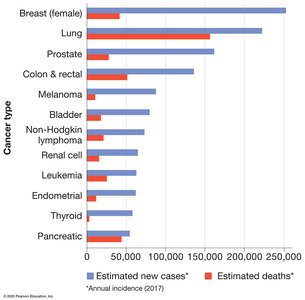
Example: Cancer Incidence
Cancer is a major health concern, with various types affecting different tissues. The failure of cell cycle regulation is a common underlying cause.
Key Terms and Concepts
Cell cycle: Sequence of events from cell formation to division.
Mitosis: Division of the nucleus, producing genetically identical cells.
Cytokinesis: Division of the cytoplasm.
Chromosome: DNA molecule with associated proteins.
Checkpoint: Regulatory point in the cell cycle.
Cancer: Disease caused by uncontrolled cell division.
Equations and Formulas
Cell cycle regulation often involves phosphorylation reactions:
Phosphorylation:
Additional info: The notes include expanded explanations and context for cell cycle regulation, mitosis, and cancer, based on standard General Biology curriculum.
