 Back
Cell Cycle and Mitosis: Structure, Function, and Regulation
Study Guide - Smart Notes
 Tailored notes based on your materials, expanded with key definitions, examples, and context.
Cell Cycle and Mitosis
Key Roles of Cell Division
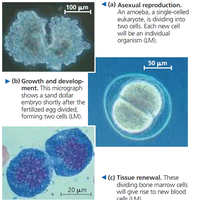
The cell cycle is fundamental for the continuity of life, enabling organisms to grow, develop, and maintain tissues. Cell division results in two genetically identical daughter cells, supporting asexual reproduction, growth, and tissue renewal.
Asexual reproduction: Single-celled eukaryotes (e.g., Amoeba) divide to produce new individuals.
Growth and development: Multicellular organisms grow by increasing cell number.
Tissue renewal: Damaged or dead cells are replaced through division.
Cellular Organization of Genetic Material
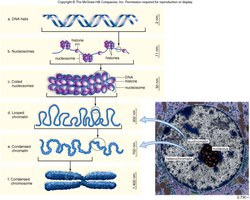
Genetic information is stored in the genome, which consists of DNA organized into chromosomes. Eukaryotic chromosomes are linear and contain both coding (genes) and noncoding regions. DNA is highly condensed and packaged with histone proteins to form chromatin.
Chromatin: Complex of DNA and histones; exists in two forms: heterochromatin (condensed, inactive) and euchromatin (less condensed, active).
Chromosome: Highly condensed chromatin visible during cell division.
Structure of Chromosomes
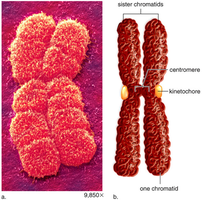
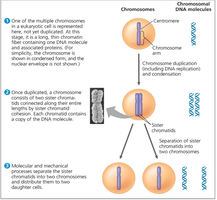
Chromosomes are composed of two sister chromatids joined at a centromere. Key terminology includes:
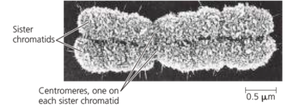
Sister chromatids: Identical copies of a chromosome connected at the centromere.
Centromere: Region where chromatids are joined; site of kinetochore formation.
Kinetochore: Protein structure at the centromere, essential for chromosome movement.
Diploid (2n): Two sets of chromosomes; haploid (n): one set.
Chromosome Duplication and Distribution
During cell division, chromosomes are duplicated and distributed to daughter cells. Each duplicated chromosome consists of two sister chromatids, which are separated during mitosis.
Chromosome duplication: DNA is replicated, forming two sister chromatids.
Distribution: Chromatids are separated, resulting in unduplicated chromosomes in daughter cells.
The Cell Cycle
Phases of the Cell Cycle
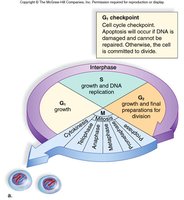
The cell cycle is a repeating series of events divided into five stages: G1, S, G2, Mitosis, and Cytokinesis. Interphase (G1, S, G2) is the period of growth and DNA replication, while the M phase includes mitosis and cytokinesis.
G1 phase: Cell growth and metabolic activity.
S phase: DNA synthesis and replication of chromatids.
G2 phase: Preparation for cell division, synthesis of proteins.
M phase: Division of genetic material (mitosis) and cytoplasm (cytokinesis).
Interphase
Interphase is the longest phase, where the cell grows, replicates DNA, and prepares for division.
G1: Metabolic activity and growth.
S: DNA replication.
G2: Synthesis of proteins and preparation for mitosis.
M Phase: Mitosis and Cytokinesis
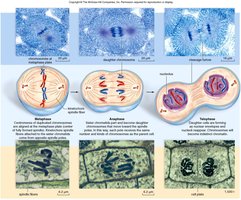
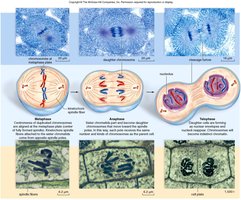
Mitosis is the process of nuclear division, followed by cytokinesis, the division of cytoplasm. Mitosis consists of several stages:
Prophase: Chromatin condenses, nucleolus disappears, spindle forms.
Prometaphase: Nuclear envelope fragments, kinetochores form.
Metaphase: Chromosomes align at the metaphase plate.
Anaphase: Sister chromatids separate and move to opposite poles.
Telophase: Nuclear envelope reforms, chromosomes decondense.
Cytokinesis: Division of cytoplasm; animal cells form a cleavage furrow, plant cells form a cell plate.
Prokaryotic Cell Division: Binary Fission
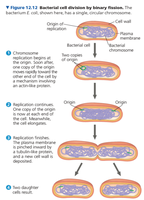
Prokaryotes divide by binary fission, a simpler process than mitosis. The single DNA molecule is replicated, and the cell splits into two daughter cells.
Replication: Chromosome is copied.
Segregation: Copies move to opposite ends.
Division: Plasma membrane pinches, new cell wall forms.
Cell Cycle Regulation and Cancer
Cell Cycle Control
The cell cycle is regulated by checkpoints (G1, G2, M) that ensure proper division. Regulatory proteins such as cyclins and kinases control progression. If DNA is damaged, apoptosis (programmed cell death) may occur.
G1 checkpoint: Most important; cell commits to division or enters non-dividing state (Go phase).
G2 checkpoint: Ensures DNA replication is complete.
M checkpoint: Ensures chromosomes are properly attached to spindle.
Normal Cell Division vs. Cancer
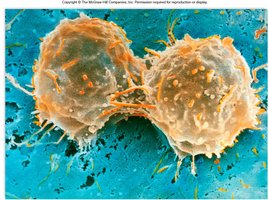
Normal cells exhibit density-dependent inhibition and anchorage dependence. Cancer results from loss of cell cycle control, leading to uncontrolled division and abnormal growth.
Benign tumors: Do not spread; generally not dangerous.
Malignant tumors: Spread (metastasis); dangerous.
Mutations: In proto-oncogenes (become oncogenes) or tumor suppressor genes can cause cancer.
Treatment of Cancer
Cancer treatments include surgery, radiotherapy, and chemotherapy. Chemotherapy targets actively dividing cells, often affecting normal cells and causing side effects. Precision medicine uses genetic testing to select effective drugs.
Surgery: Removal of tumor.
Radiotherapy: Uses radiation to kill cancer cells.
Chemotherapy: Drugs interfere with mitosis (e.g., Taxol).
Precision diagnostics: Personalized medicine based on genetic mutations.
Summary Table: Stages of Mitosis
Stage | Main Event |
|---|---|
Prophase | Chromosomes condense, spindle forms |
Metaphase | Chromosomes align at metaphase plate |
Anaphase | Sister chromatids separate |
Telophase | Nuclear envelope reforms, chromosomes decondense |
Cytokinesis | Division of cytoplasm |
Key Concepts and Equations
Mitosis: One diploid cell (2n) produces two diploid cells (2n); chromosome number remains the same.
Binary fission: Prokaryotic cell division; simpler than mitosis.
Cell cycle regulation: Failure leads to cancer.
Equation for DNA replication:
Equation for mitosis:
Equation for binary fission:
Remember: Mitosis produces genetically identical cells; cancer results from failure of cell cycle regulation and checkpoints.
