 Back
Cell Cycle, Cell Division, and Molecular Regulation in Prokaryotes and Eukaryotes
Study Guide - Smart Notes
 Tailored notes based on your materials, expanded with key definitions, examples, and context.
Prokaryotic Cell Division
Binary Fission in Prokaryotes
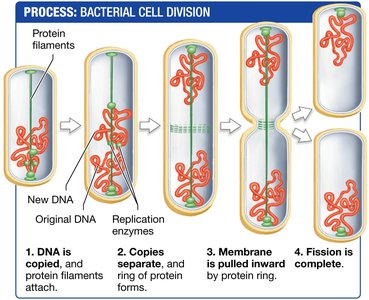
Prokaryotic cells, such as bacteria, reproduce through a process called binary fission. This process is distinct from mitosis and is a simpler mechanism for cell division. - Definition: Binary fission is the process by which a prokaryotic cell divides into two genetically identical daughter cells. - Key Steps: 1. DNA is copied, and protein filaments attach. 2. Copies of DNA separate, and a ring of protein forms. 3. The membrane is pulled inward by the protein ring. 4. Fission is complete, resulting in two cells. - Outcome: Each daughter cell receives a complete copy of the original DNA. 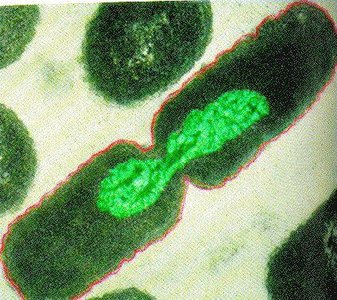
Eukaryotic Cell Cycle
Phases of the Cell Cycle
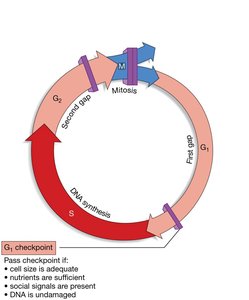
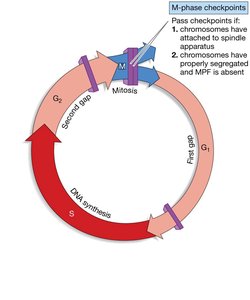
The eukaryotic cell cycle consists of a series of phases that prepare the cell for division and ensure proper replication and distribution of genetic material. - G1 Phase (First Gap): Cell grows and prepares for DNA synthesis. - S Phase (Synthesis): DNA is replicated. - G2 Phase (Second Gap): Cell prepares for mitosis; checks for DNA replication errors. - M Phase (Mitosis): Cell divides its nucleus and cytoplasm, resulting in two daughter cells. 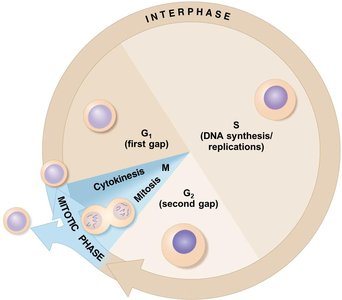
Cell Cycle Regulation and Checkpoints
The cell cycle is tightly regulated by checkpoints that ensure the integrity of the cell's genetic material and proper cell division. - G1 Checkpoint: Ensures cell size is adequate, nutrients are sufficient, and DNA is undamaged. - G2 Checkpoint: Ensures DNA replication is complete and undamaged. - M (Metaphase) Checkpoint: Ensures all chromosomes are properly attached to the spindle apparatus. - G0 Phase: Cells may exit the cycle and enter a quiescent state if conditions are not favorable for division. 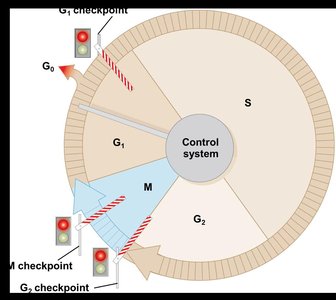
Molecular Regulation of the Cell Cycle
Cyclins and Cyclin-Dependent Kinases (Cdks)
Progression through the cell cycle is controlled by molecular regulators, primarily cyclins and cyclin-dependent kinases (Cdks). - Cyclins: Proteins whose concentration fluctuates throughout the cell cycle. - Cdk: Enzyme that is only active when bound to a cyclin. - Cyclin-Cdk Complex: Drives the cell through different phases by phosphorylating target proteins. 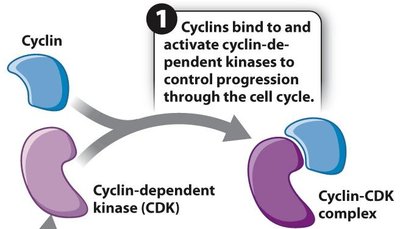
Mitosis-Promoting Factor (MPF)
MPF is a key molecular signal that initiates mitosis in eukaryotic cells. - Structure: MPF is a dimer consisting of a cyclin and a cyclin-dependent kinase. - Function: MPF activates proteins involved in chromosomal condensation and spindle formation. - Regulation: MPF triggers the destruction of its own cyclin, leading to its deactivation via negative feedback. 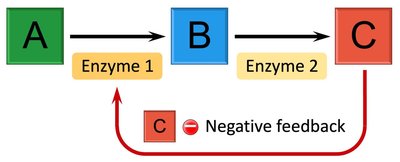
Cancer and Cell Cycle Regulation
Genetic Regulation and Cancer
Uncontrolled cell division can lead to cancer, which is often caused by mutations in genes that regulate the cell cycle. - Proto-oncogenes: Genes that promote cell division. - Tumor Suppressor Genes: Genes that halt cell division. - p53 Protein: Tumor-suppressor protein that can trigger apoptosis if DNA is damaged. - Cancer: Results from mutations in proto-oncogenes or tumor suppressor genes, leading to loss of cell cycle control. 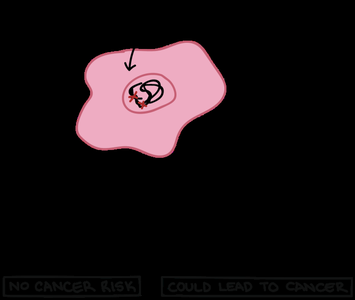
Gene Type | Function | Effect of Mutation |
|---|---|---|
Proto-oncogene | Promotes cell division | Uncontrolled division (cancer risk) |
Tumor suppressor gene | Halts cell division | Loss of control (cancer risk) |
Summary Table: Cell Cycle Checkpoints
Checkpoint | Main Function | Pass Criteria |
|---|---|---|
G1 | Cell growth, DNA integrity | Cell size, nutrients, DNA undamaged |
G2 | DNA replication completion | DNA fully replicated, undamaged |
M | Chromosome attachment | Chromosomes attached to spindle, properly segregated |
Key Equations and Concepts
Phosphorylation by Kinases
- Definition: Phosphorylation is the addition of a phosphate group to a protein, often regulating its activity. - General Equation:
Negative Feedback Regulation
- Concept: Negative feedback occurs when the product of a process inhibits its own production, maintaining balance. - Example: MPF triggers destruction of cyclin, leading to its own inactivation.
Conclusion
Understanding the cell cycle, its regulation, and the consequences of its dysregulation is fundamental to cell biology and the study of diseases such as cancer. The interplay between molecular signals, checkpoints, and genetic regulation ensures proper cell division and organismal health.
