 Back
Cell Cycle Checkpoints and Genetic Code Table – Study Guidance
Study Guide - Smart Notes
 Tailored notes based on your materials, expanded with key definitions, examples, and context.
Q1. Summarize what happens at each cell cycle checkpoint (G1, G2, M) and how it is controlled.
Background
Topic: Cell Cycle Regulation
This question tests your understanding of the cell cycle checkpoints, which are control mechanisms that ensure proper cell division. Each checkpoint (G1, G2, and M) serves a specific purpose in monitoring and regulating the progression of the cell cycle.
Key Terms:
Checkpoint: A control point where the cell cycle can be stopped if conditions are not favorable.
G1 checkpoint: Monitors cell size, nutrients, growth signals, and DNA integrity before DNA replication.
G2 checkpoint: Ensures DNA replication is complete and checks for DNA damage before mitosis.
M checkpoint: Ensures chromosomes are properly attached to the spindle before separation.
Regulatory proteins: Cyclins and cyclin-dependent kinases (CDKs) are key regulators.
Step-by-Step Guidance
Start by identifying the three main checkpoints: G1, G2, and M.
For the G1 checkpoint, consider what the cell needs to check before entering S phase (DNA synthesis). Think about cell size, nutrients, and DNA damage.
For the G2 checkpoint, focus on what must be verified after DNA replication but before mitosis. Consider DNA integrity and completion of replication.
For the M checkpoint, reflect on what needs to happen before the cell divides its chromosomes. This involves checking spindle attachment and chromosome alignment.
For each checkpoint, think about the regulatory molecules involved (cyclins and CDKs) and how the cell responds if something is wrong (e.g., cell cycle arrest, repair mechanisms).
Try solving on your own before revealing the answer!
Final Answer:
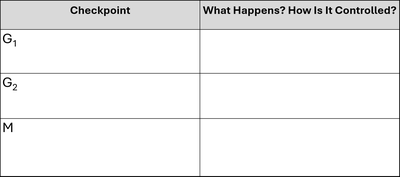
G1 checkpoint: The cell checks for adequate size, nutrients, growth signals, and DNA integrity. If conditions are not met, the cell may enter a resting state (G0) or repair DNA. Controlled by cyclins and CDKs.
G2 checkpoint: The cell verifies that DNA replication is complete and checks for DNA damage. If errors are found, the cell cycle is paused for repair. Controlled by cyclins and CDKs.
M checkpoint: The cell ensures all chromosomes are properly attached to the spindle apparatus before proceeding with chromosome separation. If not, the cell cycle is halted until proper attachment occurs. Controlled by spindle assembly checkpoint proteins.
Each checkpoint prevents the cell from progressing if errors or unfavorable conditions are detected, helping maintain genomic stability.
Q2. Use the genetic code table to translate mRNA sequences and answer questions about codons and amino acids.
Background
Topic: Genetic Code and Translation
This question tests your ability to use the genetic code table to determine which codons specify which amino acids, and to translate mRNA sequences into polypeptides.
Key Terms and Concepts:
Codon: A sequence of three mRNA nucleotides that codes for a specific amino acid.
Start codon: AUG (codes for methionine, signals start of translation).
Stop codons: UAA, UAG, UGA (signal end of translation).
Redundancy: Multiple codons can code for the same amino acid.
Step-by-Step Guidance
Identify the mRNA sequence you need to translate. Break it into codons (groups of three nucleotides).
Use the genetic code table to match each codon to its corresponding amino acid. Start with the first codon and proceed sequentially.
Look for the start codon (AUG) to begin translation, and stop codons (UAA, UAG, UGA) to end translation.
Note that some amino acids are specified by multiple codons (redundancy), and some codons do not code for amino acids (stop codons).
Write out the amino acid sequence, but stop before the final step of listing the complete sequence.
Try solving on your own before revealing the answer!
Final Answer:
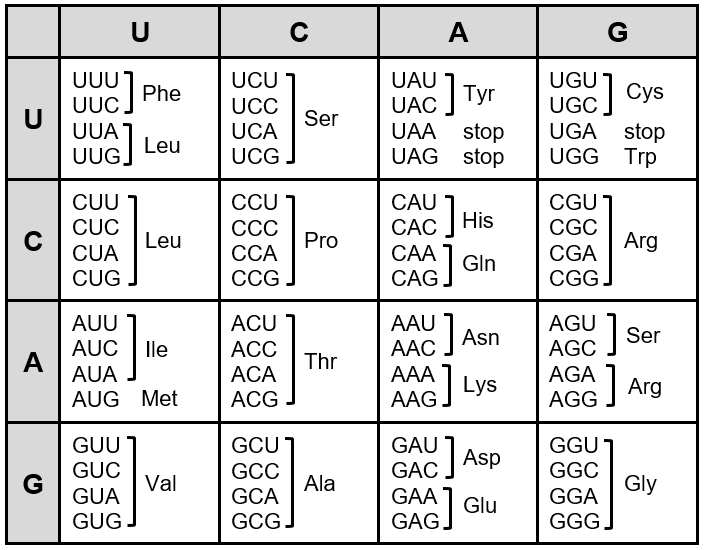
To translate an mRNA sequence, break it into codons and use the genetic code table to determine the amino acid for each codon. For example, the mRNA sequence AUG UGG GCU UGG codes for Met-Trp-Ala-Trp. The genetic code table shows that:
AUG = Met (start)
UGG = Trp
GCU = Ala
UGG = Trp
Redundancy means multiple codons can code for the same amino acid, and stop codons signal the end of translation.
