 Back
Cell Cycle Checkpoints: What Happens and How Are They Controlled?
Study Guide - Smart Notes
 Tailored notes based on your materials, expanded with key definitions, examples, and context.
Q1. Summarize what happens at each cell cycle checkpoint (G1, G2, M) and how each is controlled.
Background
Topic: Cell Cycle Regulation and Checkpoints
This question tests your understanding of the cell cycle checkpoints, which are critical control mechanisms that ensure proper cell division. Each checkpoint (G1, G2, and M) serves as a quality control step to prevent errors such as DNA damage or incomplete replication from being passed on to daughter cells.
Key Terms and Concepts:
Checkpoint: A control point in the cell cycle where stop and go-ahead signals regulate the cycle.
G1 Checkpoint: Occurs before DNA replication; checks for cell size, nutrients, growth signals, and DNA integrity.
G2 Checkpoint: Occurs after DNA replication; checks for DNA damage and completeness of replication.
M Checkpoint: Occurs during mitosis; ensures chromosomes are properly attached to the spindle before separation.
Regulatory Proteins: Cyclins and cyclin-dependent kinases (CDKs) are key regulators of checkpoint control.
Step-by-Step Guidance
Start by identifying the three main checkpoints: G1, G2, and M.
For the G1 checkpoint, consider what the cell needs to check before committing to DNA replication. Think about cell size, nutrient availability, and DNA integrity.
For the G2 checkpoint, focus on what must be verified after DNA replication but before mitosis. Consider whether the DNA has been fully replicated and if there is any DNA damage.
For the M checkpoint, reflect on what needs to happen before the cell divides. This involves checking that all chromosomes are properly attached to the mitotic spindle.
For each checkpoint, think about the molecular signals (such as cyclins and CDKs) that control progression. If problems are detected, the cell cycle is halted for repairs or, if necessary, the cell may undergo apoptosis.
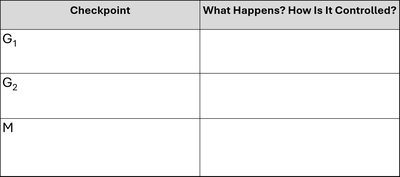
Fill in the table by summarizing what happens at each checkpoint and how it is controlled, but stop before writing the full details for each checkpoint.
Try solving on your own before revealing the answer!
Final Answer:
Checkpoint | What Happens? How Is It Controlled? |
|---|---|
G1 | Cell checks for size, nutrients, growth signals, and DNA damage. Controlled by cyclins and CDKs; if conditions are not met, cell cycle is halted. |
G2 | Cell checks for DNA replication completeness and DNA damage. Controlled by cyclins and CDKs; cell cycle pauses for repair if needed. |
M | Cell checks that all chromosomes are properly attached to the spindle. Controlled by spindle assembly checkpoint proteins; prevents chromosome mis-segregation. |
Each checkpoint ensures the cell is ready to proceed to the next phase, preventing errors that could lead to cell malfunction or disease.
