 Back
Cell Cycle, Chromosomes, and Mitosis: Structured Study Notes
Study Guide - Smart Notes
 Tailored notes based on your materials, expanded with key definitions, examples, and context.
Cell Cycle: Chromosomes and Mitosis
Introduction to Cell Division
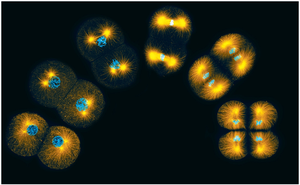
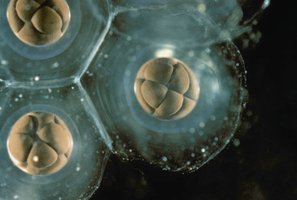
Cell division is a fundamental process in biology, essential for growth, asexual reproduction, and tissue repair in multicellular organisms. The cell cycle encompasses the sequence of events that cells undergo to duplicate their contents and divide into two daughter cells.
Growth: Cell division increases the number of cells, enabling organismal growth.
Asexual Reproduction: Many organisms reproduce by dividing a single cell into two genetically identical offspring.
Repair and Regeneration: Damaged tissues are repaired by replacing lost or injured cells through division.
Asexual Reproduction in Prokaryotes: Binary Fission
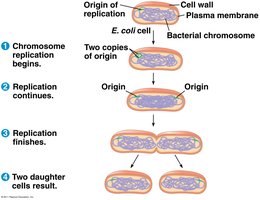
Prokaryotes, such as bacteria, reproduce asexually through binary fission. This process involves the replication of the bacterial chromosome and division of the cell into two genetically identical daughter cells.
Chromosome Replication: The single, circular chromosome is copied.
Cell Division: The cell elongates and splits, distributing one chromosome to each daughter cell.
Result: Two genetically identical cells are produced.
Chromosomes in Eukaryotes
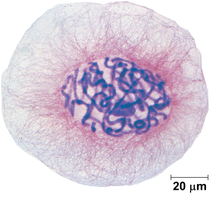
In eukaryotic cells, DNA is organized as chromatin within the nucleus. Chromatin consists of DNA associated with structural proteins. Prior to cell division, chromatin condenses to form visible chromosomes.
Chromatin: DNA-protein complex in the nucleus; diffuse and not visible under light microscopy during interphase.
Chromosome Number: Each somatic cell contains a species-specific number of chromosomes.
Structure of a Eukaryotic Chromosome
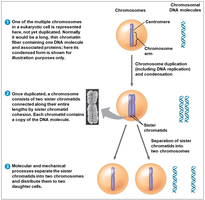
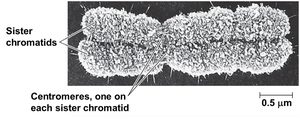
Before cell division, each chromosome is duplicated, resulting in two sister chromatids joined at the centromere. Sister chromatids are identical DNA molecules.
Duplicated Chromosome: X-shaped structure composed of two sister chromatids.
Centromere: Region where sister chromatids are joined.
Separation: During mitosis, sister chromatids are separated into daughter cells.
The Cell Cycle
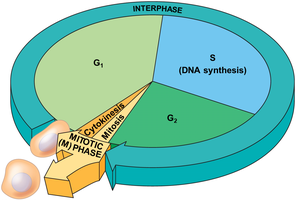
The cell cycle is divided into interphase and the mitotic (M) phase. Interphase consists of G1, S, and G2 subphases, during which the cell grows and DNA is replicated. The M phase includes mitosis and cytokinesis.
G1 Phase: Cell growth and preparation for DNA replication.
S Phase: DNA synthesis and replication.
G2 Phase: Further growth and preparation for mitosis.
M Phase: Division of the nucleus (mitosis) and cytoplasm (cytokinesis).
DNA Replication
DNA replication occurs during the S phase of interphase. Each DNA molecule is copied, ensuring that each daughter cell receives a complete set of genetic information.
Replication: The process by which DNA is duplicated.
Result: Two identical DNA molecules (sister chromatids) per chromosome.
Stages of Mitotic (M) Phase
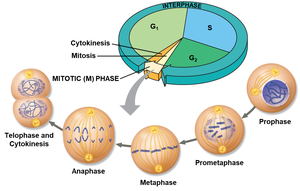
Mitosis is the process by which a eukaryotic cell divides its nucleus and distributes duplicated chromosomes to two daughter cells. It consists of several distinct stages:
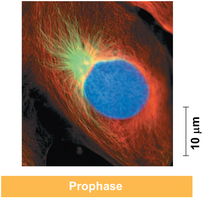
Prophase: Chromosomes condense; mitotic spindle forms.
Prometaphase: Spindle fibers attach to kinetochores; nuclear envelope breaks down.
Metaphase: Chromosomes align at the metaphase plate.
Anaphase: Sister chromatids separate and move to opposite poles; cell elongates.
Telophase: Nuclear envelopes reform; chromosomes decondense; cytokinesis nearly complete.
Interphase
Interphase is the period between cell divisions, comprising G1, S, and G2 phases. During interphase, chromosomes are in the form of chromatin and are not visible under a light microscope.
Cell Growth: Occurs in G1 and G2 phases.
DNA Replication: Occurs in S phase.
Chromosome Condensation
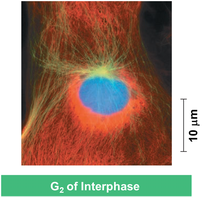
Chromosomes become highly condensed and visible under a microscope as the cell enters mitosis. This condensation is essential for accurate chromosome segregation.
Definitions of Mitotic Stages
Each stage of mitosis is characterized by specific events:
Prophase: Chromosomes condense; spindle forms.
Prometaphase: Spindle fibers attach; nuclear envelope disappears.
Metaphase: Chromosomes align at the cell's equator.
Anaphase: Sister chromatids separate; cell elongates.
Telophase: Nuclear envelopes reform; chromosomes uncoil.
Cytokinesis
Cytokinesis is the division of the cytoplasm, resulting in two daughter cells. The mechanism differs between animal and plant cells:
Animal Cells: Cytokinesis occurs via cleavage furrow.
Plant Cells: Cytokinesis occurs via cell plate formation.
Summary Table: Key Features of Mitosis
Stage | Main Event |
|---|---|
Prophase | Chromosomes condense, spindle forms |
Prometaphase | Spindle fibers attach, nuclear envelope disappears |
Metaphase | Chromosomes align at metaphase plate |
Anaphase | Sister chromatids separate, cell elongates |
Telophase | Nuclear envelopes reform, chromosomes uncoil |
Cytokinesis | Division of cytoplasm |
Additional info:
Species-specific chromosome number is a fundamental concept in genetics and cell biology.
Mitotic spindle is composed of microtubules and is essential for chromosome movement.
Cell cycle checkpoints ensure proper progression and fidelity of cell division.
Errors in mitosis can lead to aneuploidy and are implicated in cancer.
