 Back
Cell Cycle, DNA, and Gene Expression: Study Guide for General Biology
Study Guide - Smart Notes
 Tailored notes based on your materials, expanded with key definitions, examples, and context.
Cell Cycle and Mitosis
Purposes of Cell Division
Cell division is a fundamental process in all living organisms, allowing for growth, repair, reproduction, and maintenance of tissues. In prokaryotes, cell division primarily serves for reproduction, while in eukaryotes, it supports growth, tissue repair, and development.
Prokaryotes: Divide by binary fission to produce genetically identical offspring.
Eukaryotes: Undergo mitosis for growth and repair, and meiosis for sexual reproduction.
Stages of Mitosis
Mitosis is the process by which a eukaryotic cell separates its duplicated chromosomes into two identical sets. The stages include:
Prophase: Chromosomes condense, spindle fibers form.
Metaphase: Chromosomes align at the cell's equator.
Anaphase: Sister chromatids separate and move to opposite poles.
Telophase: Nuclear envelopes reform around each set of chromosomes.
Cytokinesis: Division of the cytoplasm, resulting in two daughter cells.
Cell Cycle Checkpoints
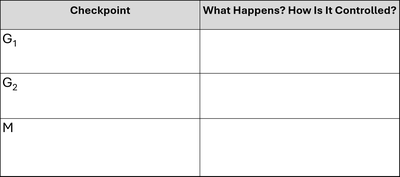
Checkpoints are regulatory points in the cell cycle that ensure proper division and prevent errors. The three main checkpoints are G1, G2, and M.
Checkpoint | What Happens? How Is It Controlled? |
|---|---|
G1 | Checks for cell size, nutrients, growth factors, and DNA damage. If conditions are not met, the cell may enter G0 (a non-dividing state). Controlled by cyclins and cyclin-dependent kinases (CDKs). |
G2 | Ensures DNA replication is complete and checks for DNA damage. If errors are detected, the cell cycle is paused for repair. Controlled by cyclin B/CDK1 complex. |
M | Checks that all chromosomes are properly attached to the spindle apparatus before anaphase begins. Prevents chromosome missegregation. Controlled by the spindle assembly checkpoint. |
DNA Structure, Replication, and Repair
DNA as the Genetic Material
DNA was identified as the genetic material through experiments such as those by Griffith, Avery, MacLeod, and McCarty, and Hershey-Chase. These experiments demonstrated that DNA, not protein, carries genetic information.
Key Evidence: Only DNA could transform non-virulent bacteria into virulent forms.
Structure: DNA is a double helix composed of nucleotides (phosphate, deoxyribose sugar, nitrogenous base).
DNA and RNA: Structure and Differences
DNA: Double-stranded, deoxyribose sugar, bases A, T, C, G.
RNA: Single-stranded, ribose sugar, bases A, U, C, G.
Base Pairing and Strand Directionality
DNA strands have directionality (5' to 3'). Complementary base pairing (A-T, G-C) allows for accurate replication. The number of hydrogen bonds differs: A-T pairs have 2, G-C pairs have 3, making G-C rich DNA more stable.
DNA Replication
Enzymes: DNA helicase unwinds the helix, DNA polymerase synthesizes new strands, DNA ligase joins fragments.
Leading vs. Lagging Strand: Leading strand synthesized continuously; lagging strand synthesized in Okazaki fragments.
Direction: DNA polymerase adds nucleotides in the 5' to 3' direction.
Genetic Code and Gene Expression
Properties of the Genetic Code
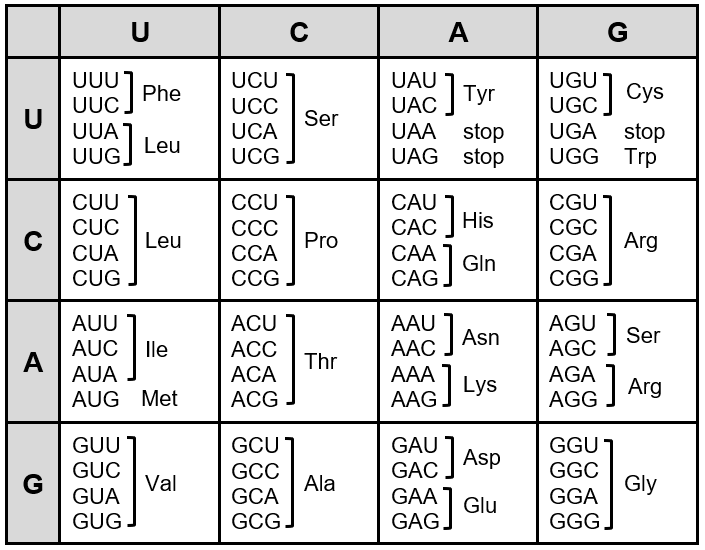
The genetic code is the set of rules by which nucleotide sequences are translated into amino acid sequences. It is:
Redundant: Multiple codons can specify the same amino acid.
Unambiguous: Each codon specifies only one amino acid.
Non-overlapping: Codons are read one after another, without overlap.
Transcription and Translation
Gene expression involves two main processes:
Transcription: DNA is transcribed into mRNA by RNA polymerase. In eukaryotes, mRNA is processed (capping, poly-A tail, splicing).
Translation: mRNA is translated into a polypeptide chain at the ribosome, using tRNAs and the genetic code.
Mutations and Their Effects
Missense Mutation: Changes one amino acid in the protein.
Nonsense Mutation: Introduces a premature stop codon.
Silent Mutation: Does not change the amino acid sequence due to redundancy in the genetic code.
Frameshift Mutation: Addition or deletion of nucleotides alters the reading frame, usually resulting in a nonfunctional protein.
Comparison Table: DNA Replication vs. Transcription
Feature | DNA Replication | Transcription |
|---|---|---|
Template | Both strands used | One strand (template strand) |
Product | DNA | RNA |
Enzyme | DNA polymerase | RNA polymerase |
Direction | 5' to 3' | 5' to 3' |
Primer Required? | Yes | No |
Location (Eukaryotes) | Nucleus | Nucleus |
Key Equations and Concepts
Chargaff's Rule: In double-stranded DNA, %A = %T and %G = %C.
Central Dogma:
Transcription:
Translation:
Summary
Understanding the cell cycle, DNA structure and replication, the genetic code, and gene expression is essential for success in General Biology. Practice applying these concepts to new scenarios, interpreting experimental data, and predicting the effects of mutations on gene expression and protein function.
