 Back
BackCell Cycle, DNA Structure, and Chromosome Organization
Study Guide - Smart Notes
 Tailored notes based on your materials, expanded with key definitions, examples, and context.
Cell Cycle and Cell Growth
Overview of Cell Growth
Cell growth and reproduction are fundamental characteristics of living organisms. In humans, cell replication begins with fertilization and continues throughout development, childhood, and adolescence. The process of creating new cells from existing cells is central to the cell theory.
Cell Cycle: The sequence of events that cells undergo for growth and division, typically lasting 18–24 hours in actively dividing cells.
Continuous Replication: By birth, humans have over 10 trillion cells, with replication continuing through life.
The Cell Cycle: Phases and Processes
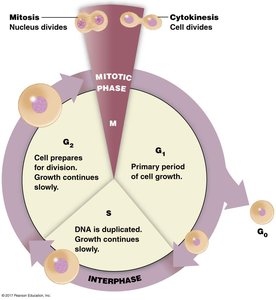
The cell cycle consists of two main phases: Interphase and the Mitotic Phase. Interphase is further subdivided into G1, S, and G2 phases, while the Mitotic Phase includes mitosis and cytokinesis.
Interphase: Period of cell growth and DNA duplication. Subdivided into:
G1 Phase: Primary period of cell growth after division; cell is at its smallest size and grows rapidly (6–9 hours).
S Phase: Synthesis phase; DNA replication occurs, chromosomes are duplicated, growth slows (7–8 hours).
G2 Phase: Second gap phase; cell continues to grow and prepares for division (6–9 hours).
G0 Phase: Non-dividing, non-growing stage; many cells enter this phase permanently (e.g., neurons, osteocytes).
Mitotic Phase: Much shorter (30–45 minutes); includes:
Mitosis: Division of the nucleus and duplicated DNA into two sets.
Cytokinesis: Division of the cytoplasm, forming two new cells.
DNA Structure and Chromosome Organization
DNA: The Genetic Material
DNA (deoxyribonucleic acid) is the hereditary material found in the nucleus of every cell. It consists of 3 billion pairs of nucleotides, forming a double helix. The nucleotides pair as A-T and C-G, known as base pairs.
Base Pairs: The fundamental units of DNA, forming the genetic code.
Chromosomes: DNA is organized into chromosomes for efficient storage and management within the nucleus.
Chromosome Numbers in Different Species
Humans: 46 chromosomes (23 pairs)
Blue Whale: 44 chromosomes (22 pairs)
Fruit Fly: 8 chromosomes (4 pairs)
Chromatin and Histones
During interphase, chromosomes are not visible under a microscope. Instead, DNA exists as chromatin, a long, thin material. Chromatin contains proteins called histones, which act as spools for DNA, keeping it compacted and organized.
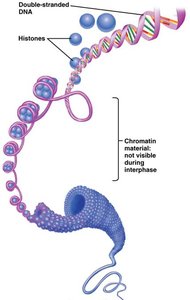
Chromatin: DNA-protein complex that is not visible during interphase.
Histones: Proteins that help package DNA into chromatin.
Chromosomes During Mitosis
Before nuclear division, chromosomes condense and become visible. Each chromosome consists of two identical sister chromatids held together by a centromere.
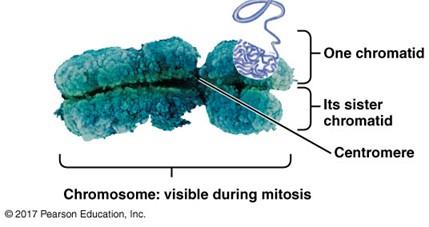
Sister Chromatids: Identical copies of a chromosome, joined at the centromere.
Centromere: The region where chromatids are attached.
Genes: Functional Units of DNA
Definition and Role of Genes
A gene is a short segment of DNA that contains the code for making one or more proteins. Genes are the smallest functional units of DNA and are located at specific positions on chromosomes.
Number of Genes: Humans have approximately 20,000–21,000 genes distributed across 46 chromosomes.
Gene Location: Each gene occupies a unique locus on a chromosome.
Summary Table: Cell Cycle Phases
Phase | Main Event | Duration |
|---|---|---|
G1 | Cell growth | 6–9 hours |
S | DNA replication | 7–8 hours |
G2 | Preparation for division | 6–9 hours |
Mitotic Phase | Nucleus and cytoplasm divide | 30–45 minutes |
G0 | Non-dividing stage | Variable |
Key Equations and Concepts
DNA Base Pairing:
Chromosome Number:
References
Johnson, M.D. (2017). Human biology: Concepts and current issues (8th ed). Pearson Education Inc.
