 Back
Cell Cycle, Mitosis, and Cancer: Principles of Eukaryotic Cell Division
Study Guide - Smart Notes
 Tailored notes based on your materials, expanded with key definitions, examples, and context.
Cell Cycle, Mitosis, and Cancer
Key Learning Outcomes
This section introduces the fundamental concepts of cell division, the organization of genetic material, and the regulation of the cell cycle, with a focus on the implications for cancer biology.
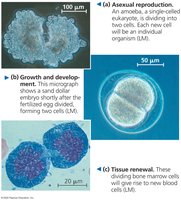
Why Cell Division?
Reproduction: Cell division enables organisms to reproduce asexually or sexually, ensuring the continuation of species.
Growth and Development: Multicellular organisms grow and develop from a single cell through repeated cell divisions.
Tissue Renewal: Cell division replaces old, damaged, or dead cells, maintaining tissue health.
Cellular Organization of Genetic Information
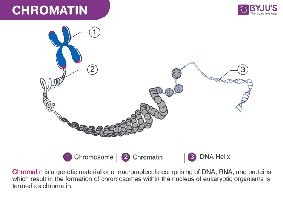
Genetic information is organized into structures called chromosomes, which are composed of chromatin—a complex of DNA and proteins. Chromatin condenses to form visible chromosomes during cell division.
Somatic Cells vs. Gametic Cells
Somatic Cells: All body cells except reproductive cells; diploid (2n), containing two sets of chromosomes.
Gametic Cells: Reproductive cells (sperm and egg); haploid (n), containing one set of chromosomes.
Chromosome Number & Ploidy
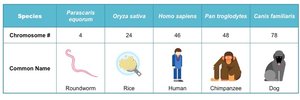
Different species have characteristic chromosome numbers. Ploidy refers to the number of sets of chromosomes in a cell.
Species | Chromosome # | Common Name |
|---|---|---|
Parasitic equorum | 4 | Roundworm |
Oryza sativa | 24 | Rice |
Homo sapiens | 46 | Human |
Pan troglodytes | 48 | Chimpanzee |
Canis familiaris | 78 | Dog |
Polyploidy in Plants
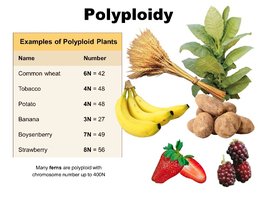
Many plants are polyploids, meaning they have more than two sets of chromosomes. Polyploidy can result in increased size and vigor.
Name | Ploidy | Chromosome Number |
|---|---|---|
Common wheat | 6N | 42 |
Tobacco | 4N | 48 |
Potato | 4N | 48 |
Banana | 3N | 27 |
Boysenberry | 7N | 49 |
Strawberry | 8N | 56 |
Chromosome Duplication and Structure
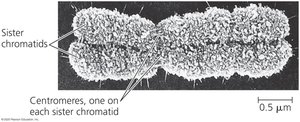
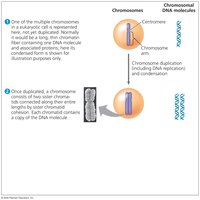
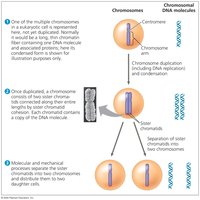
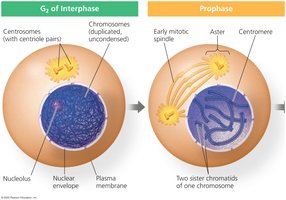
Before a cell divides, its chromosomes must be duplicated. Each duplicated chromosome consists of two sister chromatids joined at a centromere.
The Cell Cycle
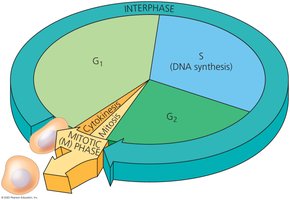
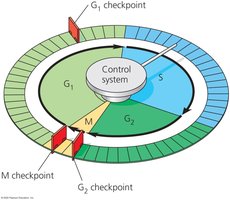
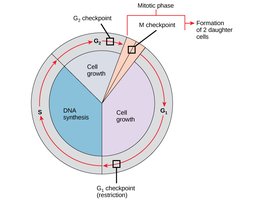
The cell cycle is the ordered sequence of events that a cell goes through to divide and produce two daughter cells. It consists of interphase (G1, S, G2) and the mitotic (M) phase.
G1 phase: Cell growth
S phase: DNA synthesis (replication)
G2 phase: Preparation for mitosis
M phase: Mitosis and cytokinesis
Phases of Mitosis
Mitosis is divided into several stages: prophase, prometaphase, metaphase, anaphase, and telophase, followed by cytokinesis.
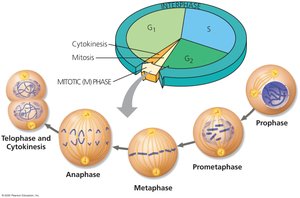
Prophase: Chromosomes condense, spindle apparatus forms.
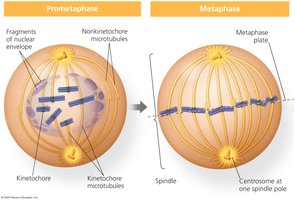
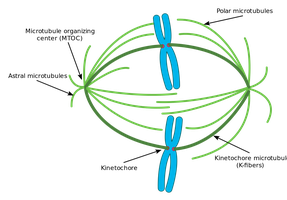
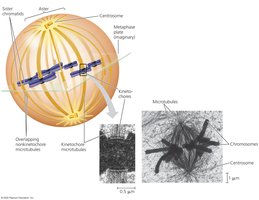
Prometaphase: Nuclear envelope breaks down, spindle fibers attach to kinetochores.
Metaphase: Chromosomes align at the metaphase plate.
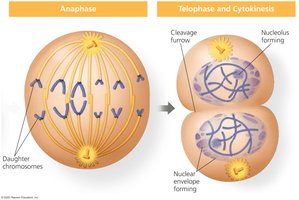
Anaphase: Sister chromatids separate and move to opposite poles.
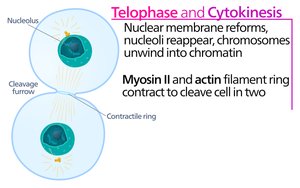
Telophase: Nuclear envelopes reform, chromosomes decondense.
Cytokinesis: Division of the cytoplasm, forming two daughter cells.
Mitotic Spindle and Chromosome Movement
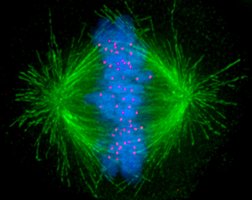
The mitotic spindle is a structure made of microtubules that segregates chromosomes during mitosis. Kinetochores are protein complexes on chromosomes where spindle fibers attach.
Cytokinesis
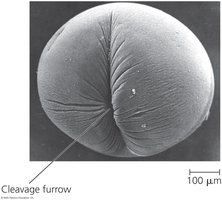
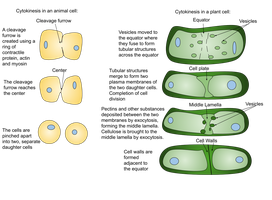
Cytokinesis is the process of dividing the cytoplasm to form two separate daughter cells. In animal cells, this occurs via a cleavage furrow; in plant cells, a cell plate forms.
Bacterial Cell Division (Binary Fission)
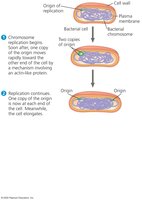
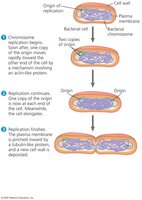
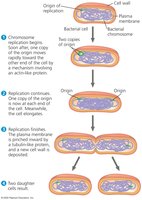
Bacteria divide by binary fission, a simpler process than mitosis. The single, circular chromosome replicates, and the cell splits into two genetically identical daughter cells.
Early Eukaryotic Cell Division
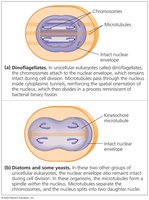
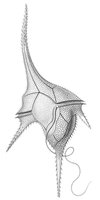
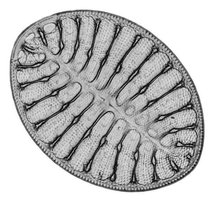
Some unicellular eukaryotes, such as dinoflagellates and diatoms, have unique mechanisms of cell division that differ from typical mitosis in multicellular eukaryotes.
Cell Cycle Regulation
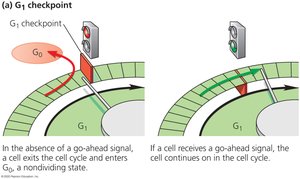
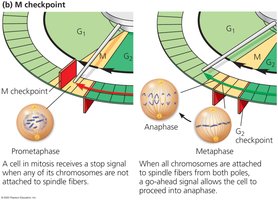
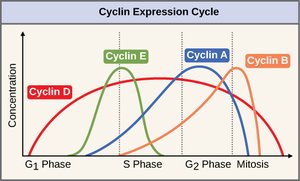
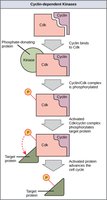
The cell cycle is tightly regulated by checkpoints (G1, G2, M) that ensure proper division. Regulatory proteins such as cyclins and cyclin-dependent kinases (Cdks) control progression through the cycle.
Positive Regulation: Cyclins and Cdks
Cyclins: Proteins whose concentrations fluctuate throughout the cell cycle.
Cyclin-dependent kinases (Cdks): Enzymes that, when bound to cyclins, phosphorylate target proteins to drive cell cycle progression.
Negative Regulation: Tumor Suppressors
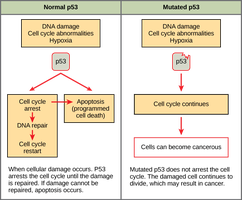
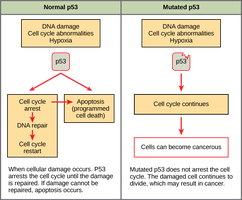
Negative regulators, such as the p53 protein, halt the cell cycle in response to DNA damage or other problems, preventing the propagation of errors.
Breakdown of Cell Cycle Regulation and Cancer
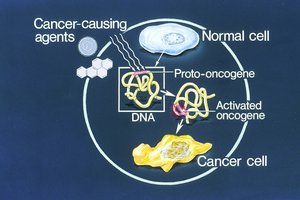
When cell cycle regulation fails, cells may divide uncontrollably, leading to cancer. Tumor suppressors (negative regulators) and proto-oncogenes (positive regulators) are key players in this process.
Tumor Suppressors: Genes that inhibit cell division; mutations can lead to loss of control.
Proto-Oncogenes: Genes that promote cell division; when mutated, they become oncogenes and drive cancer.
Metastasis and Cancer Biology
Cancer cells can invade other tissues and spread throughout the body (metastasis). Studying cancer cells, such as HeLa cells, has provided insights into cell cycle regulation and cancer biology.
Comparison of Asexual and Sexual Reproduction
Asexual Reproduction: Single parent produces genetically identical offspring (clones).
Sexual Reproduction: Two parents produce offspring with unique genetic combinations.
Inheritance of Genes and Chromosome Sets
Human somatic cells have 23 pairs of chromosomes (46 total), including autosomes and sex chromosomes (XX or XY). Each pair consists of homologous chromosomes, one from each parent.
Behavior of Chromosome Sets in the Human Life Cycle
Fertilization: Union of gametes forms a diploid zygote.
Somatic Cells: Produced by mitosis from the zygote.
Meiosis and Genetic Variation
Meiosis reduces chromosome number from diploid to haploid, producing four genetically unique gametes. It consists of two divisions: meiosis I and meiosis II.
Crossing Over: Exchange of genetic material between homologous chromosomes during prophase I.
Independent Assortment: Random orientation of homologous pairs during metaphase I.
Random Fertilization: Any sperm can fertilize any egg, increasing genetic diversity.
Summary
Cell division is essential for reproduction, growth, and tissue maintenance.
The cell cycle is regulated by checkpoints and proteins such as cyclins, Cdks, and tumor suppressors.
Disruption of cell cycle regulation can lead to cancer.
Meiosis and sexual reproduction generate genetic diversity through independent assortment, crossing over, and random fertilization.
