 Back
BackCell Cycle, Mitosis, and Meiosis: Structure, Function, and Regulation
Study Guide - Smart Notes
 Tailored notes based on your materials, expanded with key definitions, examples, and context.
Cell Division and the Cell Cycle
Introduction to Cell Division
Cell division is a fundamental process in biology, responsible for growth, repair, and reproduction in living organisms. It results in the formation of genetically identical daughter cells in mitosis, or genetically diverse gametes in meiosis.
Binary fission occurs in prokaryotes, producing two identical cells.
Mitosis is the process by which eukaryotic somatic cells divide.
Meiosis is the process by which gametes (egg and sperm) are produced, reducing chromosome number by half.
Genetic Material and Chromosome Structure
Genome, Chromatin, and Chromosomes
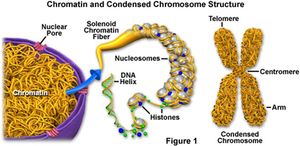
The genome is the complete set of DNA in a cell. In eukaryotes, DNA is packaged with proteins called histones to form chromatin, which condenses into chromosomes during cell division.
Somatic cells contain two sets of chromosomes (diploid, 2n).
Chromosome number varies by species (e.g., humans have 46, cabbages have 18).
Chromosome Terminology
Chromatid: A single DNA molecule wrapped around histones, with one centromere.
Sister chromatids: Two identical DNA molecules joined at a single centromere, formed after DNA replication.
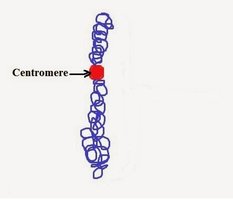
Centromere: The region where sister chromatids are joined and spindle fibers attach during division.
Homologous Chromosomes
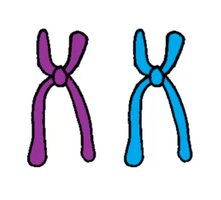
Homologous chromosomes are pairs of chromosomes (one from each parent) that are similar in length, gene position, and centromere location. They carry the same genes but may have different alleles.
The Eukaryotic Cell Cycle
Phases of the Cell Cycle
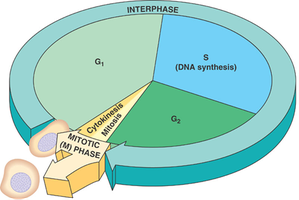
The eukaryotic cell cycle consists of interphase (G1, S, G2) and the mitotic (M) phase. Interphase is a period of cell growth and DNA replication, while the M phase includes mitosis and cytokinesis.
G1 phase: Cell growth and normal metabolic roles.
S phase: DNA synthesis (replication).
G2 phase: Preparation for mitosis, further growth, and protein synthesis.
M phase: Mitosis and cytokinesis.
Cell Cycle Checkpoints
Checkpoints are regulatory points that ensure the cell is ready to proceed to the next stage. They help prevent errors such as DNA damage or incomplete replication.
G1 checkpoint: Checks for cell size, nutrients, and DNA integrity.
G2 checkpoint: Ensures DNA replication is complete and checks for DNA damage.
M checkpoint: Ensures all chromosomes are properly attached to the spindle apparatus before anaphase.
If checkpoints fail, uncontrolled cell division can occur, leading to cancer.
Mitosis
Overview of Mitosis
Mitosis is the process by which a eukaryotic cell divides its chromosomes equally between two daughter cells. It is essential for growth, repair, and asexual reproduction.
Spindle fibers (microtubules) attach to chromosomes at the kinetochores and help segregate them.
Animal cells use centrosomes as spindle origins; plant cells organize spindles differently.
Phases of Mitosis
Prophase: Chromosomes condense, spindle fibers form, and centrosomes move to opposite poles.
Prometaphase: Nuclear envelope breaks down, spindle fibers attach to kinetochores.
Metaphase: Chromosomes align at the metaphase plate.
Anaphase: Sister chromatids separate and move to opposite poles.
Telophase: Chromosomes decondense, nuclear envelope reforms.
Cytokinesis: Division of the cytoplasm, forming two daughter cells.
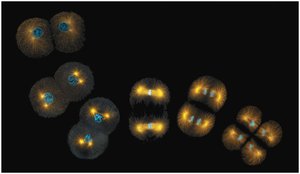
Cytokinesis
Cytokinesis differs between plant and animal cells:
Animal cells: Microfilaments pinch the cytoplasm (cleavage furrow).
Plant cells: A cell plate forms, leading to a new cell wall between daughter cells.
Binary Fission in Prokaryotes
Binary Fission
Prokaryotes such as bacteria divide by binary fission, a simpler process than mitosis. The single, circular DNA molecule is replicated, and the cell splits into two identical cells.
Meiosis and Sexual Life Cycles
Introduction to Meiosis
Meiosis is the process by which diploid cells produce haploid gametes (egg and sperm), ensuring genetic diversity and maintaining chromosome number across generations.
Meiosis I: Homologous chromosomes separate, reducing chromosome number by half.
Meiosis II: Sister chromatids separate, similar to mitosis.
Homologous Chromosomes and Genetic Variation
Homologous chromosomes pair up during meiosis, allowing for crossing over and independent assortment, which increase genetic variation in offspring.
Phases of Meiosis
Meiosis I: Prophase I (crossing over), Metaphase I (homologous pairs align), Anaphase I (homologs separate), Telophase I & Cytokinesis.
Meiosis II: Prophase II, Metaphase II, Anaphase II (sister chromatids separate), Telophase II & Cytokinesis.
Genetic Variation Mechanisms
Crossing over: Exchange of genetic material between homologous chromosomes during Prophase I.
Independent assortment: Random alignment of homologous pairs during Metaphase I.
Random fertilization: Any sperm can fertilize any egg, further increasing variation.
Comparison of Mitosis and Meiosis
Key Differences
Feature | Mitosis | Meiosis |
|---|---|---|
Number of divisions | 1 | 2 |
Number of daughter cells | 2 | 4 |
Genetic composition | Identical | Genetically diverse |
Chromosome number | Diploid (2n) | Haploid (n) |
Role | Growth, repair, asexual reproduction | Sexual reproduction |
Summary
Cell division is essential for life, enabling growth, repair, and reproduction.
Mitosis produces genetically identical cells; meiosis produces genetically diverse gametes.
Checkpoints regulate the cell cycle, preventing errors and uncontrolled growth.
Genetic variation is crucial for evolution and adaptation.
