 Back
Cell Cycle, Mitosis, and Sexual Life Cycles: Study Notes for General Biology
Study Guide - Smart Notes
 Tailored notes based on your materials, expanded with key definitions, examples, and context.
The Cell Cycle and Cell Division
Overview of Cell Division
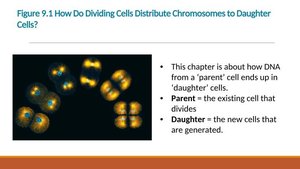
Cell division is a fundamental process by which cells reproduce, enabling growth, development, and tissue repair in multicellular organisms. It ensures the continuity of life by passing genetic material from parent cells to daughter cells.
Cell division produces more cells, distinguishing living organisms from nonliving matter.
Parent cells divide to generate daughter cells, each inheriting genetic material.
Phases of the Cell Cycle
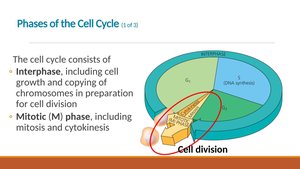
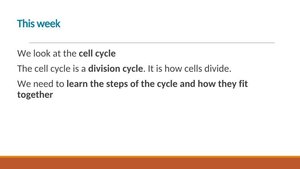
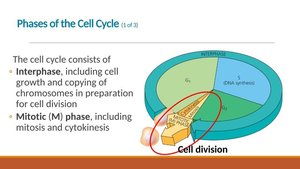
The cell cycle is the sequence of events that a cell undergoes to divide and produce new cells. It consists of interphase and the mitotic (M) phase.
Interphase: Cell growth and chromosome copying (includes G1, S, and G2 phases).
Mitotic (M) phase: Includes mitosis (division of chromosomes) and cytokinesis (division of the cytoplasm).
Cell Cycle Summary
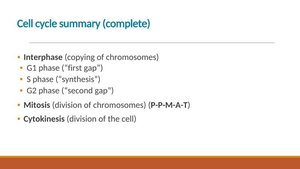
G1 phase: First gap, cell grows.
S phase: Synthesis, DNA is replicated.
G2 phase: Second gap, cell prepares for division.
Mitosis: Division of chromosomes (P-P-M-A-T: Prophase, Prometaphase, Metaphase, Anaphase, Telophase).
Cytokinesis: Division of the cell.
Cellular Organization of Genetic Material
Chromatin and Chromosomes
Eukaryotic chromosomes are composed of chromatin, a complex of DNA and protein. Each species has a characteristic number of chromosomes in its cells.
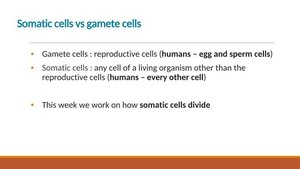
Somatic cells: Nonreproductive cells, humans have 46 chromosomes (2 sets of 23).
Gametes: Reproductive cells (sperm and eggs), humans have 23 chromosomes.
Chromosome Structure and Replication
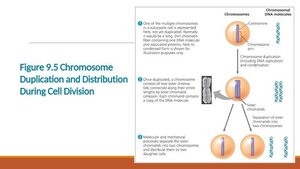
Chromosomes are duplicated before cell division, resulting in two identical sister chromatids joined at a centromere.
Each replicated chromosome consists of two sister chromatids.
Centromere: Region where sister chromatids are joined.
Sets of Chromosomes in Human Cells
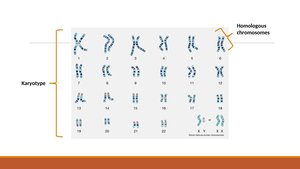
Human somatic cells contain 23 pairs of chromosomes, including autosomes and sex chromosomes.
Karyotype: Ordered display of chromosome pairs.
Homologous chromosomes: Chromosomes of the same length and shape, carrying genes for the same traits.
Sex chromosomes: X and Y; females (XX), males (XY).
Autosomes: The remaining 22 pairs.
Distribution of Chromosomes During Eukaryotic Cell Division
Mitosis and Cytokinesis
Eukaryotic cell division consists of mitosis (division of genetic material) and cytokinesis (division of cytoplasm). Gametes are produced by meiosis, which yields nonidentical daughter cells with half the chromosome number.
Mitosis: Produces identical daughter cells.
Meiosis: Produces gametes with half the chromosome number.
Phases of Mitosis
Stages of Mitosis
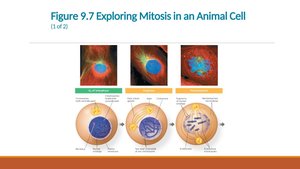
Mitosis is divided into distinct phases: prophase, prometaphase, metaphase, anaphase, and telophase. Each phase is characterized by specific events involving chromosome movement and spindle formation.
Prophase: Chromosomes condense, spindle forms.
Prometaphase: Nuclear envelope breaks down, spindle fibers attach to chromosomes.
Metaphase: Chromosomes align at the metaphase plate.
Anaphase: Sister chromatids separate and move to opposite poles.
Telophase: Nuclear envelopes reform, chromosomes decondense.
The Mitotic Spindle and Chromosome Movement
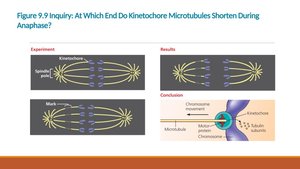
The mitotic spindle is a structure composed of microtubules that orchestrates chromosome movement during mitosis. At metaphase, chromosomes align at the metaphase plate. During anaphase, sister chromatids are separated and moved to opposite poles.
Microtubules attach to kinetochores on chromosomes.
Microtubules shorten by depolymerizing at kinetochore ends.
Motor proteins help "reel in" chromosomes.
Cytokinesis
Division of the Cytoplasm
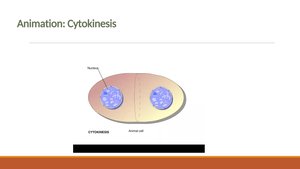
Cytokinesis is the process by which the cytoplasm divides, resulting in two separate daughter cells. In animal cells, this occurs via cleavage, forming a cleavage furrow.
Occurs after mitosis.
Ensures each daughter cell receives a complete set of organelles and genetic material.
Binary Fission in Bacteria
Prokaryotic Cell Division
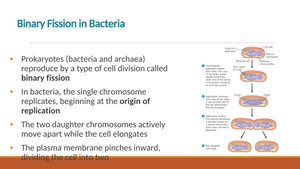
Prokaryotes reproduce by binary fission, a simpler process than mitosis. The single chromosome replicates, and the cell divides into two.
Replication begins at the origin of replication.
Daughter chromosomes move apart as the cell elongates.
Plasma membrane pinches inward, dividing the cell.
Control of the Cell Cycle
Cell Cycle Checkpoints
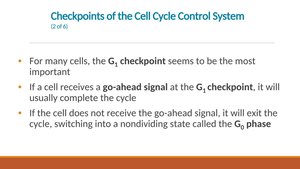
The cell cycle is regulated by checkpoints, which ensure proper division and prevent errors. The G1 checkpoint is particularly important.
If a cell receives a go-ahead signal at G1, it completes the cycle.
If not, it enters a nondividing state called G0.
Molecular Regulation and Cancer
Cell division frequency varies by cell type and is regulated at the molecular level. Cancer cells can escape these controls, leading to uncontrolled growth.
Regulation ensures normal development and tissue maintenance.
Cancer results from loss of cell cycle control.
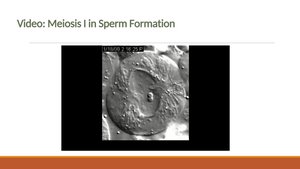
Sexual Life Cycles and Meiosis
Comparison of Asexual and Sexual Reproduction
Asexual reproduction involves a single parent and produces genetically identical offspring. Sexual reproduction involves two parents and produces offspring with unique gene combinations.
Clone: Genetically identical individuals from one parent.
Life cycle: Sequence of stages in an organism's reproductive history.
Sets of Chromosomes and Meiosis
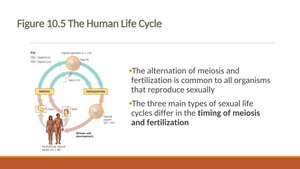
Meiosis reduces the chromosome number by half, producing haploid gametes. Fertilization restores the diploid state.
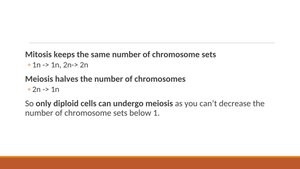
Mitosis: Maintains chromosome number ().
Meiosis: Halves chromosome number ().
Variety of Sexual Life Cycles
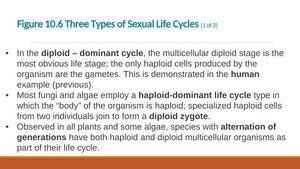
Organisms exhibit different sexual life cycles, including diploid-dominant, haploid-dominant, and alternation of generations.
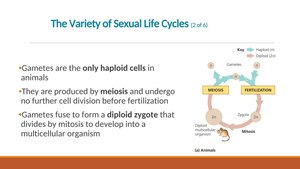
Gametes are the only haploid cells in animals.
Gametes fuse to form a diploid zygote, which divides by mitosis.
Alternation of meiosis and fertilization is common to all sexually reproducing organisms.
Research Methods in Chromosome Study
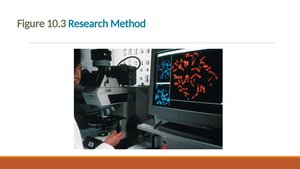
Modern research methods use microscopy and imaging to study chromosomes and their behavior during cell division.
Animation and Visuals
Animations and videos are useful for visualizing complex processes such as meiosis and mitosis.
Summary Table: Comparison of Mitosis and Meiosis
Process | Chromosome Number | Type of Cells Produced | Genetic Identity |
|---|---|---|---|
Mitosis | Maintained (2n → 2n) | Somatic cells | Identical to parent |
Meiosis | Halved (2n → n) | Gametes | Genetically unique |
Key Terms
Chromatin: DNA-protein complex forming chromosomes.
Chromosome: Structure carrying genetic material.
Sister chromatids: Identical copies of a chromosome joined at a centromere.
Karyotype: Ordered display of chromosome pairs.
Homologous chromosomes: Chromosome pairs with same genes.
Autosomes: Non-sex chromosomes.
Sex chromosomes: X and Y chromosomes.
Interphase: Cell growth and DNA replication phase.
Mitosis: Division of genetic material.
Cytokinesis: Division of cytoplasm.
Meiosis: Cell division producing gametes.
Metaphase plate: Imaginary plane where chromosomes align during metaphase.
Kinetochore: Protein structure on chromatids where spindle fibers attach.
