Back
Cell Cycle, Mitosis/Meiosis, Viral Replication, Homeostasis, and Cellular Communication: Study Guide
Study Guide - Smart Notes
 Tailored notes based on your materials, expanded with key definitions, examples, and context.
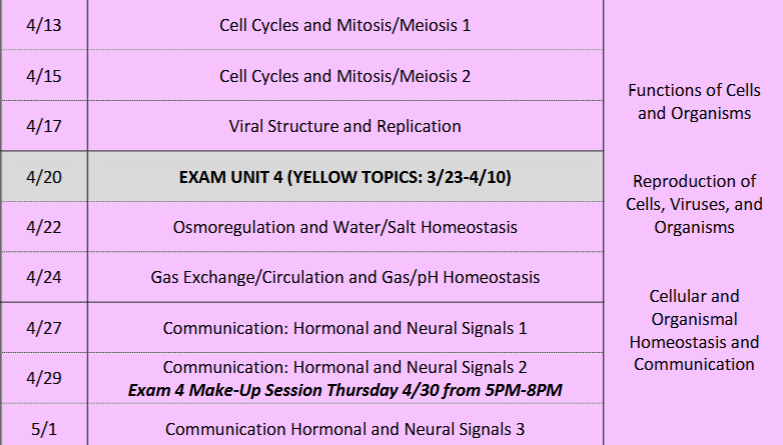
Cell Cycles and Mitosis/Meiosis
Overview of the Cell Cycle
The cell cycle is the series of events that cells undergo to grow and divide. It consists of interphase (G1, S, G2 phases) and the mitotic phase (mitosis and cytokinesis). - Interphase: The cell grows (G1), replicates its DNA (S), and prepares for division (G2). - Mitosis: The process by which a cell divides its nucleus and genetic material. - Cytokinesis: Division of the cytoplasm, resulting in two daughter cells.
Mitosis
Mitosis is the process of nuclear division in eukaryotic cells, resulting in two genetically identical daughter cells. - Phases: Prophase, Metaphase, Anaphase, Telophase. - Purpose: Growth, repair, and asexual reproduction.
Meiosis
Meiosis is a specialized type of cell division that reduces the chromosome number by half, producing four genetically diverse gametes. - Phases: Meiosis I and Meiosis II, each with Prophase, Metaphase, Anaphase, and Telophase. - Purpose: Sexual reproduction, genetic diversity.
Viral Structure and Replication
Structure of Viruses
Viruses are infectious agents composed of genetic material (DNA or RNA) surrounded by a protein coat (capsid). Some viruses have an additional lipid envelope. - Capsid: Protein shell protecting viral genome. - Envelope: Lipid membrane derived from host cell, present in some viruses.
Viral Replication
Viral replication involves the infection of host cells and the production of new viral particles. - Attachment: Virus binds to host cell surface. - Entry: Viral genome enters the host cell. - Replication: Host machinery replicates viral genome and proteins. - Assembly: New viral particles are assembled. - Release: Viruses exit the cell, often destroying it.
Osmoregulation and Water/Salt Homeostasis
Osmoregulation
Osmoregulation is the process by which organisms regulate the balance of water and electrolytes in their bodies. - Importance: Maintains cellular function and overall homeostasis. - Mechanisms: Kidneys in animals, contractile vacuoles in protists, and stomata in plants.
Water/Salt Homeostasis
Organisms use various strategies to maintain water and salt balance, adapting to their environments. - Examples: Marine fish excrete excess salt, freshwater fish conserve salt.
Gas Exchange, Circulation, and Gas/pH Homeostasis
Gas Exchange
Gas exchange is the process of obtaining oxygen and removing carbon dioxide. - Mechanisms: Diffusion across membranes, specialized organs (lungs, gills, stomata).
Circulation
Circulatory systems transport gases, nutrients, and waste throughout the body. - Types: Open and closed circulatory systems.
Gas/pH Homeostasis
Maintaining proper gas concentrations and pH is essential for cellular function. - Buffer systems: Help regulate pH in blood and tissues.
Communication: Hormonal and Neural Signals
Hormonal Communication
Hormones are chemical messengers that regulate physiological processes. - Endocrine system: Releases hormones into the bloodstream. - Examples: Insulin regulates blood sugar; adrenaline triggers fight-or-flight response.
Neural Communication
Neural signals are transmitted via neurons, enabling rapid communication. - Action potential: Electrical signal traveling along a neuron. - Synapse: Junction where neurotransmitters transmit signals between neurons.
Functions of Cells and Organisms
Cells and organisms perform essential functions such as metabolism, growth, reproduction, and response to stimuli.
Reproduction of Cells, Viruses, and Organisms
Reproduction ensures the continuity of life, occurring via mitosis, meiosis, viral replication, and organismal reproduction.
Cellular and Organismal Homeostasis and Communication
Homeostasis and communication are vital for maintaining internal stability and coordinating responses to environmental changes.