 Back
Cell Cycle, Mutation, and Cancer: From One Cell to 37 Trillion
Study Guide - Smart Notes
 Tailored notes based on your materials, expanded with key definitions, examples, and context.
Cell Cycle and Its Regulation
Overview of the Cell Cycle
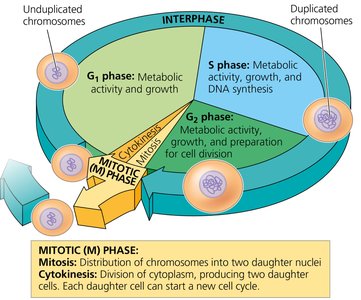
The cell cycle is the series of events that cells undergo to grow and divide. It is essential for development, tissue maintenance, and repair. The cycle consists of four main phases: G1, S, G2, and M, with a resting phase called G0.
G1 phase: Cell grows and prepares for DNA replication.
S phase: DNA synthesis occurs, duplicating the chromosomes.
G2 phase: Cell continues to grow and prepares for mitosis.
M phase: Mitosis and cytokinesis, resulting in two daughter cells.
G0 phase: Cells exit the cycle and remain quiescent.
Cell Cycle Checkpoints
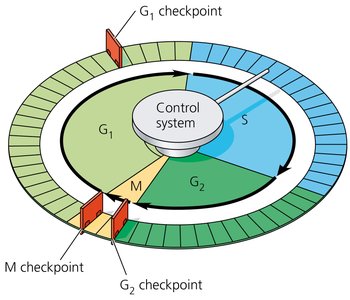
Checkpoints are control mechanisms that ensure the cell cycle progresses only when certain conditions are met. They prevent errors such as DNA damage or incomplete replication from being passed to daughter cells.
G1 checkpoint: Checks for cell size, nutrients, growth signals, and DNA integrity.
G2 checkpoint: Ensures DNA replication is complete and checks for DNA damage.
M checkpoint: Verifies that all chromosomes are properly attached to the spindle before division.
Molecular Regulation of the Cell Cycle
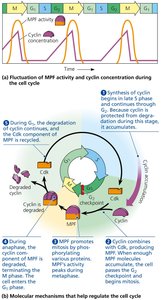
The cell cycle is regulated by cyclins and cyclin-dependent kinases (Cdks). Cyclin levels fluctuate throughout the cycle, activating Cdks at specific points to drive cell cycle transitions.
Cyclins: Proteins whose concentrations rise and fall during the cell cycle.
Cdk: Enzymes that, when bound to cyclins, phosphorylate target proteins to advance the cell cycle.
MPF (Maturation Promoting Factor): A Cdk-cyclin complex that triggers entry into mitosis.
Chromosome Structure and Duplication
Chromosome Organization
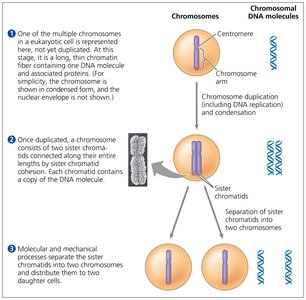
Chromosomes are structures composed of DNA and proteins. Each chromosome contains a centromere and arms. Before cell division, chromosomes are duplicated, resulting in two sister chromatids joined at the centromere.
Centromere: Region where sister chromatids are joined.
Sister chromatids: Identical copies of a chromosome, formed during DNA replication.
Chromosome duplication: Occurs during S phase, producing two chromatids per chromosome.
Mutation and Its Effects
Types and Consequences of Mutations
Mutations are changes in the DNA sequence. Their effects depend on where and when they occur, and which gene or regulatory region is affected. Most mutations are silent or have no detectable effect, but some can alter protein function or gene regulation.
Coding region mutations: May change the protein's amino acid sequence.
Regulatory region mutations: Affect when, where, and how much a gene is expressed.
Epistasis: The effect of a mutation can depend on other genes.
Environmental influence: Some mutations only manifest under certain conditions.
Example: A mutation in an early embryonic cell will be inherited by all its descendants, creating a mosaic of cells with the mutation.
Cancer: Mutation in Cell Cycle Control
How Cancer Develops
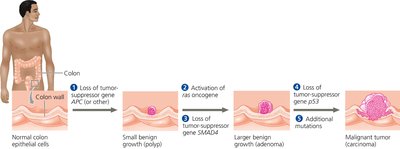
Cancer arises from mutations in genes that regulate cell division. These include proto-oncogenes (accelerators) and tumor-suppressor genes (brakes). Multiple mutations are usually required for a cell to become cancerous.
Proto-oncogene: Normal gene that promotes cell division; mutation can create an oncogene.
Tumor-suppressor gene: Inhibits cell division; loss of function leads to uncontrolled growth.
Metastasis: Additional mutations allow cancer cells to migrate and invade other tissues.
Mechanisms of Oncogene Activation
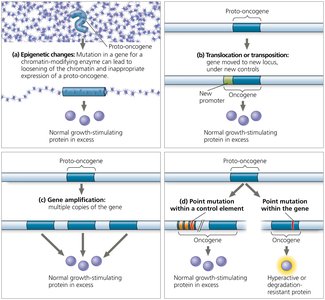
Proto-oncogenes can become oncogenes through several mechanisms, leading to excessive cell division and cancer.
Epigenetic changes: Mutation in a gene for a chromatin-modifying enzyme can loosen chromatin, increasing expression.
Translocation/transposition: Gene moved under new regulatory controls, causing overexpression.
Gene amplification: Multiple copies of a gene increase protein production.
Point mutation: Mutation within the gene or its control element alters protein function or regulation.
Summary: Key Concepts
Where and when a mutation occurs determines its effect.
Cancer results from mutations in cell cycle control genes.
The cell cycle is tightly regulated by checkpoints and molecular signals.
Chromosome duplication and segregation are essential for cell division.
Multiple mechanisms can activate oncogenes and lead to cancer.
