 Back
Cell Cycle Regulation and Cancer: Study Notes for General Biology
Study Guide - Smart Notes
 Tailored notes based on your materials, expanded with key definitions, examples, and context.
The Cell Cycle Control System
Overview of Cell Cycle Regulation
The cell cycle is a series of events that cells undergo to grow and divide. This process is tightly regulated by a cell cycle control system, which acts like a clock to ensure proper timing and coordination. The control system is governed by internal and external signals and includes checkpoints where the cycle can pause until conditions are favorable.
Cell Cycle Control System: Directs the sequential events of the cell cycle.
Checkpoints: Specific points where the cell cycle stops until a go-ahead signal is received.
Internal and External Controls: Internal signals (e.g., DNA integrity) and external signals (e.g., growth factors) regulate progression.
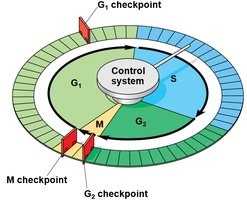
Cell Cycle Checkpoints
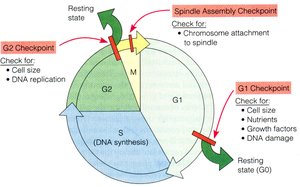
Checkpoints are critical control mechanisms that ensure the cell is ready to proceed to the next phase. The main checkpoints are G1, G2, and M.
G1 Checkpoint: Checks for cell size, nutrients, growth factors, and DNA damage.
G2 Checkpoint: Checks for cell size and DNA replication completion.
M (Spindle Assembly) Checkpoint: Ensures chromosomes are properly attached to the spindle before division.
Discovery of Cell Cycle Regulation
Experimental Evidence for Cytoplasmic Regulation
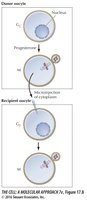
Experiments with oocytes demonstrated that injecting cytoplasm from M phase cells into G2-arrested oocytes induces progression to M phase. This indicated the presence of a regulatory substance in the cytoplasm.
Oocyte Injection: G2-arrested oocytes injected with M phase cytoplasm enter M phase.
Conclusion: M phase cytoplasm contains a factor that promotes cell cycle progression.
Maturation Promoting Factor (MPF)
The substance responsible for triggering M phase was identified as MPF (Maturation Promoting Factor), a general regulator of the G2 to M transition in both mitosis and meiosis.
MPF: Regulates transition from G2 to M phase.
Present in Somatic Cells: MPF also functions in somatic cells to allow entry into mitosis.
Molecular Mechanisms of Cell Cycle Regulation
Cyclins and Cyclin-Dependent Kinases (Cdks)
Two types of regulatory proteins are central to cell cycle control: cyclins and cyclin-dependent kinases (Cdks).
Cyclins: Proteins with cyclic patterns of accumulation and degradation during the cell cycle (e.g., cyclin A and cyclin B).
Cyclin-Dependent Kinases (Cdks): Enzymes that require cyclins to be active; Cdk1 is a key catalytic subunit.
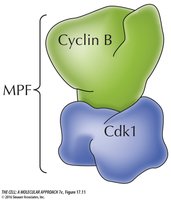
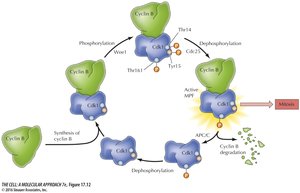
MPF Structure: MPF is a complex of cyclin B (regulatory subunit) and Cdk1 (catalytic subunit).
Regulation of MPF Activity
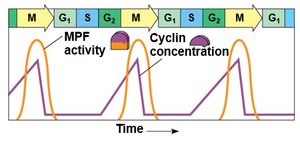
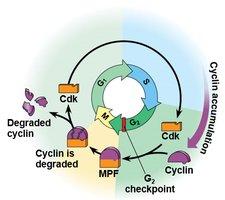
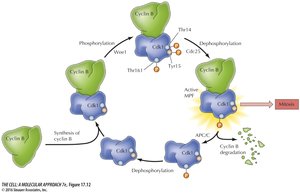
MPF activity is regulated by the synthesis and degradation of cyclin B, as well as phosphorylation events.
Cyclin B Synthesis: Cyclin B is synthesized during G2 and binds to Cdk1.
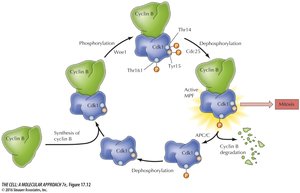
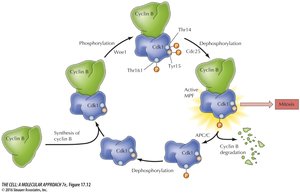
Phosphorylation: MPF has three phosphorylation sites; activation requires specific dephosphorylation.
Degradation: Cyclin B is degraded at the end of mitosis, inactivating MPF.
MPF Regulation Cycle
The regulation of MPF involves synthesis, phosphorylation, activation, and degradation.
Inactive MPF: Accumulates during G2.
Activation: Dephosphorylation activates MPF, triggering entry into mitosis.
Degradation: Cyclin B is degraded, leading to exit from mitosis.
Cancer and Cell Cycle Checkpoints
Characteristics of Cancer
Cancer arises from cells in which cell cycle checkpoints have failed, leading to uncontrolled cell division.
Variation: Cancers vary in onset, growth rate, seriousness, and cause.
Checkpoint Failure: All cancers result from failure of cell cycle checkpoints.
Benign vs. Malignant Tumors
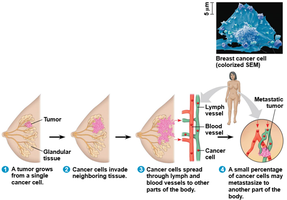
Benign Tumors: Abnormal cells remain at the original site.
Malignant Tumors: Invade surrounding tissues and can metastasize to other parts of the body.
Cell Proliferation and G1 Checkpoint
Most adult mammalian cells cannot proliferate, but some can re-enter the cell cycle when needed. Many cancers are hypothesized to result from defects in the G1 checkpoint.
G0 Phase: Cells may remain in a resting state (G0) but can re-enter the cycle.
G1 Checkpoint Defects: Allow abnormal proliferation.
Growth Factors and Social Control
Unicellular Eukaryotes: Check for cell size and nutrient availability.
Multicellular Eukaryotes: Require signals from other cells (growth factors).
Cancer Cells: Can proliferate without growth factors.
Regulation of G1 Checkpoint
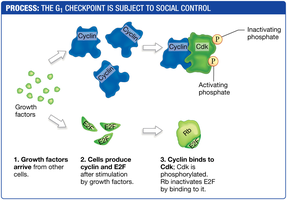
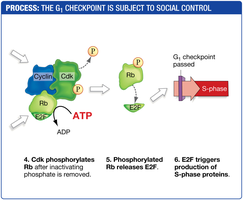
Growth factors stimulate production of cyclin and E2F. The retinoblastoma protein (Rb) keeps E2F inactive. Cdk phosphorylates Rb, releasing E2F to trigger S phase.
Growth Factors: Stimulate cyclin and E2F production.
Rb Protein: Inhibits E2F; phosphorylation by Cdk releases E2F.
E2F: Triggers start of S phase.
Mutations and Cancer Progression
Mutations in E2F or cyclin can allow cells to enter S phase without growth factors, contributing to cancer development.
Mutation Effects: Loss of regulation leads to uncontrolled cell division.
Learning Objectives – Chapter 12: The Cell Cycle
Key Learning Goals
Identify chromosomes, chromatids, sister chromatids, and homologous chromosomes in cell images.
Explain stages of mitosis and chromosome structure at each stage.
Distinguish and explain sequence of major cell cycle stages (M, G1, S, G2).
Predict consequences of altering cell cycle stages and explain checkpoint mechanisms.
Summary Table: Cell Cycle Checkpoints
Checkpoint | Main Function | Key Factors Checked |
|---|---|---|
G1 | Entry into S phase | Cell size, nutrients, growth factors, DNA damage |
G2 | Entry into M phase | Cell size, DNA replication |
M (Spindle Assembly) | Chromosome segregation | Chromosome attachment to spindle |
Summary Table: MPF Regulation
Phase | Cyclin B Level | MPF Activity |
|---|---|---|
G2 | High | Inactive |
M | High | Active |
End of M | Low (degraded) | Inactive |
Summary Table: Cancer Cell Characteristics
Characteristic | Description |
|---|---|
Onset | Varies by cancer type |
Growth Rate | Varies by cancer type |
Seriousness | Varies by cancer type |
Cause | Failure of cell cycle checkpoints |
Key Equations and Concepts
MPF Activation
MPF = Cyclin B + Cdk1
Activation requires dephosphorylation of Cdk1
Cell Cycle Progression
Progression depends on accumulation and degradation of cyclins
Checkpoint passage requires specific signals and protein modifications
LaTeX Equations
MPF Complex:
Cell Cycle Stages:
Additional info:
Some details about the molecular regulation of MPF and the G1 checkpoint were inferred from standard biology knowledge to ensure completeness.
