 Back
Cell Cycle, Regulation, and Cancer: Study Notes for General Biology
Study Guide - Smart Notes
 Tailored notes based on your materials, expanded with key definitions, examples, and context.
Cell Cycle Overview
Introduction to the Cell Cycle
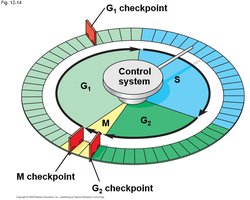
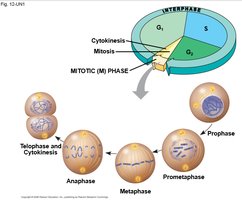
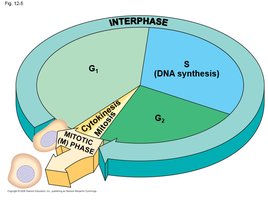
The cell cycle is the series of events that cells undergo to grow and divide. It is essential for organismal growth, tissue repair, and reproduction. The cell cycle consists of distinct phases: G1, S, G2, and M, with cells sometimes entering a resting state called G0.
G1 phase: Cell growth and organelle reproduction.
S phase: DNA and organelle replication.
G2 phase: Preparation for mitosis, including protein synthesis for spindle formation.
M phase: Mitosis and cytokinesis, resulting in two genetically identical daughter cells.
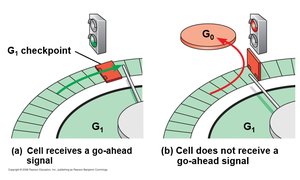
G0 phase: Cells exit the cycle and become quiescent (e.g., neurons, heart muscle cells).
Key Functions of Cell Cycle Phases
G1 Checkpoint: Ensures cell is ready for DNA synthesis; organelles reproduce and proteins are synthesized.
S Phase: DNA replication guarantees genetic consistency in daughter cells.
G2 Phase: Cell prepares for mitosis by synthesizing proteins (e.g., tubulin for spindle fibers).
M Phase: Nuclear division (mitosis) and cytoplasmic division (cytokinesis).
Regulation of the Cell Cycle
Internal and External Controls
The cell cycle is tightly regulated by internal and external signals to ensure proper cell division and prevent uncontrolled growth.
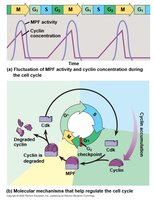
Internal controls: Protein molecules (e.g., cyclins and Cdks) fluctuate in concentration and activity during the cycle.
External controls: Signals from other cells, such as growth factors and environmental cues, influence cell cycle progression.

Internal Controls: Cyclins and Cdks
Cyclin-dependent kinases (Cdks) are enzymes that phosphorylate target proteins, driving cell cycle transitions. Cyclins are regulatory proteins that activate Cdks. The mitosis promotion factor (MPF) is a complex of cyclin and Cdk that triggers mitosis.
Cdk: Constant concentration; requires cyclin to be active.
Cyclin: Concentration increases during interphase; acts as the "on switch" for Cdk.
MPF: Cyclin + Cdk; activates proteins for mitosis (e.g., microtubule formation).
External Controls: Growth Factors and Environmental Signals
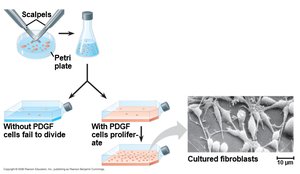
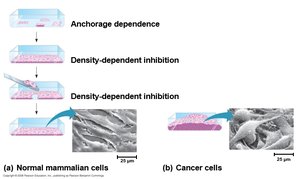
External signals such as platelet-derived growth factor (PDGF) and nutrient availability can stimulate or inhibit cell division. Normal cells require anchorage and are subject to density-dependent inhibition, while cancer cells ignore these controls.
PDGF: Stimulates fibroblast formation and cell division.
Nutrients: Essential for cell cycle progression.
Positional inhibition: Cells must be anchored and not overcrowded; cancer cells do not respond to this.
Cancer: Uncontrolled Cell Division
Causes and Characteristics of Cancer
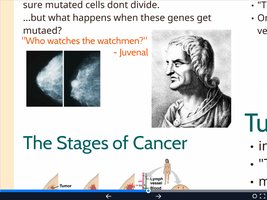
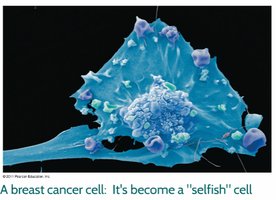
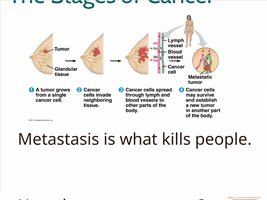
Cancer arises from mutations that disrupt normal cell cycle regulation, leading to uncontrolled cell division. Mutations accumulate over time, especially with exposure to carcinogens (e.g., heavy metals, UV radiation, chemicals). Metastasis is the process by which cancer spreads to other parts of the body, often leading to fatal outcomes.
Mutation rates: Increase with age and exposure to carcinogens.
Metastasis: Cancer cells invade neighboring tissues and spread via blood and lymph vessels.
Genetic Control of Cancer
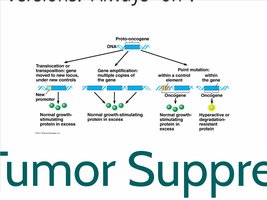
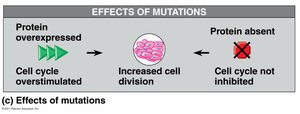
Cancer development involves mutations in two main types of genes: proto-oncogenes and tumor suppressor genes.
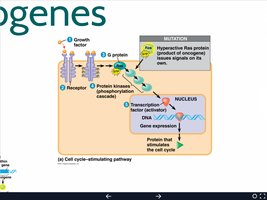
Proto-oncogenes: Stimulate cell division; mutated forms (oncogenes) are always active, leading to excessive cell proliferation.
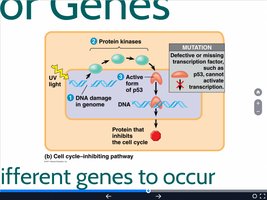
Tumor suppressor genes: Inhibit cell division; mutated forms lose function, removing cell cycle brakes.
Examples: RAS protein (proto-oncogene), pRb, p16, p53 (tumor suppressors).
Multi-step Model of Cancer Development
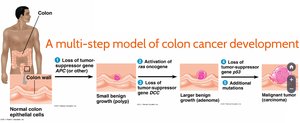
Cancer is a multistep process requiring mutations in several genes. The risk increases with age as mutations accumulate. Colon cancer is a well-studied example of this multistep pathway.
Multiple mutations: Required for malignant transformation.
Example: Colon cancer progression involves loss of tumor suppressor genes, activation of oncogenes, and additional mutations.
Apoptosis and Cancer Prevention
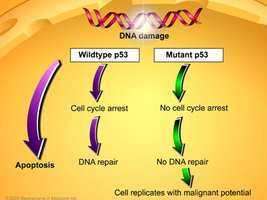
Apoptosis is programmed cell death, a mechanism to eliminate damaged or mutated cells without causing inflammation. Mutations in apoptosis-related genes can prevent cell death, contributing to cancer development.
Triggers: Cellular damage and mutation accumulation.
p53: Key regulator of apoptosis; mutations in p53 can prevent cell cycle arrest and DNA repair, allowing malignant cells to survive.
Gene Type | Normal Function | Mutation Effect |
|---|---|---|
Proto-oncogene | Stimulates cell division | Oncogene: always active, excessive division |
Tumor suppressor gene | Inhibits cell division | Loss of function: cell cycle not inhibited |
Apoptosis gene (e.g., p53) | Triggers cell death in damaged cells | Mutation: prevents apoptosis, allows survival of damaged cells |
Summary: The cell cycle is a highly regulated process essential for life. Disruption of its regulation through mutations leads to cancer, a multistep disease involving both genetic and environmental factors. Understanding cell cycle checkpoints, regulatory proteins, and apoptosis is crucial for comprehending cancer biology.
