Back
Cell Cycles, Mitosis/Meiosis, Viral Replication, and Homeostasis: Course Schedule Overview
Study Guide - Smart Notes
 Tailored notes based on your materials, expanded with key definitions, examples, and context.
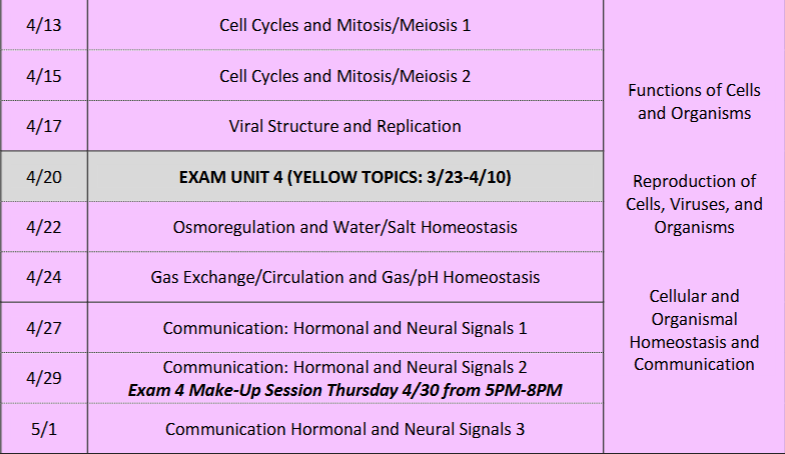
Course Schedule Overview: Functions of Cells and Organisms
Cell Cycles and Mitosis/Meiosis
This section introduces the processes by which cells divide and reproduce, focusing on the cell cycle, mitosis, and meiosis. These topics are foundational for understanding growth, development, and genetic inheritance in eukaryotic organisms.
Cell Cycle: The ordered sequence of events that a cell goes through between one division and the next, including interphase (G1, S, G2 phases) and the mitotic phase (M phase).
Mitosis: The process by which a eukaryotic cell separates its duplicated chromosomes into two identical nuclei, resulting in two genetically identical daughter cells.
Meiosis: A specialized form of cell division that reduces the chromosome number by half, producing four genetically distinct gametes; essential for sexual reproduction.
Importance: Ensures genetic continuity and variation, supports organismal growth, tissue repair, and reproduction.
Viral Structure and Replication
This topic covers the basic structure of viruses and the mechanisms by which they replicate within host cells. Understanding viral replication is crucial for studying infectious diseases and biotechnology applications.
Viral Structure: Viruses consist of genetic material (DNA or RNA) enclosed in a protein coat (capsid); some have an additional lipid envelope.
Replication: Viruses infect host cells and hijack cellular machinery to replicate their genomes and produce new viral particles.
Relevance: Viral replication is central to understanding viral pathogenesis, immune responses, and antiviral strategies.
Osmoregulation and Water/Salt Homeostasis
This section explores how cells and organisms regulate water and salt balance to maintain internal stability (homeostasis). These processes are vital for survival in varying environmental conditions.
Osmoregulation: The control of water and solute concentrations to prevent excessive water loss or gain.
Mechanisms: Involves specialized cells and organs (e.g., kidneys in vertebrates) that regulate ion transport and water movement.
Importance: Maintains cellular function, volume, and overall organismal health.
Gas Exchange, Circulation, and Gas/pH Homeostasis
This topic addresses how organisms exchange gases (oxygen and carbon dioxide) with their environment, circulate these gases via transport systems, and regulate blood pH for metabolic stability.
Gas Exchange: Occurs across respiratory surfaces (e.g., lungs, gills, skin) by diffusion.
Circulation: The movement of gases and nutrients via circulatory systems (open or closed).
pH Homeostasis: Regulation of blood and cellular pH through buffering systems, respiration, and renal function.
Communication: Hormonal and Neural Signals
This section examines how cells and organisms communicate using chemical (hormonal) and electrical (neural) signals to coordinate physiological processes and responses to the environment.
Hormonal Signals: Chemical messengers (hormones) released by endocrine glands travel through the bloodstream to target organs.
Neural Signals: Electrical impulses transmitted by neurons enable rapid communication between cells and tissues.
Integration: Hormonal and neural systems often interact to regulate complex behaviors and homeostatic mechanisms.
Exam and Review Sessions
Exam Unit 4: Covers topics from 3/23 to 4/10, including cell cycles, mitosis/meiosis, viral replication, and homeostasis mechanisms.
Make-Up Session: Scheduled for students who need to retake or complete missed assessments.
Major Themes
Functions of Cells and Organisms: How cells and multicellular organisms maintain life processes.
Reproduction of Cells, Viruses, and Organisms: Mechanisms of cellular and viral replication, and organismal reproduction.
Cellular and Organismal Homeostasis and Communication: Maintenance of internal stability and coordination of physiological activities.