 Back
Cell Division and Reproduction: Mitosis, Meiosis, and Chromosomal Alterations
Study Guide - Smart Notes
 Tailored notes based on your materials, expanded with key definitions, examples, and context.
Cell Division and Reproduction
Introduction to Cell Division
Cell division is a fundamental process in all living organisms, enabling growth, development, tissue repair, and reproduction. While normal cell division is tightly regulated, mutations can lead to uncontrolled division, resulting in cancer. Understanding the mechanisms of cell division is essential for grasping how organisms reproduce and maintain genetic continuity.
The Eukaryotic Cell Cycle and Mitosis
The Cell Cycle
The cell cycle is an ordered sequence of events from the formation of a cell to its own division. It consists of interphase (G1, S, G2) and the mitotic (M) phase.
G1 phase: Cell growth and normal functions
S phase: DNA synthesis (chromosome duplication)
G2 phase: Preparation for mitosis
M phase: Mitosis and cytokinesis
Mitosis: Distribution of Chromosomes
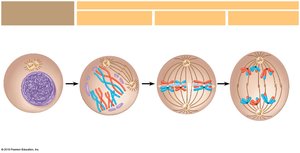
Mitosis is the process by which a eukaryotic cell separates its duplicated chromosomes into two identical nuclei. It is essential for growth, repair, and asexual reproduction in multicellular organisms.
Prophase: Chromosomes condense, spindle forms.
Prometaphase: Nuclear envelope fragments, spindle fibers attach to kinetochores.
Metaphase: Chromosomes align at the metaphase plate.
Anaphase: Sister chromatids separate to opposite poles.
Telophase: Nuclear envelopes reform, chromosomes decondense.
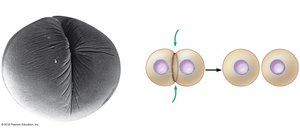
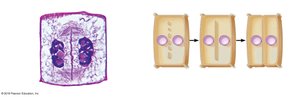
Cytokinesis: Division of the cytoplasm, forming two daughter cells.
Cytokinesis in Animal and Plant Cells
Cytokinesis differs between animal and plant cells:
Animal cells: Form a cleavage furrow that pinches the cell in two.
Plant cells: Form a cell plate that develops into a new cell wall.
Regulation of the Cell Cycle
The cell cycle is regulated by internal and external signals, including growth factors. Checkpoints ensure that each phase is completed correctly before the next begins. Loss of regulation can result in cancer.
Prokaryotic Cell Division: Binary Fission
Binary Fission
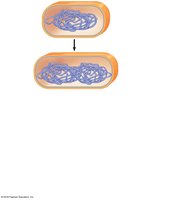
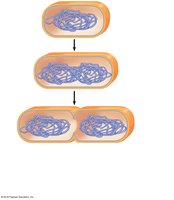
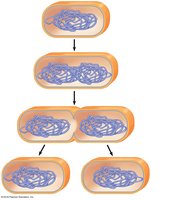
Prokaryotes reproduce asexually by binary fission, a process in which the cell duplicates its single, circular chromosome and divides into two genetically identical daughter cells.
Chromosome duplication and separation
Elongation of the cell
Division into two daughter cells
Chromosomes and Their Duplication
Structure of Chromosomes
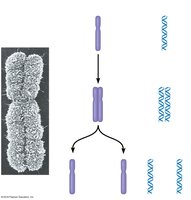
Eukaryotic chromosomes are composed of DNA and proteins, forming chromatin. Before division, chromosomes duplicate, forming two sister chromatids joined at a centromere.
Meiosis and Sexual Reproduction
Homologous Chromosomes and Ploidy
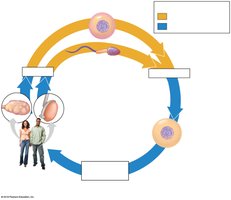
Somatic cells are diploid (2n), containing pairs of homologous chromosomes. Gametes (egg and sperm) are haploid (n), containing one set of chromosomes. Fertilization restores diploidy.
Meiosis: Reduction Division
Meiosis reduces the chromosome number by half, producing four genetically unique haploid cells. It consists of two divisions: meiosis I (homologous chromosomes separate) and meiosis II (sister chromatids separate).
Crossing over during prophase I increases genetic variation.
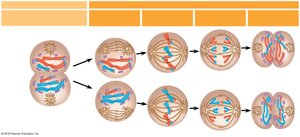
Comparison of Mitosis and Meiosis
Feature | Mitosis | Meiosis |
|---|---|---|
Number of divisions | 1 | 2 |
Number of daughter cells | 2 | 4 |
Genetic identity | Identical | Unique |
Chromosome number | Diploid | Haploid |
Role | Growth, repair, asexual reproduction | Sexual reproduction |
Genetic Variation
Sources of Genetic Variation
Independent assortment: Random orientation of homologous pairs during metaphase I.
Crossing over: Exchange of genetic material between nonsister chromatids.
Random fertilization: Any sperm can fertilize any egg.
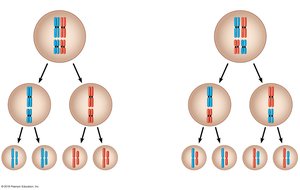
Alterations of Chromosome Number and Structure
Nondisjunction
Nondisjunction is the failure of chromosomes to separate properly during meiosis, resulting in gametes with abnormal chromosome numbers. This can lead to disorders such as Down syndrome (trisomy 21).
Karyotyping
A karyotype is a photographic inventory of an individual's chromosomes, used to detect chromosomal abnormalities.
Structural Alterations
Deletion: Loss of a chromosome segment
Duplication: Repetition of a segment
Inversion: Reversal of a segment
Translocation: Segment moves to a nonhomologous chromosome
Summary Table: Key Differences Between Mitosis and Meiosis
Process | Number of Divisions | Number of Daughter Cells | Genetic Identity | Chromosome Number |
|---|---|---|---|---|
Mitosis | 1 | 2 | Identical | Diploid |
Meiosis | 2 | 4 | Unique | Haploid |
Additional info: This guide covers the essential concepts of cell division, including the cell cycle, mitosis, meiosis, genetic variation, and chromosomal alterations, as outlined in a typical college biology curriculum.
