 Back
Cell Division and the Cell Cycle: Structure, Function, and Regulation
Study Guide - Smart Notes
 Tailored notes based on your materials, expanded with key definitions, examples, and context.
Cell Division: The Foundation of Life
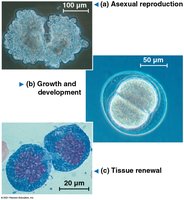
Key Roles of Cell Division
Cell division is a fundamental process that enables organisms to reproduce, grow, and repair tissues. It is essential for the continuity of life, as it ensures the distribution of genetic material to daughter cells.
Asexual reproduction: Single-celled organisms reproduce by dividing, creating genetically identical offspring.
Growth and development: Multicellular organisms grow and develop through repeated cell divisions.
Tissue renewal: Cell division replaces damaged or dead cells in tissues.
Cellular Organization of Genetic Material
Chromosomes and Chromatin
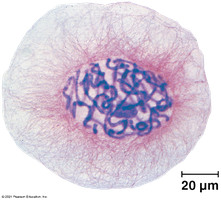
All the DNA in a cell constitutes its genome. In eukaryotes, DNA is organized into multiple chromosomes, each consisting of chromatin—a complex of DNA and protein that condenses during cell division.
Somatic cells: Non-reproductive cells with two sets of chromosomes.
Gametes: Reproductive cells (sperm and eggs) with half as many chromosomes as somatic cells.
Chromosome Duplication and Distribution
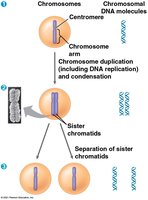
Before cell division, chromosomes are duplicated. Each duplicated chromosome consists of two sister chromatids joined at the centromere. During division, chromatids separate and are distributed to daughter cells.
Chromosome duplication: DNA replication and condensation.
Sister chromatids: Identical copies joined together.
Centromere: Region where chromatids are most closely attached.
The Cell Cycle
Phases of the Cell Cycle
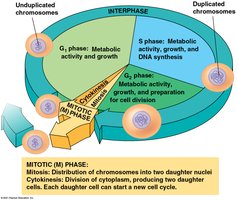
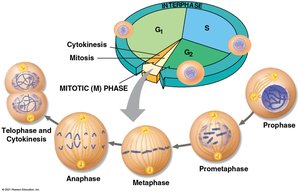
The cell cycle is the series of events that cells go through as they grow and divide. It consists of interphase (G1, S, G2) and the mitotic (M) phase.
Interphase: Cell growth and chromosome duplication (G1: growth, S: DNA synthesis, G2: preparation for division).
Mitotic (M) phase: Includes mitosis (nuclear division) and cytokinesis (cytoplasmic division).
Mitosis: Stages and Process
Mitosis is conventionally divided into five stages: prophase, prometaphase, metaphase, anaphase, and telophase. Each stage is characterized by specific events that ensure accurate chromosome segregation.
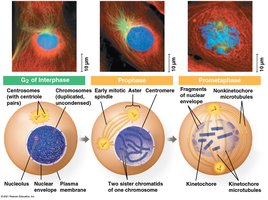
Prophase: Chromosomes condense, spindle apparatus forms.
Prometaphase: Nuclear envelope fragments, spindle fibers attach to kinetochores.
Metaphase: Chromosomes align at the metaphase plate.
Anaphase: Sister chromatids separate and move to opposite poles.
Telophase: Nuclear envelopes reform, chromosomes decondense.
Cytokinesis: Division of cytoplasm, forming two daughter cells.
The Mitotic Spindle: Structure and Function
Spindle Apparatus and Chromosome Movement
The mitotic spindle is a structure made of microtubules that orchestrates chromosome movement during mitosis. It consists of kinetochore, nonkinetochore, and astral microtubules.
Kinetochore microtubules: Attach to chromosomes and pull them apart.
Nonkinetochore microtubules: Overlap and elongate the cell.
Astral microtubules: Anchor the spindle to the cell membrane.
Centrosome: Microtubule-organizing center that replicates and migrates to opposite poles.
Cytokinesis: Animal vs. Plant Cells
Mechanisms of Cytokinesis
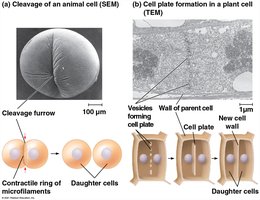
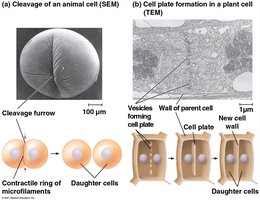
Cytokinesis differs between animal and plant cells. In animals, it occurs via cleavage, forming a cleavage furrow. In plants, a cell plate forms, eventually becoming the new cell wall.
Cleavage furrow: Contractile ring of microfilaments pinches the cell in two (animal cells).
Cell plate: Vesicles fuse to form a new cell wall (plant cells).
Binary Fission in Prokaryotes
Cell Division in Bacteria
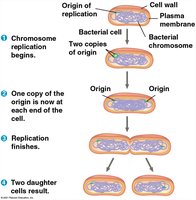
Prokaryotes reproduce by binary fission, a simpler process than mitosis. The chromosome replicates, and the cell divides into two genetically identical daughter cells.
Origin of replication: Site where DNA replication begins.
Plasma membrane: Pinches inward to separate cells.
Regulation of the Cell Cycle
Cell Cycle Control System
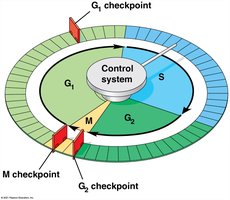
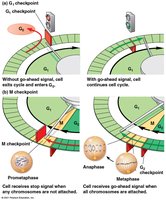
The cell cycle is regulated by a molecular control system with checkpoints at G1, G2, and M phases. These checkpoints ensure proper division and prevent errors.
G1 checkpoint: Most important; determines if cell will proceed to division.
G2 checkpoint: Ensures DNA is properly replicated.
M checkpoint: Ensures chromosomes are properly attached to spindle.
Cyclins and Cyclin-Dependent Kinases (Cdks)
Two types of regulatory proteins control the cell cycle: cyclins and Cdks. Cyclins fluctuate in concentration, while Cdks are active only when bound to cyclins. The maturation-promoting factor (MPF) is a cyclin-Cdk complex that triggers cell cycle progression.
Cyclins: Proteins with cyclically fluctuating concentrations.
Cyclin-dependent kinases (Cdks): Enzymes that drive cell cycle events.
MPF: Cyclin-Cdk complex that promotes mitosis.
External Regulation and Cancer
External Signals and Cell Division
Cell division is influenced by external factors such as growth factors, density-dependent inhibition, and anchorage dependence. Cancer cells lose these regulatory controls, leading to uncontrolled growth.
Growth factors: Stimulate cell division (e.g., PDGF).
Density-dependent inhibition: Crowded cells stop dividing.
Anchorage dependence: Cells must be attached to a substratum to divide.
Cancer cells: Ignore normal regulatory signals, may form tumors and metastasize.
Benign vs. Malignant Tumors
Transformed cells that evade immune detection can form tumors. Benign tumors remain localized, while malignant tumors invade tissues and can spread (metastasis).
Benign tumor: Localized, usually not life-threatening.
Malignant tumor: Invades tissues, can metastasize.
Chemotherapy: Targets rapidly dividing cells, causing side effects.
Summary Table: Cell Division Mechanisms
Process | Organism Type | Key Features |
|---|---|---|
Mitosis | Eukaryotes | Genetically identical daughter cells, nuclear division, cytokinesis |
Meiosis | Eukaryotes | Non-identical daughter cells, half chromosome number, gamete production |
Binary Fission | Prokaryotes | Simple division, chromosome replication, plasma membrane pinching |
Key Equations and Concepts
Chromosome number in daughter cells:
Cell cycle phases:
Additional info: Academic context was added to clarify the stages of mitosis, the role of checkpoints, and the distinction between benign and malignant tumors.
