 Back
Cell Division, Cancer, and Chemotherapy: Step-by-Step Study Guidance
Study Guide - Smart Notes
 Tailored notes based on your materials, expanded with key definitions, examples, and context.
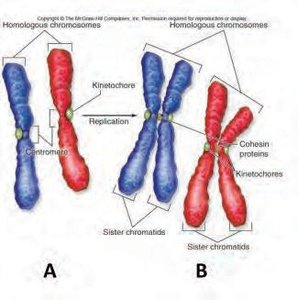
Q3. Use the figures to the right to describe the following: Homologous Chromosomes and Sister Chromatids
Background
Topic: Chromosome Structure and Cell Division
This question tests your understanding of the differences between homologous chromosomes and sister chromatids, which are key concepts in genetics and cell division (mitosis and meiosis).
Key Terms and Concepts:
Homologous Chromosomes: Chromosome pairs (one from each parent) that are similar in length, gene position, and centromere location, but may have different alleles.
Sister Chromatids: Identical copies of a single chromosome that are connected by a centromere after DNA replication.
Centromere: The region where sister chromatids are joined together.
Kinetochore: Protein structure on the centromere where spindle fibers attach during cell division.
Step-by-Step Guidance
Examine the diagram: Notice that there are two pairs of chromosomes, each with a different color. Each color represents a chromosome from a different parent, making them homologous chromosomes.
Identify homologous chromosomes: Homologous chromosomes are the two chromosomes (one red, one blue) that are similar in size and gene location but are not identical. They pair up during meiosis.
Identify sister chromatids: After DNA replication, each chromosome consists of two identical sister chromatids (same color, joined at the centromere). These are shown as the X-shaped structures in the diagram.
Note the centromere and kinetochore: The centromere is the region where the sister chromatids are joined, and the kinetochore is the protein complex where spindle fibers attach during cell division.
Try solving on your own before revealing the answer!
Final Answer:
Homologous chromosomes are the two chromosomes (one from each parent) that carry the same genes but may have different alleles. Sister chromatids are the identical copies of a chromosome formed after DNA replication, joined at the centromere. The diagram shows homologous chromosomes as pairs of different colors, and sister chromatids as the two arms of each X-shaped chromosome.
