 Back
BackChapter 8
Study Guide - Smart Notes
 Tailored notes based on your materials, expanded with key definitions, examples, and context.
Functions of Cell Division
Overview of Cell Division
Cell division is a fundamental biological process that enables organisms to grow, repair tissues, and reproduce. In unicellular organisms, cell division is the means of reproduction, while in multicellular organisms, it supports development, maintenance, and healing. There are two main types of reproduction: asexual (producing genetically identical offspring) and sexual (producing genetically diverse offspring).
Growth: Increases the number of cells in an organism.
Repair: Replaces damaged or dead cells.
Reproduction: Enables both asexual and sexual reproduction.
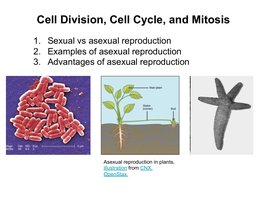
Prokaryotic vs Eukaryotic Cell Division
Binary Fission, Mitosis, and Meiosis
Prokaryotic cells divide by binary fission, a simple process involving DNA replication and cell splitting. Eukaryotic cells divide by mitosis (for growth and repair) and meiosis (for sexual reproduction, producing gametes).
Binary Fission: Produces two identical cells; common in bacteria.
Mitosis: Produces two genetically identical daughter cells; used for growth and tissue repair.
Meiosis: Produces four genetically diverse haploid cells (gametes); essential for sexual reproduction.
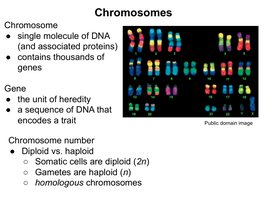
Chromosome Structure and Terms
Chromatin, Chromosomes, and Chromatids
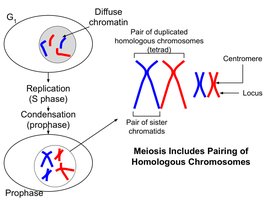
Chromosomes are structures composed of DNA and proteins. Chromatin is the diffuse form of DNA and protein found in the nucleus. During cell division, chromatin condenses into visible chromosomes. Each replicated chromosome consists of two sister chromatids joined at a centromere.
Gene: A sequence of DNA that encodes a trait.
Homologous Chromosomes: Chromosome pairs with similar structure and gene content.
Diploid (2n): Cells with two sets of chromosomes (somatic cells).
Haploid (n): Cells with one set of chromosomes (gametes).
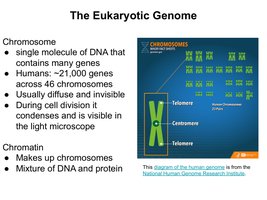
The Eukaryotic Genome
Organization of Genetic Material
The eukaryotic genome consists of multiple linear chromosomes. Each chromosome contains many genes and is made of chromatin (DNA and protein). During cell division, chromosomes condense and become visible under a microscope.
Telomere: Protective end region of a chromosome.
Centromere: Region where sister chromatids are joined.
Cell Cycle Stages
Phases of the Cell Cycle
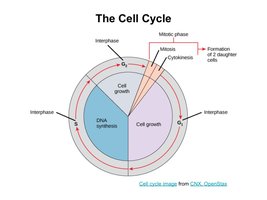
The cell cycle is divided into interphase (G1, S, G2) and the mitotic phase (M). Interphase is the period of cell growth and DNA replication, while the M phase includes mitosis and cytokinesis.
G1 Phase: Cell growth and preparation for DNA synthesis.
S Phase: DNA replication.
G2 Phase: Preparation for mitosis.
M Phase: Mitosis and cytokinesis (cell division).
Cell Cycle Control
Checkpoints and Regulation
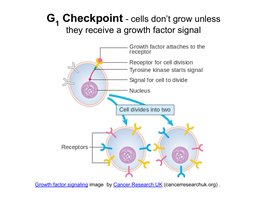
The cell cycle is regulated by checkpoints at G1, G2, and M phases. These checkpoints ensure that the cell only proceeds to the next stage if conditions are favorable and DNA is undamaged. Growth factors and signaling pathways play a key role in this regulation.
G1 Checkpoint: Checks for cell size, nutrients, and DNA integrity.
G2 Checkpoint: Ensures DNA replication is complete and undamaged.
M Checkpoint: Ensures chromosomes are properly attached to the spindle before separation.
Errors in the Cell Cycle
Cancer and Uncontrolled Cell Division
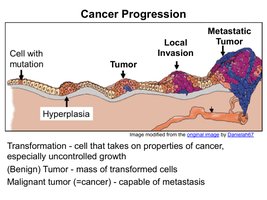
Errors in cell cycle regulation can lead to uncontrolled cell division, resulting in cancer. Cancer progression involves transformation (cells acquire cancerous properties), formation of benign or malignant tumors, and metastasis (spread to other tissues).
Transformation: Normal cell becomes cancerous.
Benign Tumor: Mass of non-invasive transformed cells.
Malignant Tumor: Cancerous, capable of invading other tissues (metastasis).
Mitosis
Stages of Mitosis
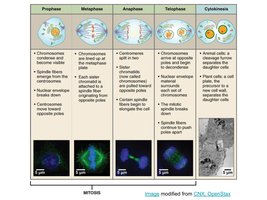
Mitosis is the process by which a eukaryotic cell divides its nucleus and contents to produce two identical daughter cells. The stages include prophase, metaphase, anaphase, telophase, and cytokinesis.
Prophase: Chromosomes condense, spindle forms.
Metaphase: Chromosomes align at the cell equator.
Anaphase: Sister chromatids separate to opposite poles.
Telophase: Nuclear envelopes reform, chromosomes decondense.
Cytokinesis: Division of the cytoplasm, forming two cells.
Cytokinesis in Plant vs Animal Cells
Mechanisms of Cytoplasmic Division
Cytokinesis differs between plant and animal cells. Animal cells form a cleavage furrow that pinches the cell in two, while plant cells build a cell plate that develops into a new cell wall.
Animal Cells: Cleavage furrow forms and deepens to split the cell.
Plant Cells: Vesicles coalesce at the center to form a cell plate, which becomes the new cell wall.
Sexual vs Asexual Reproduction
Comparison of Reproductive Strategies
Asexual reproduction produces genetically identical offspring from a single parent, while sexual reproduction combines genetic material from two parents, resulting in genetic diversity. Examples of asexual reproduction include binary fission in bacteria, budding in yeast, and vegetative propagation in plants.
Asexual Reproduction: Offspring are clones of the parent.
Sexual Reproduction: Offspring have unique genetic combinations.
Meiosis and Genetic Variation
Stages and Mechanisms
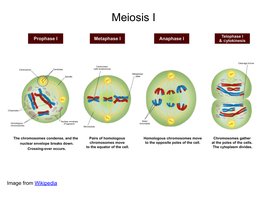
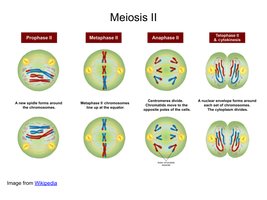
Meiosis is a two-division process that reduces chromosome number by half, producing four haploid gametes. It introduces genetic variation through crossing over and independent assortment.
Meiosis I: Homologous chromosomes separate.
Meiosis II: Sister chromatids separate.
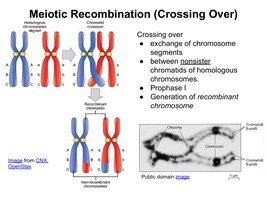
Crossing Over: Exchange of genetic material between homologous chromosomes during prophase I.
Independent Assortment: Random alignment of chromosome pairs during metaphase I.
Genetic Diversity from Meiosis
Sources and Calculations
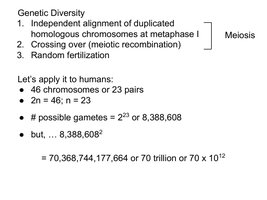
Genetic diversity arises from independent assortment, crossing over, and random fertilization. In humans, with 23 chromosome pairs, the number of possible gamete combinations is , and the potential combinations from fertilization are even greater.
Independent Assortment: possible gametes, where n is the number of chromosome pairs.
Random Fertilization: Further increases genetic variation.
Errors in Meiosis: Nondisjunction and Aneuploidy
Consequences of Chromosome Segregation Errors
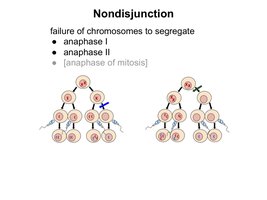
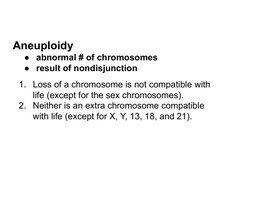
Nondisjunction is the failure of chromosomes to separate properly during meiosis, leading to gametes with abnormal chromosome numbers (aneuploidy). This can result in disorders such as Down syndrome (trisomy 21).
Nondisjunction: Can occur in anaphase I or II.
Aneuploidy: Presence of an abnormal number of chromosomes; often incompatible with life except for certain chromosomes (e.g., X, Y, 13, 18, 21).
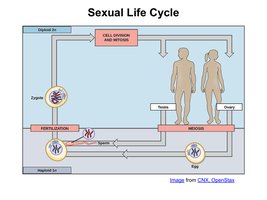
Sexual Life Cycle
Alternation of Generations and Gamete Formation
In animals, meiosis produces haploid gametes, which fuse during fertilization to form a diploid zygote. The zygote undergoes mitosis for growth and development. In plants, alternation of generations involves both haploid and diploid multicellular stages.
Summary Table: Types of Cell Division
Comparison of Binary Fission, Mitosis, and Meiosis
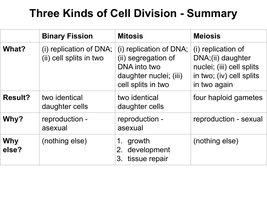
The following table summarizes the main features of binary fission, mitosis, and meiosis:
Binary Fission | Mitosis | Meiosis | |
|---|---|---|---|
What? | (i) replication of DNA; (ii) cell splits in two | (i) replication of DNA; (ii) segregation of DNA into two daughter nuclei; (iii) cell splits in two | (i) replication of DNA; (ii) daughter nuclei; (iii) cell splits in two; (iv) two cell splittings |
Result? | two identical daughter cells | two identical daughter cells | four haploid gametes |
Why? | reproduction - asexual | reproduction - asexual | reproduction - sexual |
Why else? | (nothing else) | 1. growth 2. development 3. tissue repair | (nothing else) |
