 Back
BackCell Division, Cell Cycle, and Mitosis: Study Notes
Study Guide - Smart Notes
 Tailored notes based on your materials, expanded with key definitions, examples, and context.
Cell Division, Cell Cycle, and Mitosis
Sexual vs. Asexual Reproduction
Reproduction is the biological process by which new individual organisms are produced. It can occur via two main mechanisms: sexual reproduction and asexual reproduction.
Asexual reproduction: Involves a single parent and produces offspring genetically identical to the parent. No fusion of gametes occurs.
Sexual reproduction: Involves two parents and the fusion of gametes, resulting in offspring with genetic variation.
Examples of Asexual Reproduction
Asexual reproduction occurs in many organisms, including plants and animals. Common examples include:
Binary fission: Common in prokaryotes such as bacteria.
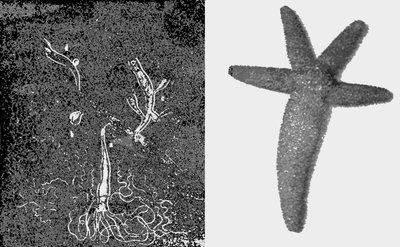
Budding: Seen in hydra and yeast.
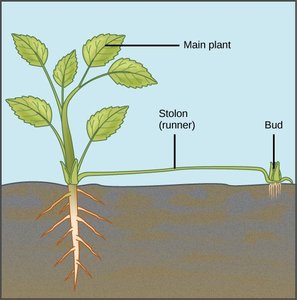
Vegetative propagation: Occurs in plants via runners, tubers, or bulbs.
Fragmentation: Observed in starfish and some worms.
Advantages of Asexual Reproduction
Asexual reproduction offers several advantages:
Rapid population increase: Offspring are produced quickly without the need for a mate.
Genetic uniformity: All offspring are clones of the parent, which is beneficial in stable environments.
Energy efficiency: No energy is spent finding a mate or producing gametes.
Three Kinds of Cell Division
Binary Fission, Mitosis, and Meiosis
Cell division is essential for reproduction, growth, and maintenance in living organisms. There are three main types:
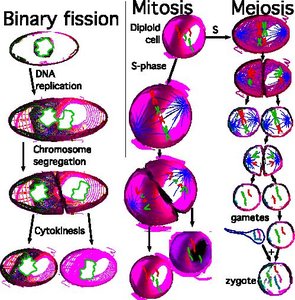
Binary fission: Occurs in prokaryotes. DNA is replicated, segregated, and the cell splits into two identical daughter cells.
Mitosis: Occurs in eukaryotes. DNA is replicated, segregated into two daughter nuclei, and the cell splits, producing two identical daughter cells.
Meiosis: Occurs in eukaryotes for sexual reproduction. DNA is replicated, segregated, and the cell divides twice, producing four haploid gametes.
Purpose:
Binary fission: Asexual reproduction
Mitosis: Asexual reproduction, growth, development, tissue repair
Meiosis: Sexual reproduction
Summary Table: Three Kinds of Cell Division
Type | Process | Result | Purpose |
|---|---|---|---|
Binary Fission | DNA replication, cell splits | 2 identical cells | Asexual reproduction |
Mitosis | DNA replication, segregation, cell splits | 2 identical cells | Asexual reproduction, growth, repair |
Meiosis | DNA replication, segregation, two cell divisions | 4 haploid gametes | Sexual reproduction |
Chromosomes and Chromatin
Chromosome Structure and Function
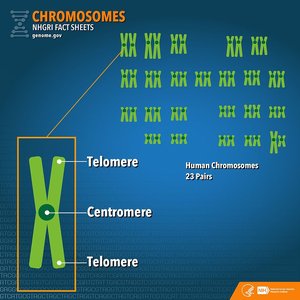
Chromosomes are single molecules of DNA containing many genes. In humans, there are approximately 21,000 genes distributed across 46 chromosomes (23 pairs). Chromosomes are usually diffuse and invisible, but condense and become visible during cell division.
Telomere: The end region of a chromosome, important for stability.
Centromere: The central region where sister chromatids are joined.
Chromatin
Chromatin is the material that makes up chromosomes, consisting of DNA and associated proteins. Chromatin structure allows for efficient packaging of DNA and regulation of gene expression.
The Eukaryotic Genome
The eukaryotic genome is organized into multiple linear chromosomes. Each chromosome contains a unique set of genes. The human genome is a well-studied example, with 23 pairs of chromosomes and thousands of genes.
Mitosis: An Overview
Stages of Mitosis
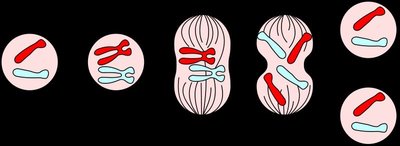
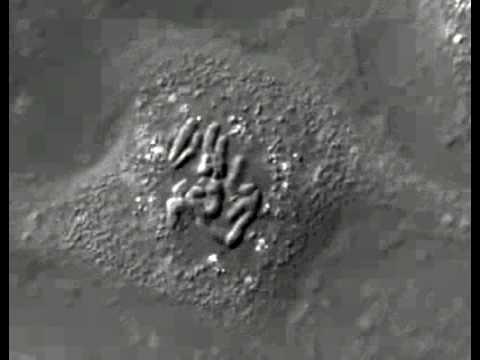
Mitosis is the process by which a eukaryotic cell divides to produce two genetically identical daughter cells. The stages include:
Prophase: Chromosomes condense and become visible.
Metaphase: Chromosomes align at the cell's equator.
Anaphase: Sister chromatids are pulled apart to opposite poles.
Telophase: Nuclear membranes reform around the separated chromatids.
Cytokinesis: The cell splits into two daughter cells.
The Cell Cycle
Phases of the Cell Cycle
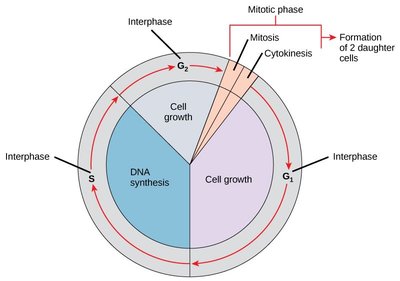
The cell cycle is the series of events that cells go through as they grow and divide. It consists of:
Interphase: The cell grows (G1), replicates DNA (S), and prepares for division (G2).
Mitotic phase: Includes mitosis and cytokinesis, resulting in two daughter cells.
The cell cycle ensures proper growth, DNA replication, and division.
Key Equation:
The DNA content doubles during S phase, then is equally divided during mitosis:
Example: In human cells, the cell cycle is tightly regulated to ensure proper tissue growth and repair.
