 Back
BackCell Division: Interphase, Mitosis, Cancer, and Meiosis
Study Guide - Smart Notes
 Tailored notes based on your materials, expanded with key definitions, examples, and context.
Cell Division: An Overview
Introduction to Cell Division
Cell division is a fundamental process in biology, essential for growth, development, and maintenance of all living organisms. This chapter focuses on the mechanisms of cell division, including mitosis, the cell cycle, and the regulation of these processes, as well as the implications of uncontrolled cell division such as cancer.
Reproduction on the Cellular Level
Key Terms and Chromosome Number
Chromosome Number: The total number of chromosomes in a cell. In humans, the diploid number (2n) is 46, and the haploid number (n) is 23.
Diploid (2n): Cells with two sets of chromosomes, one from each parent.
Haploid (n): Cells with one set of chromosomes, typical of gametes (sperm and egg).
Duplicated Chromosome: A chromosome that has been copied and consists of two sister chromatids joined at the centromere.
Unduplicated Chromosome: A single, unreplicated chromosome.
Example: If a cell has a diploid number of 6 (2n = 6), the haploid number is 3 (n = 3).
Bacteria & Binary Fission
Mechanism of Prokaryotic Cell Division
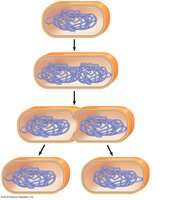
Binary fission is the process by which prokaryotic cells, such as bacteria, reproduce. It involves the duplication of the single, circular chromosome, elongation of the cell, and division into two genetically identical daughter cells.
Step 1: Duplication of the chromosome and separation of the copies.
Step 2: Continued elongation of the cell and movement of the chromosome copies to opposite ends.
Step 3: Division into two daughter cells.
Diploid and Haploid Cells
Chromosome Sets in Eukaryotes
Most eukaryotic organisms alternate between diploid and haploid stages in their life cycles. Somatic (body) cells are typically diploid, while gametes are haploid.
Diploid (2n): Contains two sets of chromosomes.
Haploid (n): Contains one set of chromosomes.
Example: Human somatic cells have 46 chromosomes (2n = 46); human gametes have 23 chromosomes (n = 23).
The Cell Cycle
Phases of the Cell Cycle
The cell cycle is the ordered sequence of events that a cell goes through to divide and produce new cells. It consists of interphase (G1, S, G2) and the mitotic (M) phase.
Interphase: The preparatory stage, including cell growth (G1), DNA replication (S), and preparation for mitosis (G2).
M Phase: Includes mitosis (nuclear division) and cytokinesis (cytoplasmic division).
G0 Phase: A resting state where cells exit the cycle and do not divide.
Mitosis
Stages of Mitosis
Mitosis is the process by which a eukaryotic cell separates its duplicated chromosomes into two identical nuclei. It is divided into several stages:
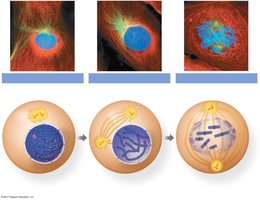
Prophase: Chromosomes condense, spindle fibers begin to form, and the nuclear envelope starts to break down.
Prometaphase: The nuclear envelope fragments, and spindle fibers attach to kinetochores on chromosomes.
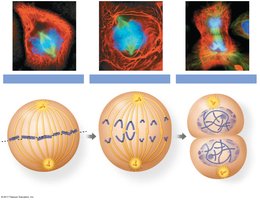
Metaphase: Chromosomes align at the metaphase plate (center of the cell).
Anaphase: Sister chromatids are pulled apart toward opposite poles of the cell.
Telophase: Nuclear envelopes reform around the two sets of chromosomes, which decondense.
Cytokinesis: Division of the cytoplasm, resulting in two daughter cells.
Cytokinesis in Animal and Plant Cells
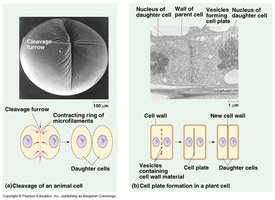
Cytokinesis differs between animal and plant cells:
Animal Cells: Cleavage furrow forms, pinching the cell into two.
Plant Cells: Cell plate forms, leading to the development of a new cell wall between daughter cells.
Regulation of the Cell Cycle
Control Mechanisms
The cell cycle is tightly regulated by checkpoints and molecular signals to ensure proper division. Key regulators include cyclins and cyclin-dependent kinases (Cdks).
Checkpoints: Critical control points where the cell assesses whether to proceed with division (e.g., G1, G2, and M checkpoints).
Cyclins and Cdks: Cyclins are proteins whose levels fluctuate during the cell cycle; Cdks are enzymes that, when activated by cyclins, phosphorylate target proteins to advance the cell cycle.
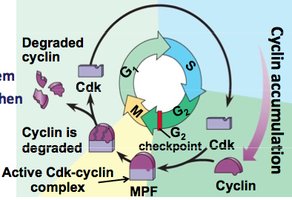
Example: The G2 checkpoint ensures all DNA is replicated before mitosis begins.
Cancer and Cell Division
Uncontrolled Cell Division
Cancer results from the loss of normal cell cycle regulation, leading to uncontrolled cell division and the formation of tumors.
Tumor: A mass or lump of tissue formed by abnormal cell growth.
Benign Tumor: Localized and generally non-harmful.
Malignant Tumor: Can invade nearby tissues and spread (metastasize) to other parts of the body.
Metastasis: The spread of cancer cells from the original site to other areas of the body.
Mutations: Changes in DNA that can disrupt normal cell cycle regulation and contribute to cancer development.
Normal Cell Division Patterns
Anchorage Dependence: Normal cells must be attached to a substrate to divide.
Density-Dependent Inhibition: Normal cells stop dividing when they come into contact with other cells.
In cancer, these regulatory mechanisms are often lost, allowing cells to divide uncontrollably.
Summary Table: Key Differences in Cell Division
Process | Organism Type | Key Features |
|---|---|---|
Binary Fission | Prokaryotes | Simple, rapid division; single circular chromosome; no mitotic spindle |
Mitosis | Eukaryotes | Multiple linear chromosomes; spindle apparatus; complex regulation |
Cancerous Division | Eukaryotes | Loss of regulation; potential for metastasis; associated with mutations |
Additional info: For further study, refer to video resources and animations on mitosis and cancer biology as recommended in the lecture materials.
