 Back
Cell Division, Mendelian Genetics, and Chromosomal Mutations: Study Notes for General Biology
Study Guide - Smart Notes
 Tailored notes based on your materials, expanded with key definitions, examples, and context.
The Cell Cycle and Mitosis
Phases of the Cell Cycle
The cell cycle is the series of events that cells go through as they grow and divide. It consists of interphase (G1, S, G2), the mitotic phase (M phase), and cytokinesis.
Interphase: Includes G1 (cell growth), S (DNA replication), and G2 (preparation for division).
Mitotic phase (M phase): Division of the nucleus (mitosis).
Cytokinesis: Division of the cytoplasm, resulting in two daughter cells.
Phases of Mitosis
Mitosis is divided into four main phases: prophase, metaphase, anaphase, and telophase.
Prophase: Chromosomes condense, spindle forms, nuclear envelope breaks down.
Metaphase: Chromosomes align at the cell's equator.
Anaphase: Sister chromatids separate and move to opposite poles.
Telophase: Chromosomes decondense, nuclear envelopes reform.
Memory trick: PMAT = Prophase, Metaphase, Anaphase, Telophase.
The Mitotic Spindle
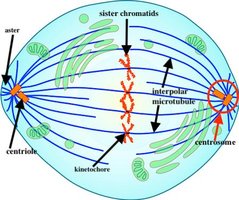
The mitotic spindle is a structure made of microtubules that segregates chromosomes during cell division.
Centrosomes: Organize spindle microtubules.
Kinetochore microtubules: Attach to chromosomes at kinetochores and pull chromatids apart.
Nonkinetochore microtubules: Overlap and push spindle poles apart.
Asters: Radiate from centrosomes, help position the spindle.
Cytokinesis in Animals vs. Plants
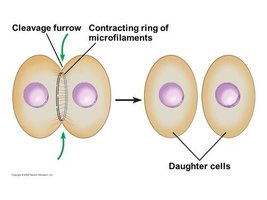
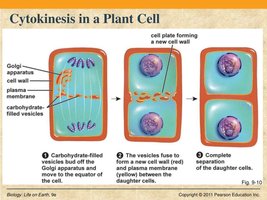
Cytokinesis divides the cytoplasm, but the process differs between animal and plant cells.
Animal cells: A cleavage furrow forms, pinching the cell in two.
Plant cells: A cell plate forms, developing into a new cell wall.
Binary Fission in Bacteria
Binary fission is the process by which prokaryotes (bacteria) reproduce asexually, producing two genetically identical cells.
DNA is replicated.
Cell elongates, DNA copies move apart.
Membrane pinches inward, new cell wall forms.
Two identical daughter cells result.
Cancer and Cell Cycle Control
Cancer results from the loss of normal cell cycle regulation, leading to uncontrolled cell division.
Mutations in genes controlling division.
Failure to respond to stop signals or apoptosis.
Potential for metastasis (spread to other tissues).
Meiosis and Sexual Life Cycles
Key Terms
Somatic cell: Any non-reproductive cell.
Gamete: Reproductive cell (sperm or egg).
Autosome: Non-sex chromosome.
Sex chromosome: Chromosome involved in sex determination (X or Y in humans).
Haploid (n): One set of chromosomes.
Diploid (2n): Two sets of chromosomes.
Phases of Meiosis
Meiosis consists of two divisions (Meiosis I and II), producing four genetically unique haploid cells.
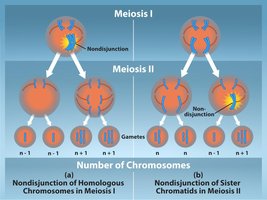
Meiosis I: Homologous chromosomes separate.
Meiosis II: Sister chromatids separate.
Unique Events in Meiosis I
Synapsis: Homologous chromosomes pair up (tetrads).
Crossing over: Exchange of DNA between non-sister chromatids.
Separation of homologous chromosomes: Reduces chromosome number by half.
Genetic Variation in Sexual Reproduction
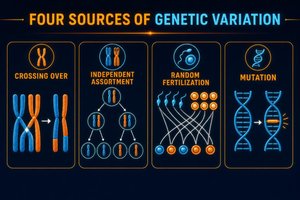
Three main mechanisms increase genetic diversity:
Crossing over: New allele combinations during Prophase I.
Independent assortment: Random orientation of homologous pairs during Metaphase I.
Random fertilization: Any sperm can fertilize any egg.
Mendelian Genetics
Key Terms and Concepts
True breeding: Homozygous for a trait, always passes it on.
Hybridization: Crossing different organisms.
Monohybrid cross: Examines one trait.
P, F1, F2 generations: Parental, first filial, second filial generations.
Dominance, Genotype, and Phenotype
Dominant allele: Expressed if present (A).
Recessive allele: Masked unless homozygous (a).
Heterozygous: Two different alleles (Aa).
Homozygous: Two identical alleles (AA or aa).
Genotype: Genetic makeup.
Phenotype: Observable trait.
Mendel's Laws
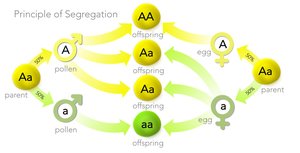
Law of Segregation: Alleles separate during gamete formation; each gamete gets one allele.
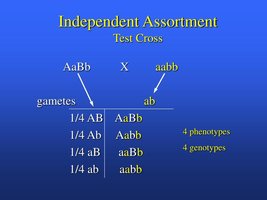
Law of Independent Assortment: Alleles of different genes assort independently if unlinked.
Genetic Ratios and Probability
Monohybrid cross (Aa × Aa): 3:1 phenotypic, 1:2:1 genotypic ratio.
Dihybrid cross (AaBb × AaBb): 9:3:3:1 phenotypic ratio.
Rule of Multiplication: Probability of independent events is the product of their probabilities.
Chromosomal Basis of Inheritance
Sex-Linked and Linked Genes
Sex-linked genes: Located on X or Y chromosomes (e.g., color blindness).
Linked genes: Located close together on the same chromosome, inherited together.
Recombinant Phenotypes and Crossing Over
Crossing over during Prophase I of meiosis creates new allele combinations, resulting in recombinant phenotypes.
Nondisjunction and Aneuploidy
Nondisjunction is the failure of chromosomes to separate properly during meiosis, leading to gametes with abnormal chromosome numbers (aneuploidy).
Trisomy: Three copies of a chromosome (e.g., Down syndrome).
Monosomy: One copy of a chromosome (e.g., Turner syndrome).
Chromosomal Mutations
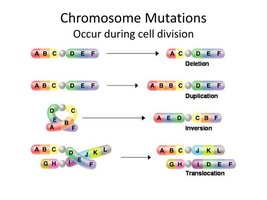
Structural changes in chromosomes include:
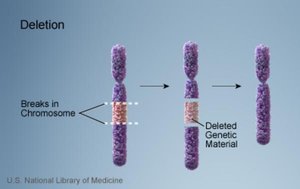
Deletion: Loss of a chromosome segment.
Duplication: Repetition of a segment.
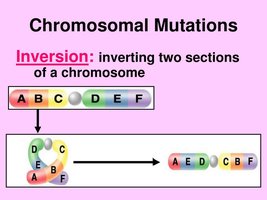
Inversion: Segment reversed within the chromosome.
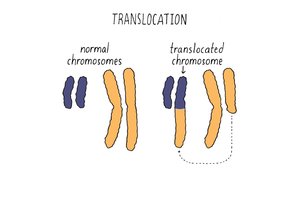
Translocation: Segment moves to a nonhomologous chromosome.
Non-Mendelian Genetics
Types of Dominance
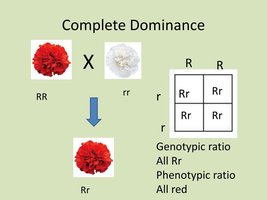
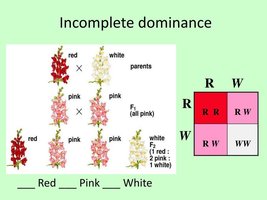
Complete dominance: One allele completely masks the other (e.g., RR = red, Rr = red, rr = white).
Incomplete dominance: Heterozygote has an intermediate phenotype (e.g., RR = red, RW = pink, WW = white).
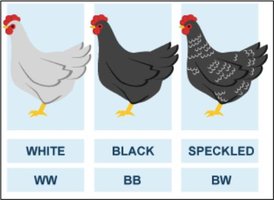
Codominance: Both alleles are fully expressed (e.g., black and white feathers in chickens).
Pleiotropy and Epistasis
Pleiotropy: One gene affects multiple traits (e.g., sickle cell disease).
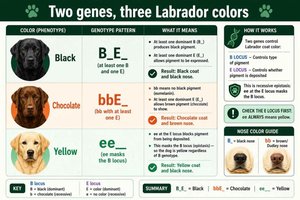
Epistasis: One gene affects the expression of another gene (e.g., Labrador retriever coat color).
Lethal Genes and Pedigree Analysis
Lethal dominant genes: Rare, as they are often eliminated from the population.
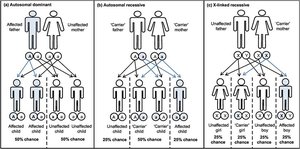
Lethal recessive genes: Can persist in heterozygous carriers.
Pedigrees: Diagrams used to track inheritance patterns across generations.
Genomic Imprinting
Genomic imprinting is when gene expression depends on the parent of origin, often due to DNA methylation. It is important for normal development and can cause disorders if disrupted (e.g., Prader-Willi and Angelman syndromes).
