 Back
BackCell Division: Mitosis, Cytokinesis, and Cell Cycle Regulation
Study Guide - Smart Notes
 Tailored notes based on your materials, expanded with key definitions, examples, and context.
Cell Division
Mitosis: Phases and Key Structures
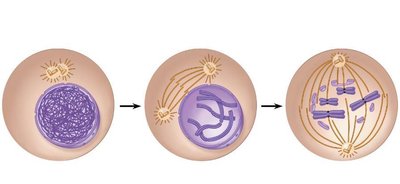
Mitosis is the process by which a eukaryotic cell separates its duplicated chromosomes into two identical sets, resulting in two daughter cells. This process ensures genetic continuity and is essential for growth, repair, and asexual reproduction.
Prophase: Chromatin condenses into visible chromosomes, each consisting of two sister chromatids joined at the centromere. The mitotic spindle begins to form from centrosomes, and the nuclear envelope starts to break down.
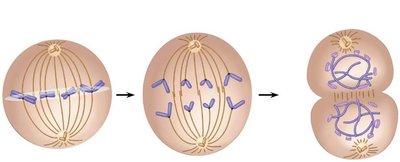
Metaphase: Chromosomes align at the metaphase plate, an imaginary plane equidistant from the spindle's two poles. Spindle fibers attach to kinetochores at the centromeres.
Anaphase: Sister chromatids are pulled apart toward opposite poles of the cell by the shortening of spindle microtubules.
Telophase: Chromosomes decondense, nuclear envelopes reform around each set of chromosomes, and the spindle apparatus disassembles.
Cytokinesis: Division of the Cytoplasm
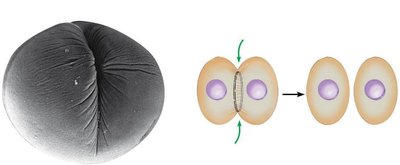
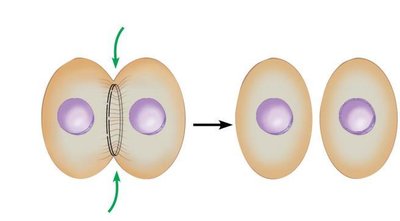
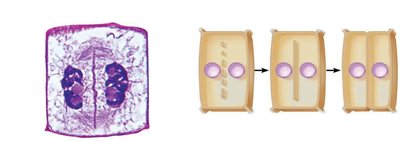
Cytokinesis is the process that divides the cytoplasm of a parental cell into two daughter cells, usually occurring simultaneously with telophase of mitosis. The mechanism differs between animal and plant cells.
In Animal Cells: Cytokinesis occurs via the formation of a cleavage furrow, which is produced by a contracting ring of actin microfilaments interacting with myosin. The furrow deepens until the cell is pinched in two.
In Plant Cells: Cytokinesis involves the formation of a cell plate in the center of the cell. Vesicles containing cell wall materials coalesce at the center, fuse, and expand outward until they reach the cell membrane, forming a new cell wall between the daughter cells.
Regulation of the Cell Cycle
Cell Cycle Checkpoints
The cell cycle is tightly regulated by a control system composed of regulatory proteins and checkpoints. These checkpoints ensure that each phase is completed accurately before the next phase begins.
G1 Checkpoint: Determines whether the cell will proceed to DNA synthesis (S phase) or exit the cycle into a non-dividing state (G0 phase).
G2 Checkpoint: Ensures that DNA replication in S phase has been completed successfully before mitosis begins.
M Checkpoint: Ensures that all chromosomes are properly attached to the spindle before anaphase proceeds.
Growth factors, anchorage dependence, and density-dependent inhibition are external signals that influence cell cycle progression.
Growth Factors: Proteins that stimulate cell division.
Anchorage Dependence: Cells must be attached to a solid surface to divide.
Density-Dependent Inhibition: Crowded cells stop dividing when they come into contact with each other.
Stem Cells and Differentiation
Definition and Importance
Stem cells are undifferentiated cells capable of giving rise to various specialized cell types through the process of differentiation. All specialized cells in the body originate from stem cells. Once a stem cell commits to a differentiation pathway, it cannot revert to another cell type on its own.
Differentiation: The process by which a stem cell becomes specialized for a specific function.
Specialized Cells: Examples include muscle cells, nerve cells, fat cells, and skin cells.
Summary Table: Comparison of Cytokinesis in Animal and Plant Cells
Feature | Animal Cells | Plant Cells |
|---|---|---|
Mechanism | Cleavage furrow forms via actin-myosin contraction | Cell plate forms from vesicles containing cell wall material |
Result | Two daughter cells separated by plasma membrane | Two daughter cells separated by new cell wall and plasma membrane |
Key Structures | Contractile ring, cleavage furrow | Vesicles, cell plate, new cell wall |
Key Terms and Definitions
Chromatin: The complex of DNA and proteins that forms chromosomes within the nucleus.
Centrosome: Organelle that serves as the main microtubule organizing center and is important for spindle formation.
Kinetochore: Protein structure on chromatids where spindle fibers attach during cell division.
Cleavage Furrow: Indentation that begins the process of cytokinesis in animal cells.
Cell Plate: Structure that forms in plant cells during cytokinesis, leading to the formation of a new cell wall.
Checkpoints: Regulatory points in the cell cycle where the cell assesses whether to proceed with division.
Equations and Formulas
Cell Cycle Phases:
Mitotic Index (for cell populations):
