 Back
Cell Division: Mitosis vs. Meiosis – Structure, Function, and Comparison
Study Guide - Smart Notes
 Tailored notes based on your materials, expanded with key definitions, examples, and context.
Cell Division
Overview of Mitosis and Meiosis
Cell division is a fundamental process in biology, allowing organisms to grow, repair tissues, and reproduce. The two main types of cell division in eukaryotes are mitosis and meiosis. Mitosis results in genetically identical cells, while meiosis produces genetically unique gametes for sexual reproduction.
Mitosis
Purpose and Process
Definition: Mitosis is the process by which a single somatic cell divides to produce two genetically identical daughter cells, each with the same number of chromosomes as the parent cell.
Function: Essential for growth, tissue repair, and asexual reproduction in multicellular organisms.
Stages: Prophase, Prometaphase, Metaphase, Anaphase, Telophase, followed by Cytokinesis.
Meiosis
Purpose and Process
Definition: Meiosis is a two-step division process that reduces the chromosome number by half, producing four genetically unique haploid gametes (sperm or eggs).
Function: Enables sexual reproduction and increases genetic diversity through recombination and independent assortment.
Stages: Meiosis I (reductional division) and Meiosis II (equational division), each with Prophase, Metaphase, Anaphase, and Telophase, followed by Cytokinesis.
Comparison of Mitosis and Meiosis
Key Differences
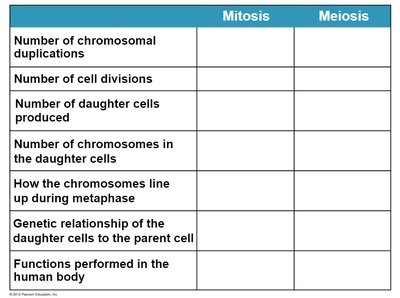
The following table summarizes the main differences between mitosis and meiosis:
Mitosis | Meiosis | |
|---|---|---|
Number of chromosomal duplications | One | One |
Number of cell divisions | One | Two |
Number of daughter cells produced | Two | Four |
Number of chromosomes in the daughter cells | Diploid (2n, same as parent) | Haploid (n, half of parent) |
How the chromosomes line up during metaphase | Single file at the metaphase plate | Homologous pairs align in Meiosis I; single file in Meiosis II |
Genetic relationship of the daughter cells to the parent cell | Genetically identical | Genetically unique |
Functions performed in the human body | Growth, repair, asexual reproduction | Production of gametes (sperm and eggs) |
Visual Representation of Mitosis and Meiosis
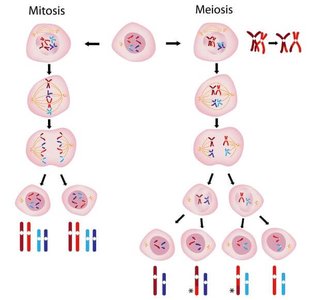
The following diagram illustrates the sequence of events and outcomes in mitosis and meiosis, highlighting the differences in chromosome behavior and the number of resulting cells.
Additional Info
Genetic Variation: Meiosis introduces genetic variation through crossing over (exchange of genetic material between homologous chromosomes during Prophase I) and independent assortment (random orientation of homologous pairs during Metaphase I).
Clinical Relevance: Errors in meiosis can lead to aneuploidy (abnormal chromosome number), such as Down syndrome (trisomy 21).
