 Back
Cell Energetics: Enzymes, Cellular Respiration, and Photosynthesis
Study Guide - Smart Notes
 Tailored notes based on your materials, expanded with key definitions, examples, and context.
Cell Energetics
Enzymes
Enzymes are biological catalysts that accelerate chemical reactions in cells by lowering the activation energy required. They are essential for metabolic processes and exhibit high specificity for their substrates.
Enzyme: A protein that speeds up chemical reactions without being consumed.
Substrate: The reactant molecule upon which an enzyme acts.
Enzyme-substrate complex: Temporary association formed when an enzyme binds its substrate.
Active site: The region on the enzyme where the substrate binds.
Induced fit: The active site changes shape to better fit the substrate upon binding.
Enzyme specificity: Each enzyme catalyzes only one type of reaction due to the unique shape of its active site.
Activation energy (EA): The minimum energy required to initiate a chemical reaction. Enzymes lower this barrier.
Cofactors: Non-protein molecules (often metal ions) required for enzyme activity.
Coenzymes: Organic cofactors (often derived from vitamins) that assist enzymes.
Inhibitors: Molecules that decrease enzyme activity.
Competitive inhibition: Inhibitor binds to the active site, blocking substrate access.
Noncompetitive (allosteric) inhibition: Inhibitor binds elsewhere, changing enzyme shape and reducing activity.
Allosteric regulation: Regulation of enzyme activity by binding of molecules at sites other than the active site, which can activate or inhibit the enzyme.
Irreversible inhibition: Inhibitor binds permanently, inactivating the enzyme.
Feedback inhibition: End product of a pathway inhibits an upstream enzyme, regulating pathway activity.
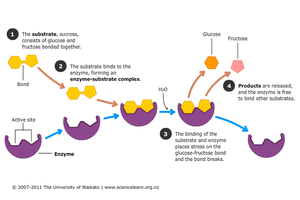
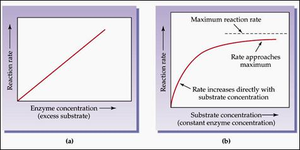
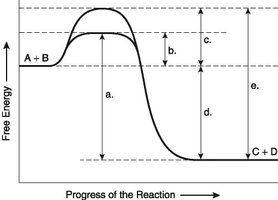
Example: The enzyme sucrase catalyzes the hydrolysis of sucrose into glucose and fructose.
Equation for enzyme-catalyzed reaction:
$\mathrm{E + S \rightleftharpoons ES \rightarrow E + P}$
Additional info: Enzyme activity can be affected by temperature, pH, and the presence of inhibitors or activators.
Cellular Respiration
Overview and Definitions
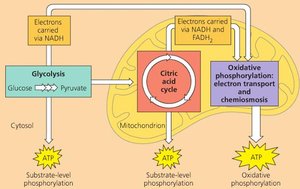
Cellular respiration is the process by which cells extract energy from organic molecules, primarily glucose, to produce ATP. It involves a series of redox reactions and occurs in both the cytoplasm and mitochondria of eukaryotic cells.
Catabolic reactions: Break down large molecules into smaller ones, releasing energy.
Anabolic reactions: Build complex molecules from simpler ones, requiring energy input.
Substrate-level phosphorylation: Direct transfer of a phosphate group to ADP to form ATP, occurring in glycolysis and the citric acid cycle.
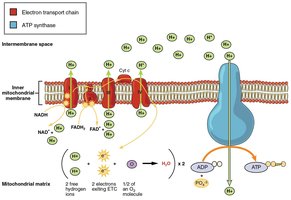
Oxidative phosphorylation: ATP formation powered by the transfer of electrons from NADH and FADH2 to oxygen via the electron transport chain, generating a proton gradient that drives ATP synthase.
ATP Synthase: Enzyme that synthesizes ATP using the energy from the proton gradient across the mitochondrial membrane.
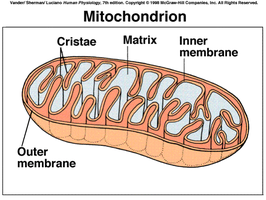
Cellular Respiration Equation
The overall equation for aerobic cellular respiration is:
$\mathrm{C_6H_{12}O_6 + 6O_2 \rightarrow 6CO_2 + 6H_2O + \text{energy (ATP + heat)}}$
Main Steps of Cellular Respiration
Glycolysis: Occurs in the cytoplasm; glucose is split into two pyruvate molecules. Produces a small amount of ATP and NADH. Oxygen is not required.
Citric Acid Cycle (Krebs Cycle): Occurs in the mitochondrial matrix; completes the breakdown of glucose derivatives, producing CO2, NADH, FADH2, and ATP. Oxygen is required indirectly.
Electron Transport Chain (ETC) and Oxidative Phosphorylation: Occurs in the inner mitochondrial membrane; electrons from NADH and FADH2 are transferred through protein complexes, creating a proton gradient that powers ATP synthase. Oxygen is the final electron acceptor.
Anaerobic Respiration
Anaerobic respiration occurs when oxygen is not available. Glycolysis still occurs, but pyruvate is converted to lactate (in animals) or ethanol and CO2 (in yeast) to regenerate NAD+. This process yields much less ATP than aerobic respiration.
What is the same: Glycolysis occurs in both aerobic and anaerobic respiration.
What is different: The fate of pyruvate and the regeneration of NAD+ differ; no electron transport chain is used in anaerobic conditions.
Inputs: Glucose
Outputs: Lactate or ethanol, CO2, and a small amount of ATP
Photosynthesis
Overview and Equation
Photosynthesis is the process by which plants, algae, and some bacteria convert light energy into chemical energy, producing glucose and oxygen from carbon dioxide and water.
$\mathrm{6CO_2 + 6H_2O + \text{light energy} \rightarrow C_6H_{12}O_6 + 6O_2}$
Leaf and Chloroplast Structure
Mesophyll cells: Main site of photosynthesis in leaves.
Cuticle: Waxy layer that prevents water loss.
Stomata (stoma): Pores for gas exchange.
Guard cells: Regulate the opening and closing of stomata.
Chloroplast parts:
Inner membrane and outer membrane: Enclose the chloroplast.
Stroma: Fluid-filled space where the Calvin cycle occurs.
Thylakoid: Membranous sacs where light reactions occur.
Granum: Stack of thylakoids.
Thylakoid membrane: Contains chlorophyll and electron transport proteins.
Thylakoid space: Interior of the thylakoid sac.
Light Reactions
Light reactions occur in the thylakoid membranes and convert solar energy into chemical energy (ATP and NADPH), releasing O2 as a byproduct.
Photosystem II and I: Protein complexes that absorb light and transfer electrons.
Electron transport chain: Series of proteins that transfer electrons, creating a proton gradient.
ATP synthase: Uses the proton gradient to synthesize ATP.
Inputs: Light, water, ADP, NADP+
Outputs: O2, ATP, NADPH
Pigments & Light Energy
Electromagnetic spectrum: Range of all wavelengths of light; visible light is used in photosynthesis.
Photon: A particle of light energy.
Pigment: Molecule that absorbs specific wavelengths of light.
Chlorophyll: Main pigment in plants, absorbs blue and red light, reflects green.
Carotenoids: Accessory pigments that absorb other wavelengths and protect chlorophyll.
Absorption and reflection: Chlorophyll absorbs blue/red, reflects green; carotenoids absorb blue/green, reflect yellow/orange.
Calvin Cycle
The Calvin cycle occurs in the stroma and uses ATP and NADPH to convert CO2 into glucose. It consists of three main phases: carbon fixation, reduction, and regeneration of RuBP.
Inputs: CO2, ATP, NADPH
Outputs: Glucose, ADP, NADP+
Phases: Fixation, reduction, regeneration
Connection Between Cellular Respiration and Photosynthesis
Photosynthesis and cellular respiration are interconnected. The products of one process serve as the reactants for the other, forming a biological cycle that sustains life on Earth.
Photosynthesis: Converts CO2 and H2O into glucose and O2 using light energy.
Cellular respiration: Breaks down glucose and O2 to produce CO2, H2O, and ATP.
