Back
Lecture 6 Notes: Cell Membranes, Diffusion, Osmosis, and Energy in Biological Systems
Study Guide - Smart Notes
 Tailored notes based on your materials, expanded with key definitions, examples, and context.
Cell Membranes, Diffusion & Osmosis
Introduction to Cell Membranes
The cell membrane is a selectively permeable barrier that regulates the movement of substances into and out of the cell. It is essential for maintaining homeostasis and enabling communication and transport between the cell and its environment.
Selective permeability: Only certain molecules can pass through freely; others require transport proteins.
Structure: Composed mainly of a phospholipid bilayer with embedded proteins.
Function: Maintains internal conditions, supports communication, and facilitates energy transformations.
Diffusion and Osmosis
Diffusion and osmosis are passive transport processes that move substances across the cell membrane without the use of cellular energy.
Diffusion: The movement of molecules from an area of higher concentration to an area of lower concentration.
Osmosis: The diffusion of water molecules across a selectively permeable membrane.
Importance: These processes are vital for nutrient uptake, waste removal, and maintaining cell turgor.
Energy and Metabolism
Energy Transformations in Cells
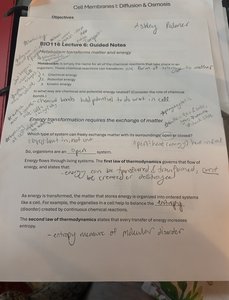
Cells require energy to perform work, which is obtained and transformed through metabolic processes. The study of energy flow in biological systems is called bioenergetics.
Energy: The capacity to do work or cause change.
Potential energy: Stored energy due to position or structure (e.g., chemical bonds).
Kinetic energy: Energy of motion (e.g., movement of molecules).
Thermodynamics in Biology
Biological systems obey the laws of thermodynamics, which govern energy transformations.
First Law of Thermodynamics: Energy cannot be created or destroyed, only transformed from one form to another.
Second Law of Thermodynamics: Every energy transfer increases the entropy (disorder) of the universe.
Application: Cells convert energy from one form to another (e.g., chemical to kinetic), but some energy is always lost as heat.
Equation:
Where is the change in free energy, is the change in enthalpy, is temperature in Kelvin, and is the change in entropy.
Chemical Reactions and Energy
Exergonic and Endergonic Reactions
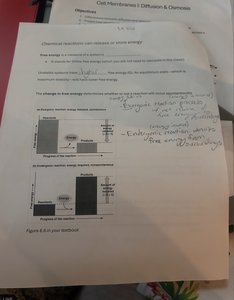
Chemical reactions in cells can either release or require energy.
Exergonic reactions: Release energy; products have less free energy than reactants ().
Endergonic reactions: Require input of energy; products have more free energy than reactants ().
Examples: Cellular respiration is exergonic; photosynthesis is endergonic.
ATP: The Energy Currency of the Cell
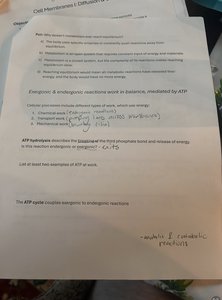
ATP (adenosine triphosphate) is the primary energy carrier in cells. It couples exergonic and endergonic reactions, allowing energy from catabolic processes to drive anabolic processes.
ATP hydrolysis: The breakdown of ATP into ADP and inorganic phosphate releases energy ( is negative).
ATP cycle: ATP is continuously regenerated from ADP and phosphate using energy from catabolic reactions.
Role: Powers cellular work such as muscle contraction, active transport, and biosynthesis.
Equation for ATP hydrolysis:
Coupling of Reactions
Cells use ATP to couple exergonic and endergonic reactions, ensuring that energy-requiring processes can proceed.
Catabolic pathways: Break down molecules and release energy (exergonic).
Anabolic pathways: Build complex molecules and require energy (endergonic).
ATP mediates: The energy released from catabolic reactions is used to drive anabolic reactions via ATP hydrolysis.
Summary Table: Exergonic vs. Endergonic Reactions
Feature | Exergonic Reaction | Endergonic Reaction |
|---|---|---|
Energy Change () | Negative | Positive |
Energy Flow | Releases energy | Requires energy input |
Example | Cellular respiration | Photosynthesis |
Key Takeaways
Cell membranes regulate the movement of substances and energy in and out of cells.
Energy transformations in cells are governed by the laws of thermodynamics.
ATP is the universal energy currency, coupling exergonic and endergonic reactions.
Understanding energy flow is essential for studying metabolism and cellular processes.