 Back
Cell Membranes: Structure and Function
Study Guide - Smart Notes
 Tailored notes based on your materials, expanded with key definitions, examples, and context.
Cell Membranes
Overview of Membrane Structure and Function
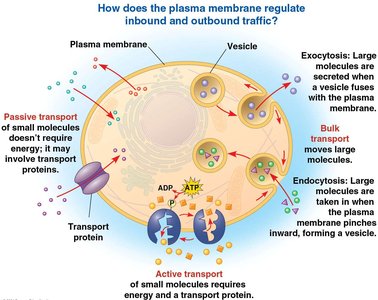
The cell membrane, also known as the plasma membrane, is a dynamic structure that regulates the movement of substances into and out of the cell. It is essential for maintaining cellular homeostasis and enabling communication with the environment.
Passive transport: Small molecules move across the membrane without energy input, sometimes using transport proteins.
Active transport: Requires energy (usually ATP) and a transport protein to move molecules against their concentration gradient.
Bulk transport: Large molecules are moved via exocytosis (out) or endocytosis (in).
Membrane Composition
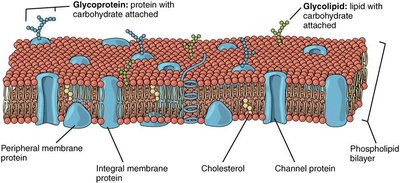
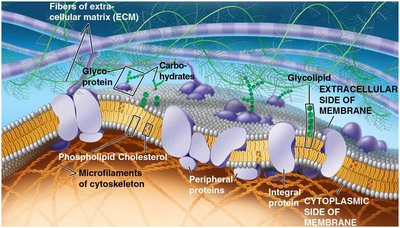
Cell membranes are primarily composed of lipids, proteins, and carbohydrates. The main lipid component is the phospholipid, which is amphipathic, containing both hydrophobic and hydrophilic regions.
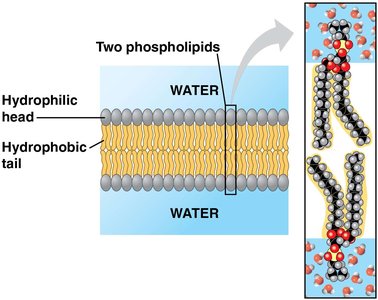
Phospholipids: Form a bilayer with hydrophobic tails facing inward and hydrophilic heads facing outward.
Proteins: Embedded within or attached to the membrane, contributing to its function.
Carbohydrates: Often attached to proteins (glycoproteins) or lipids (glycolipids), important for cell recognition.
Phospholipid Bilayer
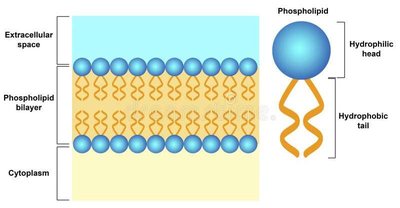
The phospholipid bilayer is the fundamental structure of the membrane, providing a barrier that separates the cell from its environment.
Hydrophilic head: Attracted to water, faces the aqueous environment.
Hydrophobic tail: Repelled by water, faces inward, away from the aqueous environment.
Fluid Mosaic Model
The fluid mosaic model describes the membrane as a mosaic of proteins floating in a fluid bilayer of phospholipids. Proteins are not randomly distributed; they often form functional groups.
Fluidity: Lipids and some proteins can move laterally within the membrane.
Rare flip-flop: Lipids rarely move from one layer to the other.
Membrane Fluidity
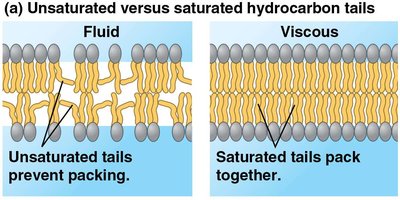
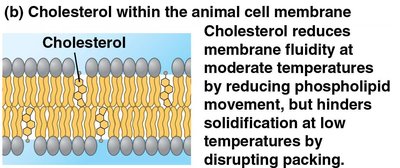
Membrane fluidity is influenced by temperature, lipid composition, and the presence of cholesterol.
Unsaturated fatty acids: Increase fluidity by preventing tight packing.
Saturated fatty acids: Decrease fluidity by allowing tight packing.
Cholesterol: Buffers fluidity, restraining movement at high temperatures and preventing solidification at low temperatures.
Membrane Proteins
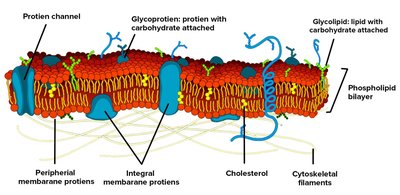
Proteins embedded in the membrane perform a variety of functions and are classified as peripheral or integral proteins.
Peripheral proteins: Bound to the membrane surface.
Integral proteins: Penetrate the hydrophobic core; transmembrane proteins span the membrane.
Attachment: Some proteins are anchored to the cytoskeleton or extracellular matrix.

Functions of Membrane Proteins
Membrane proteins are responsible for transport, enzymatic activity, signal transduction, cell-cell recognition, intercellular joining, and attachment to the cytoskeleton and ECM.
Transport: Move substances across the membrane.
Enzymatic activity: Catalyze reactions at the membrane surface.
Signal transduction: Relay signals from outside to inside the cell.
Cell-cell recognition: Allow cells to identify each other.
Intercellular joining: Connect cells together.
Attachment: Anchor the membrane to internal and external structures.
Membrane Carbohydrates and Cell Recognition
Carbohydrates attached to proteins and lipids on the cell surface serve as markers for cell identification and play a key role in cell-cell recognition.
Glycoproteins: Carbohydrates attached to proteins.
Glycolipids: Carbohydrates attached to lipids.
Diversity: Enables specific cell recognition and immune response.
Selective Permeability
The plasma membrane is selectively permeable, allowing some substances to cross more easily than others. Hydrophobic molecules pass rapidly, while hydrophilic molecules require transport proteins.
Hydrophobic molecules: (e.g., hydrocarbons, O2, CO2) pass easily.
Hydrophilic molecules: (e.g., sugars, ions, water) pass slowly or not at all.
Transport Proteins
Transport proteins facilitate the movement of hydrophilic substances across the membrane.
Channel proteins: Provide hydrophilic tunnels for molecules or ions.
Carrier proteins: Bind and change shape to shuttle molecules across.
Aquaporins: Specialized channel proteins for water.
Passive Transport: Diffusion and Osmosis
Passive transport involves the movement of substances down their concentration gradient without energy input.
Diffusion: Movement from high to low concentration.
Osmosis: Diffusion of free water across a selectively permeable membrane.
Tonicity: The effect of a solution on cell water balance (isotonic, hypertonic, hypotonic).
Facilitated Diffusion
Facilitated diffusion is passive transport aided by proteins, allowing specific molecules to cross the membrane more efficiently.
Channel proteins: Facilitate movement of ions and water.
Carrier proteins: Undergo shape changes to move solutes.
Gated channels: Open or close in response to stimuli.
Active Transport
Active transport uses energy (usually ATP) to move substances against their concentration gradients. All active transport proteins are carrier proteins.
Sodium-potassium pump: Maintains high K+ and low Na+ inside animal cells.
Electrogenic pumps: Generate voltage across membranes (e.g., proton pump in plants).
Cotransport: Active transport of one solute drives the transport of another.
Bulk Transport: Exocytosis and Endocytosis
Bulk transport moves large molecules across the membrane using vesicles.
Exocytosis: Vesicles fuse with the membrane to release contents outside the cell.
Endocytosis: Membrane forms a vesicle to bring substances into the cell.
Types of endocytosis: Phagocytosis (cell eating), pinocytosis (cell drinking), receptor-mediated endocytosis.
Type | Description |
|---|---|
Phagocytosis | Cell engulfs particles into a food vacuole |
Pinocytosis | Cell takes in extracellular fluid in vesicles |
Receptor-mediated | Specific solutes bind to receptors, triggering vesicle formation |
Example: Human cells use receptor-mediated endocytosis to take in cholesterol via LDL particles.
Additional info: Individuals with defective LDL receptors accumulate cholesterol in the blood, increasing risk for heart disease.
