 Back
Lecture 5 Notes: Cell Membranes: Structure, Diffusion, and Transport Mechanisms
Study Guide - Smart Notes
 Tailored notes based on your materials, expanded with key definitions, examples, and context.
Cell Membranes and Cell Size
Constraints on Cell Size
The size of cells is limited by the relationship between surface area and volume. As a cell increases in size, its volume grows faster than its surface area, which impacts the cell's ability to efficiently exchange materials with its environment.
Surface Area: The total area of the cell membrane through which substances can enter or exit the cell.
Volume: The amount of space inside the cell, which determines the cell's metabolic needs.
Surface Area-to-Volume Ratio: As cells grow, this ratio decreases, making it harder for the cell to transport enough materials to support its volume.
Example: Small cells have a higher surface area-to-volume ratio, allowing for more efficient exchange of materials.
Additional info: This principle explains why most cells are microscopic and why large organisms are multicellular rather than having giant cells.
The Cell Membrane
Structure and Function
The cell membrane, also known as the plasma membrane, is a selectively permeable barrier that surrounds the cell. It is composed primarily of a phospholipid bilayer with embedded proteins, cholesterol, and carbohydrates.
Phospholipid Bilayer: Provides the basic structure and forms a hydrophobic barrier.
Proteins: Serve as channels, carriers, receptors, and enzymes.
Carbohydrates: Involved in cell recognition and signaling.
Cholesterol: Modulates membrane fluidity.
Membrane Transport Mechanisms
Passive Transport
Passive transport is the movement of substances across the cell membrane without the use of cellular energy (ATP). It relies on the concentration gradient of the substance.
Diffusion: The movement of molecules from an area of higher concentration to an area of lower concentration.
Osmosis: The diffusion of water across a selectively permeable membrane.
Facilitated Diffusion: The movement of molecules across the membrane via transport proteins (channels or carriers) without energy input.
Example: Oxygen and carbon dioxide diffuse directly through the lipid bilayer, while glucose requires a transport protein.
Osmosis and Tonicity
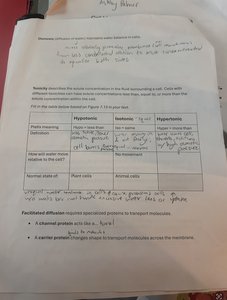
Osmosis is crucial for maintaining cell volume and function. Tonicity describes the ability of a surrounding solution to cause a cell to gain or lose water.
Tonicity | Plant Cell Response | Animal Cell Response |
|---|---|---|
Hypotonic | Cell swells; turgid (normal) | Cell swells and may burst (lysis) |
Isotonic | No net water movement; flaccid | No net water movement; normal |
Hypertonic | Cell shrinks; plasmolyzed | Cell shrinks; crenated |
Additional info: Water moves from areas of low solute concentration to high solute concentration.
Facilitated Diffusion
Facilitated diffusion uses specific transmembrane proteins to help substances move across the membrane down their concentration gradient.
Channel Proteins: Form hydrophilic pores for ions or water to pass through (e.g., aquaporins).
Carrier Proteins: Bind to specific molecules and change shape to shuttle them across the membrane.
Example: Glucose transporters facilitate the movement of glucose into cells.
Active Transport
Active transport requires energy (usually from ATP) to move substances against their concentration gradient.
Primary Active Transport: Direct use of ATP to transport molecules (e.g., sodium-potassium pump).
Secondary Active Transport: Uses the energy from the movement of one substance down its gradient to drive the transport of another substance up its gradient.
Example: The sodium-potassium pump moves 3 Na+ ions out of the cell and 2 K+ ions into the cell, maintaining electrochemical gradients essential for nerve impulse transmission.
pump: 3 Na+ out, 2 K+ in per ATP hydrolyzed.
Bulk Transport
Bulk transport moves large molecules or particles into or out of the cell via vesicles. This process requires energy.
Endocytosis: The cell engulfs material by forming a vesicle around it.
Exocytosis: The cell expels material by fusing a vesicle with the plasma membrane.
Example: White blood cells engulf bacteria by phagocytosis (a type of endocytosis).
Membrane Fluidity
Membrane fluidity is influenced by lipid composition, temperature, and cholesterol content.
Unsaturated Fatty Acids: Increase fluidity due to kinks in the hydrocarbon chains.
Saturated Fatty Acids: Decrease fluidity, making the membrane more rigid.
Cholesterol: Buffers membrane fluidity, preventing it from becoming too rigid or too fluid.
Additional info: Membrane fluidity is essential for proper membrane protein function and cell signaling.
