 Back
Cell Membranes: Structure, Function, and Transport Mechanisms
Study Guide - Smart Notes
 Tailored notes based on your materials, expanded with key definitions, examples, and context.
Concept 7.1: Cellular Membranes as Fluid Mosaics
Membrane Structure and Fluidity
The plasma membrane is a dynamic structure composed of a phospholipid bilayer with embedded proteins. This arrangement allows for both flexibility and selective interaction with the environment.
Amphipathic proteins are proteins with both hydrophilic (water-attracting) and hydrophobic (water-repelling) regions, allowing them to embed within the phospholipid bilayer.
Phospholipids have unsaturated hydrocarbon tails that prevent tight packing, maintaining membrane fluidity at lower temperatures.
Cholesterol acts as a buffer, stabilizing membrane fluidity against temperature changes by preventing excessive movement at high temperatures and hindering solidification at low temperatures.
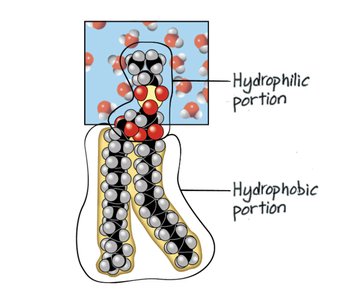
Example: The fluid mosaic model describes the membrane as a mosaic of protein molecules drifting in a fluid bilayer of phospholipids.
Concept 7.2: Selective Permeability of Membranes
Membrane Permeability and Transport Proteins
The structure of the plasma membrane results in selective permeability, allowing some substances to cross more easily than others.
Hydrophobic substances (e.g., O2, CO2) dissolve in the lipid bilayer and pass through rapidly.
Polar molecules and ions (e.g., glucose, Na+) require specific transport proteins to cross the membrane.
Aquaporins are channel proteins that facilitate the rapid transport of water molecules across the membrane, greatly increasing its permeability to water.
Example: Cells in the kidney use aquaporins to reabsorb water efficiently.
Concept 7.3: Passive Transport Across Membranes
Diffusion and Osmosis
Passive transport is the movement of substances across a membrane without energy input, driven by concentration gradients.
Diffusion is the spontaneous movement of molecules from an area of higher concentration to lower concentration.
Osmosis is the diffusion of water across a selectively permeable membrane.
Hypertonic solution: Higher concentration of nonpenetrating solutes outside the cell; water leaves the cell, causing it to shrink.
Hypotonic solution: Lower solute concentration outside; water enters the cell, causing it to swell.
Isotonic solution: Equal solute concentrations; no net water movement.
Facilitated diffusion uses transport proteins to move substances down their concentration gradient without energy input.
Ion channels and carrier proteins assist in the movement of ions and other solutes across the membrane.
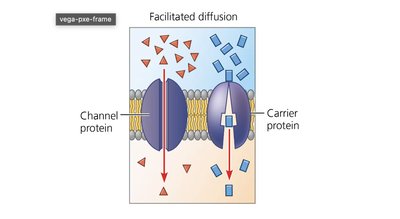
Example: Glucose enters red blood cells via facilitated diffusion through a specific carrier protein.
Additional info: In a hypertonic solution, the free water concentration is higher inside the cell than outside, leading to water loss from the cell.
Concept 7.4: Active Transport Mechanisms
Energy-Dependent Transport
Active transport moves solutes against their concentration gradients, requiring energy, usually from ATP.
Membrane proteins (pumps) use ATP to transport ions or molecules against their gradients.
Electrochemical gradient: The combined effect of a chemical gradient (concentration difference) and an electrical gradient (charge difference) across the membrane.
Cotransport: A membrane protein couples the "downhill" diffusion of one solute to the "uphill" transport of another. ATP is not directly used by the cotransporter, but is required to maintain the gradient that drives cotransport.
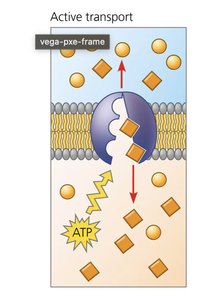
Example: The sodium-potassium pump (Na+/K+ ATPase) maintains electrochemical gradients essential for nerve impulse transmission.
Additional info: Cotransport is considered active because it relies on gradients established by primary active transport, which uses ATP.
Concept 7.5: Bulk Transport Across the Plasma Membrane
Exocytosis and Endocytosis
Large molecules and particles cross the membrane via bulk transport mechanisms that require energy.
Exocytosis: Transport vesicles fuse with the plasma membrane, releasing their contents outside the cell.
Endocytosis: The cell takes in molecules by forming vesicles from the plasma membrane. Types include:
Phagocytosis: "Cell eating"—engulfing large particles.
Pinocytosis: "Cell drinking"—ingesting extracellular fluid and dissolved solutes.
Receptor-mediated endocytosis: Specific molecules bind to receptors, triggering vesicle formation. This enables the cell to acquire bulk quantities of specific substances.
Example: Human cells use receptor-mediated endocytosis to take in cholesterol via LDL particles.
