 Back
Cell Membranes: Structure, Function, and Transport Mechanisms
Study Guide - Smart Notes
 Tailored notes based on your materials, expanded with key definitions, examples, and context.
Cell Membranes
Fluid Mosaic Model of Membrane Structure
The fluid mosaic model describes the structure of cellular membranes as a dynamic arrangement of lipids and proteins. Membranes are composed of a phospholipid bilayer with embedded proteins, which are not randomly distributed but organized in specific patterns. The membrane is held together primarily by weak hydrophobic interactions, allowing most lipids and some proteins to move laterally within the bilayer. Rarely, lipids may flip-flop between layers.
Phospholipid bilayer: Provides the main structural framework.
Membrane proteins: Embedded or attached, responsible for most membrane functions.
Membrane fluidity: Essential for proper function; proteins and lipids can move within the membrane.
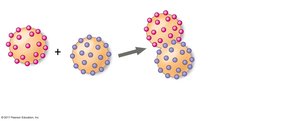
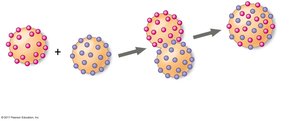
Phospholipids: Structure and Properties
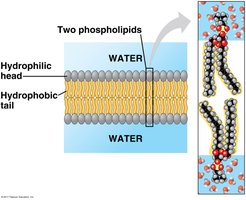
Phospholipids are the most abundant lipids in the plasma membrane. They are amphipathic, containing both hydrophobic (tails) and hydrophilic (heads) regions. The hydrophobic tails are oriented inward, away from water, while the hydrophilic heads face outward toward the aqueous environment.
Hydrophilic head: Interacts with water.
Hydrophobic tail: Avoids water, forms the interior of the membrane.
Membrane Fluidity and Composition
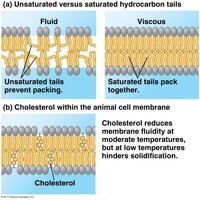
The fluidity of membranes is influenced by the types of lipids present and temperature. Unsaturated fatty acids increase fluidity, while saturated fatty acids decrease it. Cholesterol modulates fluidity, preventing solidification at low temperatures and reducing fluidity at moderate temperatures.
Unsaturated tails: Prevent tight packing, increase fluidity.
Saturated tails: Pack tightly, decrease fluidity.
Cholesterol: Maintains membrane fluidity and stability.
Membrane Proteins: Types and Functions
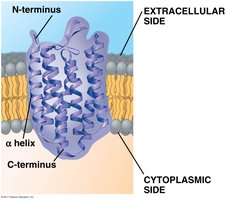
Membrane proteins are classified as peripheral (bound to the membrane surface) or integral (penetrate the hydrophobic core). Integral proteins that span the membrane are called transmembrane proteins. The hydrophobic regions of integral proteins often form α helices.
Peripheral proteins: Attached to membrane surface.
Integral proteins: Embedded within the membrane.
Transmembrane proteins: Span the entire membrane.
Functions of Membrane Proteins
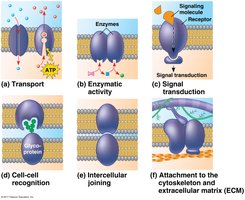
Transport: Move substances across the membrane.
Enzymatic activity: Catalyze reactions at the membrane surface.
Signal transduction: Relay signals from outside to inside the cell.
Cell-cell recognition: Identify and interact with other cells.
Intercellular joining: Connect cells together.
Attachment: Anchor the membrane to the cytoskeleton and extracellular matrix (ECM).
Membrane Carbohydrates and Cell-Cell Recognition
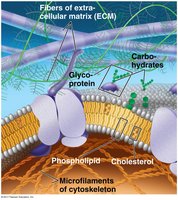
Membrane carbohydrates are involved in cell-cell recognition and are found on the extracellular surface. They may be covalently bonded to lipids (glycolipids) or proteins (glycoproteins). The composition of membrane carbohydrates varies among species, individuals, and cell types.
Synthesis and Sidedness of Membranes
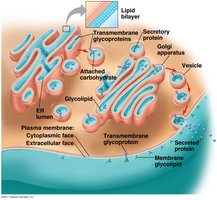
Membranes have distinct inside and outside faces, with asymmetrical distribution of proteins, lipids, and carbohydrates. This sidedness is established during membrane synthesis in the endoplasmic reticulum (ER) and Golgi apparatus.
Membrane Structure and Selective Permeability
Selective Permeability
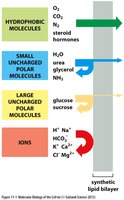
The plasma membrane allows some substances to cross more easily than others. Hydrophobic (nonpolar) molecules, such as hydrocarbons, can dissolve in the lipid bilayer and pass through rapidly. Hydrophilic molecules, including ions and polar molecules, do not cross easily and require transport proteins.
Hydrophobic molecules: Pass through easily.
Hydrophilic molecules: Require transport proteins.
Transport Proteins
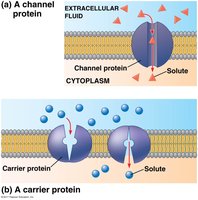
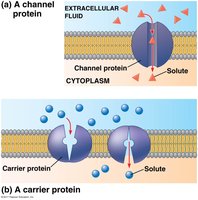
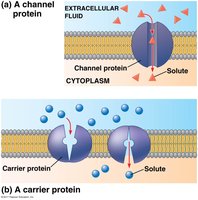
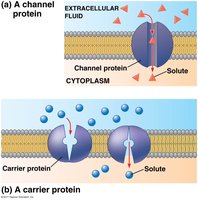
Transport proteins facilitate the movement of hydrophilic substances across the membrane. Channel proteins provide a hydrophilic tunnel, while carrier proteins bind to molecules and change shape to shuttle them across.
Channel proteins: Form pores for specific molecules or ions.
Carrier proteins: Undergo conformational changes to transport substances.
Passive Transport: Diffusion and Osmosis
Diffusion
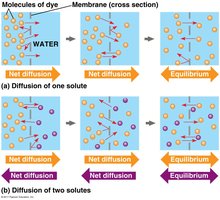
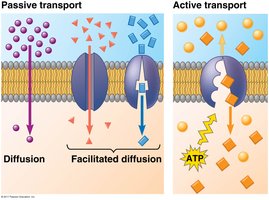
Diffusion is the movement of molecules from an area of higher concentration to lower concentration. At dynamic equilibrium, molecules move equally in both directions. Passive transport occurs when substances diffuse down their concentration gradient without energy input.
Concentration gradient: Drives diffusion.
Dynamic equilibrium: Equal movement in both directions.
Osmosis
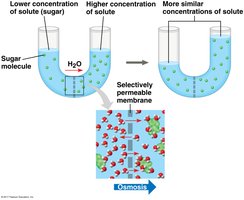
Osmosis is the diffusion of water across a selectively permeable membrane. Water moves from regions of low solute concentration to high solute concentration until equilibrium is reached.
Osmosis: Water movement across membranes.
Solute concentration: Determines direction of water movement.
Effects of Osmosis on Cells
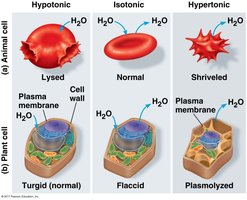
Hypotonic solution: Cell gains water, may burst (lyse).
Isotonic solution: No net water movement, cell remains normal.
Hypertonic solution: Cell loses water, shrivels.
Facilitated Diffusion
Facilitated diffusion is passive transport aided by proteins. Channel and carrier proteins help move molecules across the membrane without energy input.
Channel proteins: Provide corridors for specific molecules or ions.
Carrier proteins: Change shape to transport substances.
Active Transport
Mechanism of Active Transport
Active transport moves solutes against their concentration gradients using energy, typically from ATP hydrolysis. All active transport proteins are carrier proteins, which change shape during transport.
Requires energy: Usually ATP.
Moves substances against gradient: From low to high concentration.
Electrochemical Gradient and Membrane Potential
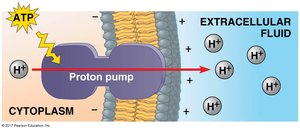
The membrane potential is created by differences in ion concentrations across the membrane, resulting in an electrical gradient. The electrochemical gradient combines the chemical force (concentration gradient) and electrical force (membrane potential).
Electrogenic pumps: Generate voltage across membranes.
Sodium-potassium pump: Major electrogenic pump in animal cells.
Proton pump: Main electrogenic pump in plants, fungi, and bacteria.
Cotransport
Cotransport occurs when the movement of one solute down its concentration gradient is coupled with the transport of another solute against its gradient, facilitated by a membrane protein.
Bulk Transport: Exocytosis and Endocytosis
Exocytosis and Endocytosis
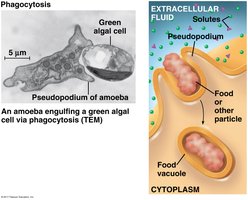
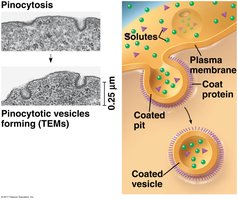
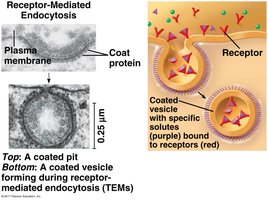
Bulk transport moves large molecules across the membrane via vesicles and requires energy. Exocytosis releases substances outside the cell, while endocytosis brings substances into the cell. Endocytosis includes phagocytosis, pinocytosis, and receptor-mediated endocytosis.
Phagocytosis: Cell engulfs particles in a vacuole.
Pinocytosis: Cell takes up dissolved molecules in vesicles.
Receptor-mediated endocytosis: Specific solutes bind to receptors, triggering vesicle formation.
Summary Table: Types of Membrane Transport
Type | Energy Required | Direction | Protein Involved |
|---|---|---|---|
Simple Diffusion | No | Down gradient | No |
Facilitated Diffusion | No | Down gradient | Yes (channel/carrier) |
Active Transport | Yes (ATP) | Against gradient | Yes (carrier) |
Bulk Transport (Exo/Endocytosis) | Yes | Variable | Vesicle/protein |
Example: The sodium-potassium pump uses ATP to move Na+ out of the cell and K+ into the cell, maintaining membrane potential.
Additional info: The notes have been expanded with academic context, definitions, and examples to ensure completeness and clarity for exam preparation.
