 Back
Cell Organelles and Cell Types: Structure and Function
Study Guide - Smart Notes
 Tailored notes based on your materials, expanded with key definitions, examples, and context.
Cell Components
Overview of Cell Organelles
Cells contain specialized structures called organelles that perform distinct functions necessary for life. Organelles are found in both plant and animal cells, though some are unique to each type. Understanding organelle structure and function is fundamental to cell biology.
Cell Wall: A rigid, tough structure made of cellulose that protects and supports the cell. Found in plant cells, fungi, and some protists.
Cytoplasm: Jelly-like substance that contains organelles and pads/supports them inside the cell. Present in both plant and animal cells.
Nucleus: Dense, ball-shaped structure containing DNA, surrounded by a nuclear envelope with pores. Controls cell activities and regulates entry/exit of materials.
Endoplasmic Reticulum (ER): Tubular system for transporting materials. Rough ER (rER) has ribosomes and makes proteins for export; Smooth ER (sER) synthesizes lipids, stores calcium, and detoxifies.
Ribosome: Small RNA-based structures found in cytoplasm or on ER. Sites of protein synthesis; free ribosomes make proteins for the cell, attached ribosomes make proteins for export.
Mitochondria: Bean-shaped organelle that supplies energy (ATP) through cellular respiration using glucose and oxygen.
Vacuole: Storage organelle for food, water, wastes, or enzymes. Larger in plant cells.
Chloroplast: Green organelle containing chlorophyll; captures sunlight for photosynthesis. Found in plants and some protists.
Golgi Body/Apparatus: Packages and secretes proteins for export from the cell.
Lysosome: Contains digestive enzymes to break down old cell parts, food, and invading pathogens. More common in animal cells.
Centrioles: Hollow tubes that help organize microtubules for chromosome movement during cell division. Found in animal cells.
Cilia and Flagella: Hair-like and whip-like structures used for movement or sensing.
Cell Membrane: Composed of a phospholipid bilayer; surrounds the cell and regulates entry/exit of substances.
Chromatin: Collection of DNA in the nucleus of eukaryotic cells.
Functions and Locations of Cell Organelles
Each organelle has a specific function and may be found in plant cells, animal cells, or both. The following table summarizes their presence:
Organelle | Plant Cells | Animal Cells |
|---|---|---|
Cell Wall | X | |
Vesicle | X | X |
Chloroplast | X | |
Chromatin | X | X |
Cytoplasm | X | X |
Cytoskeleton | X | X |
Endoplasmic Reticulum | X | X |
Golgi Apparatus | X | X |
Lysosome | X | |
Mitochondria | X | X |
Nucleolus | X | X |
Nucleus | X | X |
Plasma Membrane | X | X |
Central Vacuole | X | |
Ribosome | X | X |
Vacuole | X | X |
Protein Synthesis and Related Organelles
Protein synthesis involves several organelles:
Rough ER (rER): Ribosomes attached synthesize proteins for export.
Golgi Apparatus: Packages proteins for transport.
Vesicles: Transport proteins to their destination.
Nucleus: DNA is transcribed to RNA, which is then translated into protein.
Equation for protein synthesis:
Comparison of Prokaryotic and Eukaryotic Cells
Cells are classified as prokaryotic or eukaryotic based on their structure. The following table summarizes their differences and similarities:
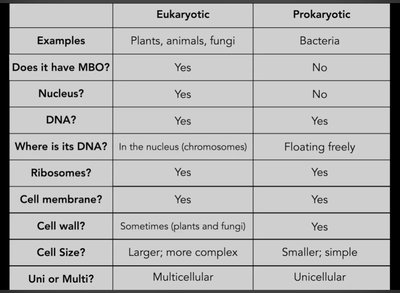
Feature | Eukaryotic | Prokaryotic |
|---|---|---|
Examples | Plants, animals, fungi | Bacteria |
Membrane-bound organelles (MBO) | Yes | No |
Nucleus | Yes | No |
DNA | Yes | Yes |
Location of DNA | In nucleus (chromosomes) | Floating freely |
Ribosomes | Yes | Yes |
Cell membrane | Yes | Yes |
Cell wall | Sometimes (plants and fungi) | Yes |
Cell size | Larger, more complex | Smaller, simple |
Unicellular/Multicellular | Multicellular | Unicellular |
Additional Key Points
Mitochondria: Site of cellular respiration; produces ATP, the cell's energy currency.
Chloroplasts: Site of photosynthesis; converts solar energy to chemical energy.
Cytoskeleton: Network of microtubules and filaments that provide structural support and facilitate movement.
Cilia and Flagella: Structures for movement and sensing; cilia are short and numerous, flagella are longer and fewer.
Cell Wall: Provides support and shape; found in plants, fungi, most bacteria, and some protists.
Example: Plant cells have cell walls and chloroplasts, while animal cells have lysosomes and centrioles.
Additional info: The cell membrane and nuclear membrane are both composed of phospholipid bilayers, but the nuclear membrane has pores to regulate entry/exit of materials specific to the nucleus.
