 Back
Cell Signaling and Communication in Biology
Study Guide - Smart Notes
 Tailored notes based on your materials, expanded with key definitions, examples, and context.
Cell Signaling
Introduction to Cell Signaling
Cell signaling is a fundamental process that enables cells to communicate with each other and coordinate their activities. This process is essential for the functioning of multicellular organisms and also plays a critical role in unicellular organisms. The plasma membrane is central to most cell signaling events, acting as the interface for signal detection and response.
Types of Cell Signaling
Local and Long-Distance Signaling
Cells communicate through both local and long-distance signaling mechanisms. The type of signaling depends on the distance the signal must travel and the nature of the signaling molecules involved.
Direct Contact: Animal and plant cells can communicate directly through junctions—gap junctions in animals and plasmodesmata in plants—allowing substances to pass freely between adjacent cells.
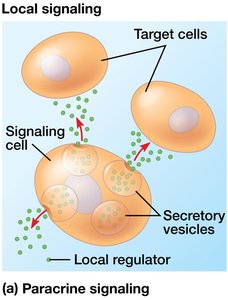
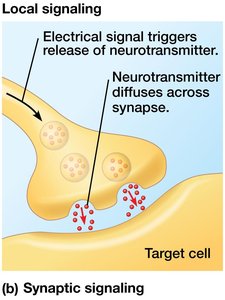
Local Signaling: Involves signaling molecules that affect nearby cells. Two main types are paracrine signaling and synaptic signaling.
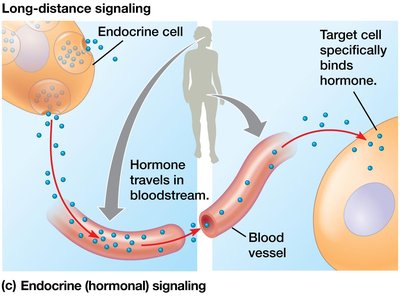
Long-Distance Signaling: Utilizes hormones that travel through the circulatory system in animals or through air/vessels in plants to reach distant target cells.
The Three Stages of Cell Signaling
Overview of Signal Transduction
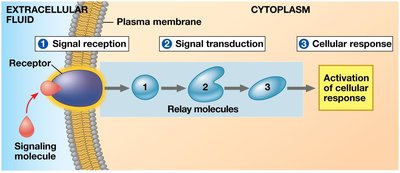
Cell signaling typically involves three main stages: reception, transduction, and response. Earl W. Sutherland's research on epinephrine action led to the identification of these stages:
Reception: The target cell detects a signaling molecule (ligand) when it binds to a receptor protein on the cell surface or inside the cell.
Transduction: The binding of the ligand changes the receptor in some way, initiating a signal transduction pathway—a series of steps that convert the signal to a form that can bring about a specific cellular response.
Response: The transduced signal triggers a specific cellular activity, such as gene expression or enzyme activation.
Signal Reception: Receptors and Ligands
Receptors in the Plasma Membrane
Most water-soluble signaling molecules bind to specific receptor proteins embedded in the plasma membrane. The two main types of membrane receptors are:
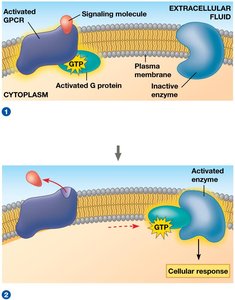
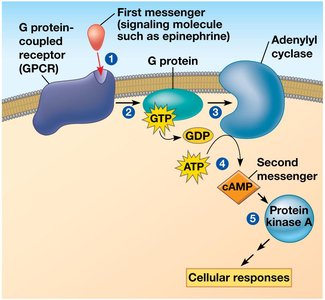
G Protein-Coupled Receptors (GPCRs): These receptors interact with G proteins, which bind GTP and relay signals from activated receptors to other proteins inside the cell. GPCR pathways are highly diverse and regulate many physiological processes.
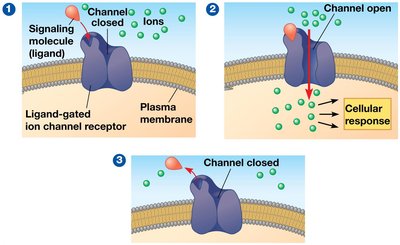
Ligand-Gated Ion Channels: These receptors act as gates for ions. When a ligand binds, the channel opens, allowing specific ions to flow through, which can trigger electrical or metabolic changes in the cell.
Intracellular Receptors
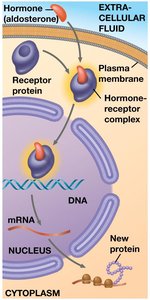
Some signaling molecules, such as steroid hormones, are hydrophobic and can cross the plasma membrane to bind intracellular receptors located in the cytoplasm or nucleus. The hormone-receptor complex often acts as a transcription factor, regulating gene expression.
Signal Transduction Pathways
Transduction by Cascades of Molecular Interactions
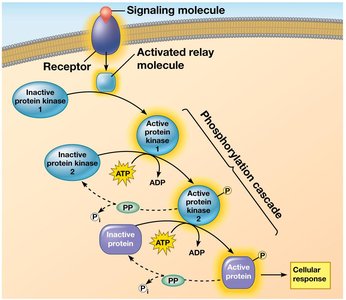
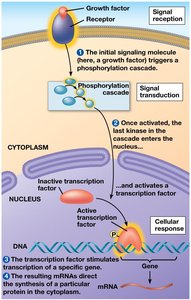
Signal transduction pathways often involve multiple steps, allowing for amplification and regulation of the signal. Each step typically involves a change in a protein's shape or activity, often through phosphorylation.
Protein Phosphorylation and Dephosphorylation
Protein Kinases: Enzymes that transfer phosphate groups from ATP to proteins, activating or deactivating them. When kinases act in sequence, they form a phosphorylation cascade.
Protein Phosphatases: Enzymes that remove phosphate groups, turning off the signal and resetting the pathway.
Second Messengers
Second messengers are small, nonprotein, water-soluble molecules or ions that relay signals inside the cell. Common examples include cyclic AMP (cAMP) and calcium ions (Ca2+).
cAMP: Produced from ATP by adenylyl cyclase in response to extracellular signals. cAMP activates protein kinase A, which phosphorylates various target proteins.
Calcium Ions: Act as second messengers in many pathways, especially in muscle contraction and neurotransmitter release.
Cellular Responses to Signals
Regulation of Transcription or Cytoplasmic Activities
The final outcome of a signaling pathway is a specific cellular response. This can involve changes in gene expression (transcriptional regulation) or alterations in cytoplasmic activities (such as enzyme activity or ion channel opening).
Transcriptional Response: The activated signaling pathway may lead to the activation of transcription factors, which turn specific genes on or off, resulting in the synthesis of new proteins.
Cytoplasmic Response: Some pathways regulate the activity of existing proteins, such as enzymes or ion channels, leading to rapid changes in cell function.
Summary Table: Types of Cell Signaling
Type | Distance | Example | Key Molecules |
|---|---|---|---|
Direct Contact | Adjacent cells | Gap junctions, plasmodesmata | Ions, small molecules |
Paracrine | Local | Growth factors | Local regulators |
Synaptic | Local | Neurotransmitters | Neurotransmitters |
Endocrine | Long-distance | Hormones | Hormones |
Key Terms and Definitions
Ligand: A molecule that specifically binds to another molecule, often a receptor.
Receptor: A protein that detects a signal molecule and initiates a cellular response.
Signal Transduction Pathway: A series of steps by which a signal on a cell's surface is converted into a specific cellular response.
Second Messenger: A small molecule or ion that relays a signal inside the cell.
Protein Kinase: An enzyme that adds phosphate groups to proteins.
Protein Phosphatase: An enzyme that removes phosphate groups from proteins.
