 Back
Cell Signaling and Gene Regulation: Mechanisms and Responses
Study Guide - Smart Notes
 Tailored notes based on your materials, expanded with key definitions, examples, and context.
Cell Signaling: Mechanisms and Stages
Overview of Cell Signaling
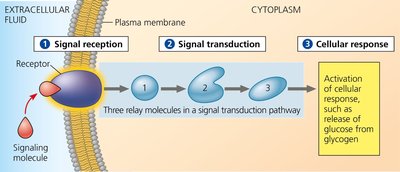
Cell signaling is the process by which cells communicate with each other and respond to external stimuli. This process is fundamental for regulating cellular activities, coordinating responses, and maintaining homeostasis. The stages of cell signaling include signal reception, signal transduction, and cellular response.
Signal Reception: A signaling molecule (ligand) binds to a specific receptor on the cell membrane or inside the cell, initiating the signaling process.
Signal Transduction: The signal is relayed and amplified through a series of intracellular molecules, often involving protein shape changes and phosphorylation cascades.
Cellular Response: The cell responds by activating enzymes, opening ion channels, or altering gene expression, leading to physiological changes.
Local and Long-Distance Signaling
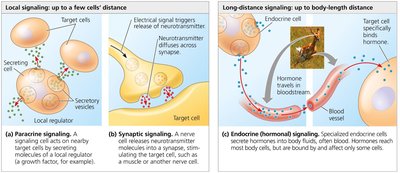
Cells can communicate over short or long distances using different signaling mechanisms.
Paracrine Signaling: Local regulators are released and affect nearby cells.
Synaptic Signaling: Neurotransmitters are released at synapses, affecting target cells such as neurons or muscle cells.
Endocrine (Hormonal) Signaling: Hormones are released into the bloodstream and can affect distant target cells throughout the body.
Types of Cell Surface and Intracellular Receptors
Membrane Receptors
Cell surface receptors are specialized proteins embedded in the plasma membrane that bind extracellular signals. The main types include:
G Protein-Coupled Receptors (GPCRs): Activate G proteins, which relay signals inside the cell.
Receptor Tyrosine Kinases (RTKs): Pair and phosphorylate each other, triggering cascades.
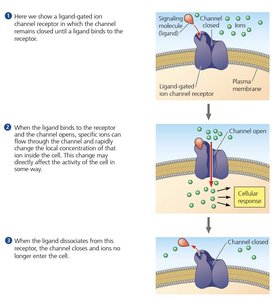
Ligand-Gated Ion Channels: Open in response to ligand binding, allowing ions to flow into the cell.
Ligand-Gated Ion Channel Mechanism
Ligand-gated ion channels are a type of membrane receptor that open to allow ions to pass through the membrane when a specific ligand binds.
The channel remains closed until a ligand binds to the receptor.
Upon ligand binding, the channel opens, allowing ions to flow and altering cell activity.
When the ligand dissociates, the channel closes and ion flow stops.
Intracellular Receptors
Lipid-soluble signals (such as steroid hormones) can cross the plasma membrane and bind to receptors inside the cell, often acting as transcription factors to regulate gene expression.
Example: Estradiol binds to intracellular receptors, which then activate specific genes.
Signal Transduction Pathways
Phosphorylation Cascades
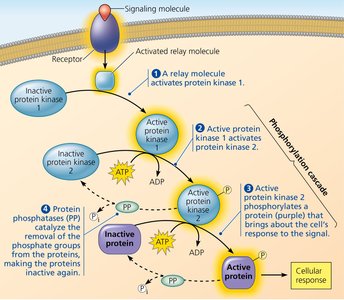
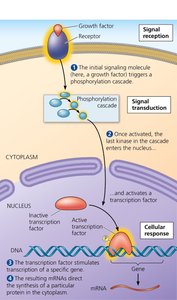
Signal transduction often involves phosphorylation cascades, where a series of protein kinases activate each other by adding phosphate groups. This amplifies the signal and allows for precise regulation.
Protein Kinase: Enzyme that adds phosphate groups to proteins, activating them.
Protein Phosphatase: Enzyme that removes phosphate groups, deactivating proteins.
Amplification: Each activated kinase can activate many downstream targets, multiplying the effect.
Second Messengers
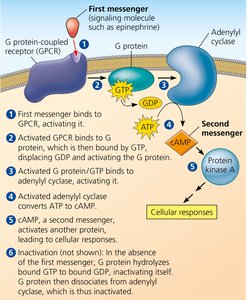
Second messengers are small, non-protein molecules that spread signals within the cell.
cAMP (cyclic AMP): Generated from ATP by adenylyl cyclase; activates protein kinase A.
Ca2+ ions: Another common second messenger.
Amplification of Cellular Response
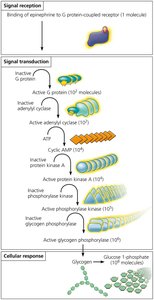
Signal transduction pathways can amplify the response, so one signaling molecule can lead to the activation of millions of target molecules.
Example: One epinephrine molecule can trigger the release of about 108 glucose molecules from glycogen in a liver cell.
Cellular Responses: Cytoplasmic and Nuclear Effects
Cytoplasmic Responses
Activation of enzymes (e.g., glycogen phosphorylase in liver cells).
Opening of ion channels.
Nuclear Responses
Activation of transcription factors, leading to changes in gene expression.
Production of new proteins that alter cell function.
Gene Regulation: The lac Operon Example
Positive and Negative Control
The lac operon in E. coli is regulated by two switches:
Repressor: Grants permission for transcription when lactose is present.
CAP and cAMP: Provide positive control, increasing transcription when glucose is absent.
Key Terms and Definitions
CAP (catabolite activator protein): Activator that helps RNA polymerase bind the lac promoter when cAMP is present.
cAMP (cyclic AMP): Small molecule made from ATP; acts as a hunger signal in bacteria and a second messenger in animal cells.
Signal transduction pathway: Series of steps by which a signal at the surface becomes a response inside.
Ligand: Molecule that binds specifically to a receptor.
Reception, transduction, response: The three stages of cell signaling.
Protein kinase: Enzyme that adds phosphate groups to proteins.
Protein phosphatase: Enzyme that removes phosphate groups from proteins.
Phosphorylation cascade: Chain of kinases activating each other.
Second messenger: Small molecule that spreads a signal inside the cell.
Adenylyl cyclase: Enzyme that converts ATP to cAMP.
Amplification: Multiplication of a signal at each enzymatic step.
Termination: Switching a signal off by deactivating proteins or breaking down second messengers.
Practice Questions and Applications
Sample Questions
What happens if protein phosphatases are blocked in a liver cell during epinephrine signaling?
Why do two cells with the same GPCR respond differently to the same hormone?
Predict lac operon transcription in a lacI mutant with glucose present and absent, but no lactose.
Worked Answers
The response is larger and does not end, as kinases and glycogen phosphorylase remain active.
The difference lies in transduction and response; different relay and target proteins cause different outcomes.
With glucose present: a trickle; with glucose absent: full speed. No repressor means permission is always granted.
Summary of Key Concepts
The lac operon requires both repressor removal and CAP activation for full transcription.
Cell signaling involves reception, transduction, and response, with shape changes relaying the signal.
Three main types of membrane receptors: GPCRs, RTKs, ion channels; steroid receptors are intracellular.
Signal amplification occurs through kinase cascades and second messengers.
Specificity of response depends on the proteins present in each cell; signals must be terminated to prevent disease.
