 Back
Cell Signaling and Gene Regulation: Mechanisms and Responses
Study Guide - Smart Notes
 Tailored notes based on your materials, expanded with key definitions, examples, and context.
Cell Signaling and Regulation
Overview of Cell Signaling
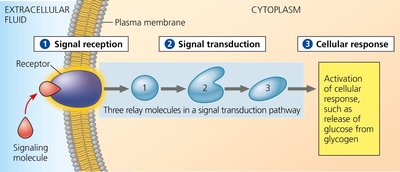
Cell signaling is a fundamental process by which cells communicate with their environment and other cells, enabling them to respond to external stimuli and regulate internal functions. The process involves the detection of signals, their relay through intracellular pathways, and the execution of specific cellular responses.
Signal reception: A signaling molecule (ligand) binds to a receptor on the cell membrane or inside the cell.
Signal transduction: The signal is relayed and amplified through a series of intracellular molecules, often involving shape changes and phosphorylation events.
Cellular response: The cell responds by activating enzymes, opening ion channels, or altering gene expression.
Types of Cell Signaling
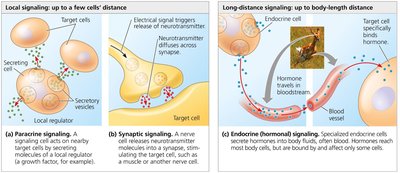
Cells use different modes of signaling depending on the distance and specificity required.
Paracrine signaling: Local regulators affect nearby cells.
Synaptic signaling: Neurotransmitters cross synapses to target cells, such as neurons or muscle cells.
Endocrine (hormonal) signaling: Hormones travel through the bloodstream to reach distant target cells.
Signal Reception: Receptors and Ligands
Receptor Types and Locations
The location and type of receptor depend on the chemical nature of the signaling molecule.
Water-soluble signals: (e.g., epinephrine) bind to membrane receptors.
Lipid-soluble signals: (e.g., steroids like estradiol) diffuse through the membrane and bind to intracellular receptors, often acting as transcription factors.
Ligand-Gated Ion Channel Receptors
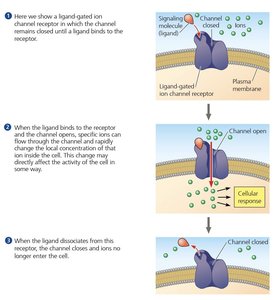
Ligand-gated ion channels are membrane proteins that open in response to ligand binding, allowing ions to flow into or out of the cell and directly affecting cellular activity.
Channel remains closed until ligand binds.
Ligand binding opens the channel, permitting ion flow and triggering a cellular response.
Channel closes when ligand dissociates.
Signal Transduction Pathways
Phosphorylation Cascades
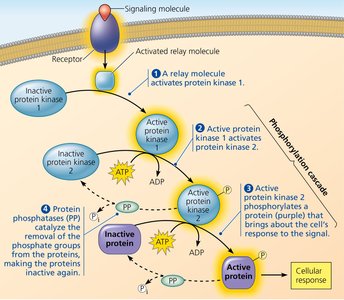
Signal transduction often involves phosphorylation cascades, where a series of protein kinases activate each other by adding phosphate groups.
Protein kinase: Enzyme that transfers phosphate from ATP to a protein, activating it.
Protein phosphatase: Enzyme that removes phosphate, deactivating the protein.
Amplification: Each kinase can activate many downstream targets, multiplying the signal.
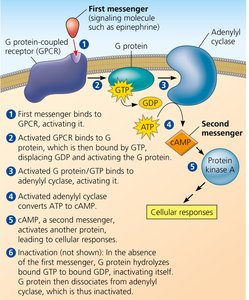
Second Messengers
Second messengers are small molecules that propagate the signal inside the cell.
cAMP (cyclic AMP): Generated from ATP by adenylyl cyclase; activates protein kinase A.
Ca2+ ions: Another common second messenger.
Amplification and Specificity of Cellular Responses
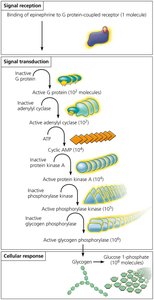
Amplification in Signal Transduction
A single signaling molecule can trigger a massive cellular response through amplification at each step of the pathway.
One hormone can activate millions of target molecules (e.g., glucose release from glycogen).
Specificity is determined by the proteins present in each cell type.
Gene Regulation and Cellular Response
Transcriptional Responses
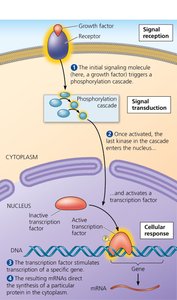
Some signaling pathways culminate in the activation of transcription factors, which enter the nucleus and regulate gene expression.
Phosphorylation cascade activates transcription factor.
Transcription factor binds DNA, promoting synthesis of specific mRNAs and proteins.
Regulation of the Lac Operon in E. coli
Dual Control Mechanism
The lac operon is regulated by two switches:
Repressor: Blocks transcription unless lactose is present.
CAP and cAMP: Activate transcription when glucose is absent (positive control).
Condition | lac mRNA Production |
|---|---|
Lactose absent, glucose present | Off |
Lactose present, glucose present | Trickle |
Lactose present, glucose absent | Full speed |
Key Terms and Definitions
CAP (catabolite activator protein): Activator that, with cAMP, helps RNA polymerase bind the lac promoter.
cAMP (cyclic AMP): Small molecule made from ATP; hunger signal in E. coli, second messenger in animal cells.
Signal transduction pathway: Steps by which a surface signal becomes an internal response.
Ligand: Molecule that binds specifically to a receptor.
G protein-coupled receptor (GPCR): Membrane receptor that activates G proteins.
Protein kinase: Enzyme that phosphorylates proteins.
Protein phosphatase: Enzyme that removes phosphate groups.
Second messenger: Small molecule that spreads a signal inside the cell (e.g., cAMP, Ca2+).
Amplification: Multiplication of a signal at each enzymatic step.
Termination: Switching a signal off (phosphatases, GTP hydrolysis, cAMP breakdown).
Practice Questions
A drug blocks every protein phosphatase in a liver cell. Predict what happens to the glucose response to epinephrine, and to its end when epinephrine is removed.
Two cells carry the same GPCR for the same hormone. One releases glucose; the other contracts. Explain, and name the stage at which they differ.
A lacI mutant makes no repressor. Predict lac transcription with glucose present and with glucose gone, with no lactose in either case.
Summary of Key Concepts
The lac operon requires both repressor removal and CAP activation for full transcription.
Cell signaling involves reception, transduction, and response, with shape changes relaying the signal.
Three main membrane receptor types: GPCR, receptor tyrosine kinase, ion channel; steroid receptors are intracellular.
Kinase cascades and second messengers amplify signals; specificity comes from cell-specific proteins.
Every signal must be terminated; failure to do so can cause disease.
Equations and Formulas
cAMP formation:
Phosphorylation:
Dephosphorylation:
Additional info: Academic context was added to clarify the mechanisms and provide self-contained explanations for exam preparation.
