 Back
BackCell Signaling and Signal Transduction Pathways
Study Guide - Smart Notes
 Tailored notes based on your materials, expanded with key definitions, examples, and context.
Cell Signaling: Reception, Transduction, and Response
Overview of Cell Signaling
Cell signaling is a fundamental process by which cells sense their environment and respond to external and internal cues. This process involves the reception of signals, their transduction through intracellular pathways, and the generation of a cellular response. The specificity and adaptability of cell signaling allow organisms to survive and thrive in changing environments.
Signal Reception: Cells detect signals (ligands) such as hormones, nutrients, ions, and environmental factors.
Signal Transduction: The signal is relayed and amplified through a series of molecular switches and messengers.
Response: The cell alters its behavior, such as growth, movement, or secretion, in response to the signal.
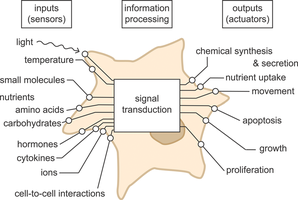
Types of Chemical Signals
Chemical signals can be categorized based on their polarity, which determines how they interact with cell membranes and receptors.
Polar Signals: Usually hydrophilic and bind to receptors on the cell surface (e.g., peptide hormones, cytokines).
Nonpolar Signals: Typically hydrophobic and diffuse through the membrane to bind intracellular receptors (e.g., steroid hormones).
Signal Reception: Receptor Proteins
Receptor proteins are highly specific for their ligands. The three-dimensional shape of the receptor determines its specificity, and binding is reversible. Upon ligand binding, the receptor undergoes a conformational change, acting as a molecular switch to initiate signal transduction.
Ligand: The signaling molecule that binds to the receptor.
Receptor: A protein that specifically recognizes and binds the ligand.
Conformational Change: The receptor alternates between inactive and active states upon ligand binding.
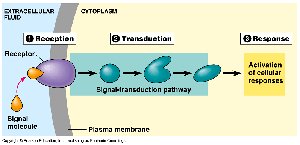
Signal Transduction Pathways
General Mechanism
Signal transduction involves a cascade of molecular events that relay and amplify the signal from the receptor to the cellular machinery responsible for the response. This often includes kinases, phosphatases, and secondary messengers.
Kinase Cascades: Series of enzymes that add phosphate groups to proteins, changing their activity.
Secondary Messengers: Small molecules such as cAMP, DAG, and IP3 that propagate the signal within the cell.
Amplification: Each step in the pathway can amplify the signal, resulting in a larger cellular response.
G-Protein Coupled Receptors (GPCRs)
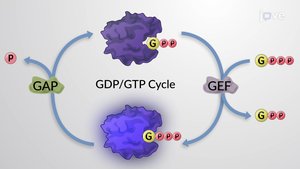
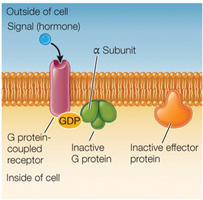
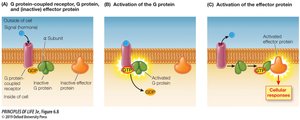
GPCRs are a major class of cell surface receptors that activate G-proteins upon ligand binding. The G-protein cycle involves the exchange of GDP for GTP, leading to activation of downstream effectors.
Inactive G-protein: Bound to GDP.
Activation: Ligand binding to GPCR causes GEF to exchange GDP for GTP on the G-protein.
Effector Activation: Activated G-protein binds and activates effector proteins, leading to cellular responses.
Receptor Tyrosine Kinases (RTKs)
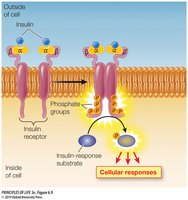
RTKs are another important class of receptors that mediate signal transduction through phosphorylation. Ligand binding induces dimerization and autophosphorylation of the receptor, which then activates downstream signaling proteins.
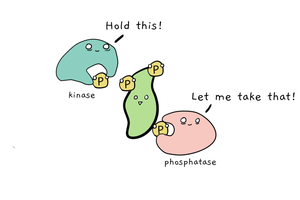
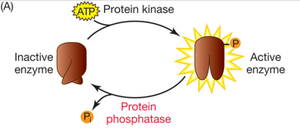
Phosphorylation: Addition of phosphate groups by kinases activates signaling proteins.
Dephosphorylation: Removal of phosphate groups by phosphatases turns off the signal.
Transient Modification: Phosphorylation is a reversible, covalent modification.
Secondary Messengers
Secondary messengers are small molecules that relay signals from receptors to target molecules inside the cell. Examples include cyclic AMP (cAMP), diacylglycerol (DAG), and inositol trisphosphate (IP3).
cAMP: Generated from ATP by adenylyl cyclase; activates protein kinase A.
DAG and IP3: Produced by cleavage of PIP2; DAG activates protein kinase C, IP3 releases Ca2+ from the endoplasmic reticulum.
Cellular Responses to Signals
Types of Cellular Responses
Cells respond to signals by altering their behavior. The specific response depends on the signal and the cell type. Common responses include changes in gene expression, metabolism, movement, secretion, growth, and apoptosis.
Gene Expression: Activation or repression of transcription.
Metabolic Changes: Alteration of enzyme activity and metabolic pathways.
Movement: Changes in cytoskeleton and cell motility.
Secretion: Release of hormones or other molecules.
Growth and Proliferation: Cell division and expansion.
Apoptosis: Programmed cell death.
Regulation and Complexity of Signaling Pathways
Regulation of Signal Transduction
Signal transduction pathways are highly regulated to ensure appropriate cellular responses. Regulation involves controlling the activity of kinases, phosphatases, G-proteins, and secondary messengers. The balance between activation and inactivation determines the outcome.
Transient Activation: Signals are often short-lived, allowing cells to return to their baseline state.
Feedback Mechanisms: Pathways can include feedback loops to modulate signal strength and duration.
Amplification: Multiple steps allow for amplification and integration of signals.
Complexity of Signaling Pathways
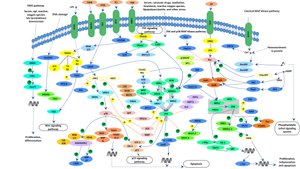
Signaling pathways can be highly complex, involving multiple components and interactions. This complexity allows for fine-tuned regulation, signal amplification, and integration of multiple signals within a single cell.
Multi-component Pathways: Provide opportunities for feedback, amplification, and cross-talk between pathways.
Integration: Cells can integrate signals from different pathways to produce coordinated responses.
Summary Table: Key Components of Signal Transduction
Component | Function | Example |
|---|---|---|
Ligand | Signal molecule | Hormone, neurotransmitter |
Receptor | Detects ligand | GPCR, RTK |
Transducer | Relays signal | G-protein, kinase |
Effector | Produces response | Adenylyl cyclase, phospholipase C |
Secondary Messenger | Amplifies signal | cAMP, Ca2+, DAG, IP3 |
Response | Cellular change | Gene expression, movement |
Practice and Application
How to Analyze a Signaling Pathway
When analyzing a signaling pathway, consider the following:
Identify the ligand or primary signal.
Determine the location and type of receptor (surface or cytoplasmic).
Assess whether secondary messengers or kinase cascades are involved.
Predict the cellular responses elicited by the pathway.
Consider the impact of malfunctioning pathway components (e.g., kinases, phosphatases).
Additional info: Academic context was added to clarify the mechanisms and importance of cell signaling, including definitions, examples, and regulatory principles. The notes are structured to provide a comprehensive overview suitable for exam preparation in a college biology course.
