 Back
BackCell Signaling and Signal Transduction Pathways
Study Guide - Smart Notes
 Tailored notes based on your materials, expanded with key definitions, examples, and context.
Cell Signaling: Overview
Introduction to Cell Signaling
Cell signaling is the process by which cells detect and respond to external and internal signals, allowing them to adapt and coordinate their activities. Signals can include light, temperature, small molecules, nutrients, hormones, and more. The process involves three main stages: reception, transduction, and response.
Reception: Detection of a signal molecule (ligand) by a receptor protein.
Transduction: Conversion of the signal into a form that can bring about a specific cellular response, often involving a cascade of molecular events.
Response: The final cellular activity triggered by the transduced signal, such as gene expression, secretion, or cell movement.
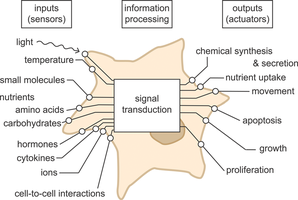
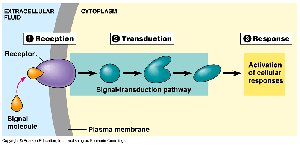
Types of Chemical Signals and Receptors
Polar vs. Nonpolar Signals
Chemical signals can be categorized based on their polarity, which determines how they interact with cell membranes and receptors.
Polar signals: (e.g., peptide hormones, neurotransmitters) are water-soluble and bind to receptors on the cell surface.
Nonpolar signals: (e.g., steroid hormones) are lipid-soluble and can diffuse through the plasma membrane to bind intracellular receptors.
Receptor Specificity and Activation
Receptors are highly specific proteins that recognize and bind their corresponding ligands. Binding is reversible and does not alter the ligand. The three-dimensional structure of the receptor determines its specificity. Upon ligand binding, the receptor undergoes a conformational change, acting as a molecular switch to initiate signal transduction.
Ligand-Receptor Interaction:
Conformational Change: The receptor alternates between inactive and active states upon ligand binding.
Major Classes of Cell Surface Receptors
1. G-Protein Coupled Receptors (GPCRs)
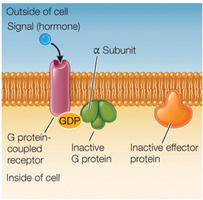
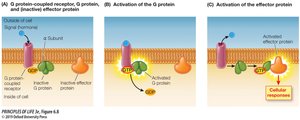
GPCRs are a large family of membrane receptors that activate G-proteins upon ligand binding.
Inactive State: G-protein is bound to GDP.
Activation: Ligand binding causes the receptor to act as a guanine nucleotide exchange factor (GEF), exchanging GDP for GTP on the G-protein, activating it.
Signal Propagation: The activated G-protein can then activate downstream effectors, such as enzymes or ion channels.
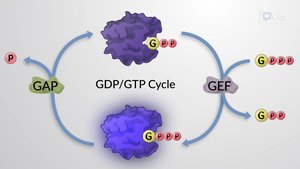
2. Receptor Tyrosine Kinases (RTKs)
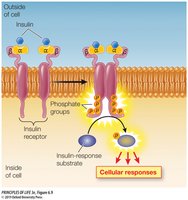
RTKs are enzyme-linked receptors that transfer phosphate groups from ATP to tyrosine residues on target proteins.
Ligand Binding: Causes receptor dimerization and autophosphorylation.
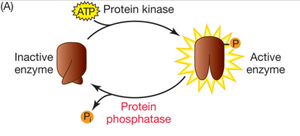
Phosphorylation: Protein kinases add phosphate groups, while phosphatases remove them, regulating protein activity.
Signal Relay: Phosphorylated tyrosines serve as docking sites for downstream signaling proteins.
Signal Transduction Pathways
Kinase Cascades
Signal transduction often involves a series of protein kinases that sequentially phosphorylate each other, amplifying the signal.
Kinase: Enzyme that adds phosphate groups to proteins, often activating them.
Phosphatase: Enzyme that removes phosphate groups, often deactivating proteins.
Second Messengers
Second messengers are small molecules that relay signals from receptors to target molecules inside the cell. Common examples include cyclic AMP (cAMP), diacylglycerol (DAG), inositol trisphosphate (IP3), and calcium ions (Ca2+).
cAMP: Produced from ATP by adenylyl cyclase, activates protein kinase A (PKA).
DAG and IP3: Produced by cleavage of PIP2 by phospholipase C; DAG activates protein kinase C, IP3 releases Ca2+ from the endoplasmic reticulum.
Amplification and Regulation of Signals
Signal Amplification
Signal transduction pathways amplify the original signal, allowing a small number of signaling molecules to produce a large cellular response. This is achieved through cascades and the generation of many second messenger molecules.
Amplification: Each activated enzyme can activate many downstream molecules, leading to a robust response.
Regulation of Signal Transduction
Cells tightly regulate signaling pathways to ensure appropriate responses.
Transient Activation: Active forms of signaling molecules are present only briefly.
Enzyme Balance: The balance between kinases and phosphatases, or GEFs and GAPs, determines the duration and intensity of the response.
Cellular Responses to Signals
Types of Cellular Responses
The final outcome of signal transduction can vary depending on the cell type and the signal received. Common responses include:
Gene expression changes
Altered metabolism
Cell growth, division, or differentiation
Movement or secretion
Apoptosis (programmed cell death)
Summary Table: Key Components of Signal Transduction
Component | Function | Example |
|---|---|---|
Ligand | Signal molecule that binds receptor | Insulin, epinephrine |
Receptor | Protein that detects ligand | GPCR, RTK |
Transducer | Relays and amplifies signal | G-protein, kinase |
Second Messenger | Small molecule that propagates signal | cAMP, Ca2+, IP3 |
Effector | Executes cellular response | Enzyme, transcription factor |
Practice and Application
Analyzing Pathways
When analyzing a signaling pathway, consider:
What is the ligand or primary signal?
Is the ligand polar or nonpolar?
What type of receptor is involved (GPCR, RTK, etc.)?
Are second messengers or kinase cascades used?
What are the possible cellular responses?
Example Application
If a ligand binds to a GPCR but GDP is not exchanged for GTP, the signal will not be transduced and the cell will not respond.
Insulin only affects cells with the appropriate receptor, demonstrating target specificity.
Steroid hormones, being lipid-soluble, bind to intracellular receptors.
Conclusion
Cell signaling is essential for cellular communication, adaptation, and survival. Understanding the mechanisms of signal reception, transduction, and response is fundamental to cell biology and physiology. Additional info: This guide integrates foundational concepts from cell signaling, including receptor types, signal transduction mechanisms, and the importance of regulation and amplification in cellular responses.
