 Back
Cell Signaling: Signal Transduction Pathways and Cellular Responses part 2
Study Guide - Smart Notes
 Tailored notes based on your materials, expanded with key definitions, examples, and context.
Signal Transduction Pathways
Overview of Signal Transduction
Cell signaling is a multistep process that allows cells to respond to external signals through a series of molecular interactions. These pathways amplify signals and provide opportunities for regulation and coordination of cellular responses.
Signal transduction pathway: The binding of a signaling molecule to a receptor triggers a chain of molecular interactions, activating proteins sequentially until the final response is produced.
Amplification: Multistep pathways can greatly amplify a signal, resulting in a larger cellular response.
Coordination and regulation: Multiple steps allow for fine-tuning and integration of signals.
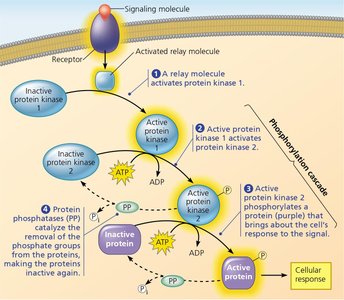
Protein Phosphorylation and Dephosphorylation
Phosphorylation and dephosphorylation are key mechanisms for regulating protein activity in cells.
Protein kinases: Enzymes that transfer phosphate groups from ATP to proteins, activating them (phosphorylation).
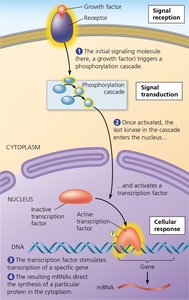
Phosphorylation cascade: Many relay molecules are protein kinases, creating a cascade that amplifies the signal.
Protein phosphatases: Enzymes that remove phosphate groups from proteins, inactivating them (dephosphorylation).
Molecular switch: The phosphorylation/dephosphorylation system acts as a switch, turning activities on/off or up/down as needed.
Second Messengers in Signal Transduction
Small Molecules and Ions as Second Messengers
Second messengers are small, nonprotein, water-soluble molecules or ions that spread throughout the cell by diffusion, participating in pathways initiated by G protein-coupled receptors (GPCRs) and receptor tyrosine kinases (RTKs).
Common second messengers: Cyclic AMP (cAMP), calcium ions (Ca2+), diacylglycerol (DAG), and inositol triphosphate (IP3).
Function: Second messengers relay and amplify signals within the cell.
Cyclic AMP (cAMP)
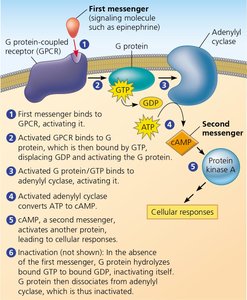
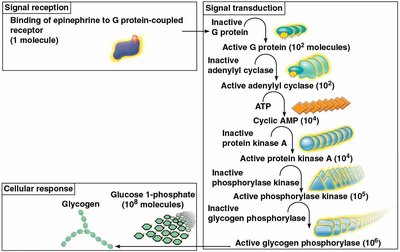
Cyclic AMP is a widely used second messenger produced from ATP by adenylyl cyclase in response to extracellular signals.
Adenylyl cyclase: Converts ATP to cAMP when activated by G proteins.
cAMP pathway: cAMP activates protein kinase A, which phosphorylates various proteins to regulate cell metabolism.
Regulation: G protein systems can inhibit adenylyl cyclase, reducing cAMP production.

Calcium Ions and Inositol Triphosphate (IP3)
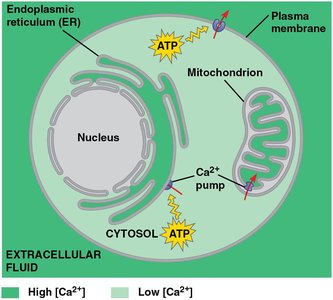
Calcium ions are used widely as second messengers, with their concentration in the cytosol kept much lower than outside the cell.
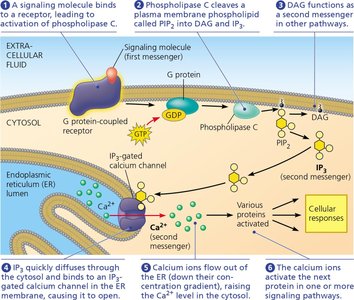
Calcium signaling: A signal transduction pathway may trigger an increase in cytosolic Ca2+, leading to various cellular responses.
IP3 and DAG: Produced by cleavage of a phospholipid in the plasma membrane, these act as additional second messengers to release Ca2+ from the endoplasmic reticulum (ER).
Cellular Responses to Signals
Nuclear and Cytoplasmic Responses
The cell's response to an extracellular signal is called the output response, which may occur in the nucleus or cytoplasm.
Nuclear response: Many signaling pathways regulate the synthesis of enzymes or proteins by turning genes on or off in the nucleus. The final activated molecule may act as a transcription factor.
Cytoplasmic response: Other pathways regulate the activity of proteins, such as opening ion channels or changing enzyme activity.
Regulation of the Signal Response
Amplification of the Signal
Enzyme cascades amplify the cell's response, with each step activating more molecules than the previous one.
Amplification: A single signaling molecule can result in a large number of activated products.
Specificity of Cell Signaling and Coordination
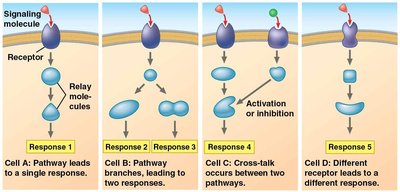
Different cells have different collections of proteins, allowing them to respond differently to the same signal.
Specificity: The same signal can have different effects in different cells.
Pathway branching and cross-talk: Help coordinate incoming signals and responses.
Signaling Efficiency: Scaffolding Proteins
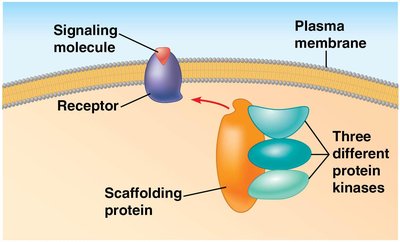
Scaffolding proteins are large relay proteins that increase signal transduction efficiency by grouping together different proteins involved in the same pathway.
Function: Scaffolding proteins can also help activate relay proteins.
Termination of the Signal
Inactivation mechanisms are essential for cell signaling.
Termination: When external signaling molecules decrease, fewer receptors are bound, and unbound receptors revert to an inactive state.
Key Terms and Concepts
Protein kinase: Enzyme that phosphorylates proteins.
Protein phosphatase: Enzyme that dephosphorylates proteins.
Second messenger: Small molecule or ion that relays signals inside the cell.
Transcription factor: Protein that regulates gene expression.
Scaffolding protein: Protein that organizes other proteins for efficient signaling.
Sample Exam Questions
Protein phosphorylation is commonly involved with which of the following? c) activation of protein kinase molecules.
Dephosphorylation is commonly involved with which of the following? e) activation of protein phosphatase molecules.
Which can be second messengers? e) Ca2+, cAMP, and DAG.
Identify the second messenger in the pathway: epinephrine → GPCR → G protein → adenylyl cyclase → cAMP. a) cAMP
Which enzyme converts ATP to cAMP? d) Adenylyl cyclase
Once adenylyl cyclase is activated it b) Makes cAMP
IP3 does which of the following? a) Opens Ca2+ doors on the Endoplasmic Reticulum
Cellular response is which step in the signal transduction pathway? c) Third
Proteins that facilitate signal transduction by binding many proteins into a complex are called d) Scaffold proteins
Correct order of events in signal transduction: c) Chemical Signal → Receptor → Intracellular Proteins → Target Proteins → Cell Response
Characteristic of a receptor: e) All except speed
Equations and Formulas
Phosphorylation:
Dephosphorylation:
cAMP formation:
Summary Table: Second Messengers
Second Messenger | Source | Main Function |
|---|---|---|
cAMP | ATP (via adenylyl cyclase) | Activates protein kinase A |
Ca2+ | ER, extracellular fluid | Activates various proteins |
DAG | Phospholipid cleavage | Activates protein kinase C |
IP3 | Phospholipid cleavage | Opens Ca2+ channels in ER |
Additional info: Academic context was added to clarify the mechanisms and significance of signal transduction, second messengers, and cellular responses, as well as to provide definitions and examples for exam preparation.
